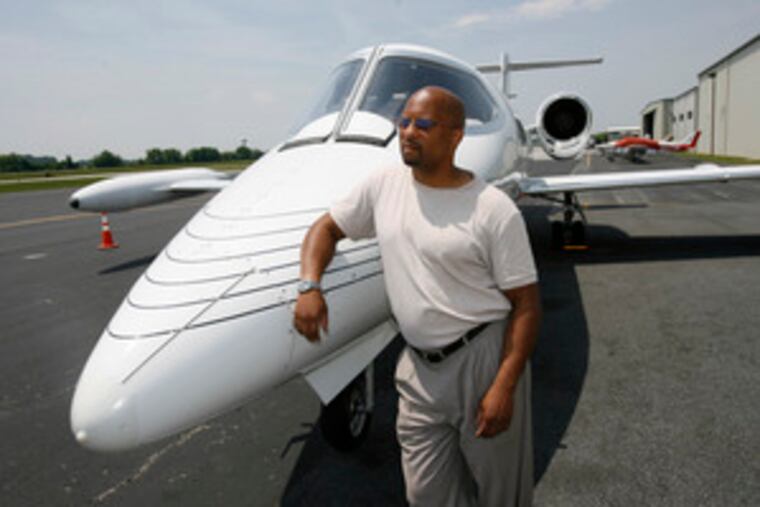
In the once-bucolic reaches of western Chester County, sleek corporate jets are hurtling into and out of G.O. Carlson Airport in record numbers - another gleaming example of the booming growth in what had been the region's most rural county.
An airfield that once catered to small propeller planes is home to 44 jets - twice the number projected just a few years ago.
The Valley Township airport isn't the only facility in the region that can handle private jets, but it offers easy access to the growing business community in Chester County, making it a corporate-jet hub.
"It is a valuable asset in this part of the county," said Terry Muto, vice president of operations for AIM development, which owns property in the nearby Bellaire Business Center. "It has definitely paid off in a big way."
But there are growing pains. The airport wants a longer runway to accommodate bigger jets, and neighbors worry that the airport's growth may diminish their quality of life.
To pilot Dave Malchione, there's no secret why business travelers are heading to Carlson.
"From the time they pull in and park their cars, they can be in the air in five minutes," he said. "It's that quick."
Forget the security lines, shoeless routine and endless delays at Philadelphia International Airport.
At Chester County, there is free parking, and the airport is within a 30-minute commute of most of the county's major businesses, many of which have interests around the globe.
"A lot of people don't realize you can take off from Chester County and go directly to Europe," said Albert A. Koenig, chairman of the Chester County Area Airport Authority, owner of the airport.
Carlson is also a bargain.
Hangar fees, fuel and maintenance are probably 50 percent cheaper than they are at Philadelphia International, Malchione said.
With 50,000 takeoffs and landings a year - roughly 10,000 by jets - Chester County is also one of the busiest regional airports for general aviation, the term the Federal Aviation Administration uses for unscheduled flights that don't require a ticket to board.
The airport is a key player in the regional system, said Roger Moog, aviation planner for the Delaware Valley Regional Planning Commission.
"There are very few airports in the suburbs that can take corporate traffic," he said. The options are Philadelphia International, Northeast Philadelphia and Trenton-Mercer, all too far away to serve the western suburbs and the Chester County business community, he said.
By chartering a jet, Moog said, companies are choosing productivity over frequent flight delays and long security lines.
Malchione sees that every day.
"It's all based on what a businessperson's time is worth," he said. It costs $1,600 an hour to charter a small Learjet and $4,000 an hour for larger aircraft such as a Dassault Falcon 900.
"If you fill the airplane up" with people, Malchione said, "it becomes competitive with an airline ticket. And you can conduct meetings all the way. That's hard to do on an airliner."
In two years, the number of jets based at the airfield has doubled to 44, and many are owned or leased by corporations, airport manager Gary L. Hudson said.
The presence of JetDirect Aviation L.L.C., a major jet-aircraft management company, has contributed to the surge, Hudson said.
"It's in the part of the greater metropolitan area that's experienced the greatest growth, both in corporate and individual wealth," said Gregory Campbell, president of JetDirect. "CEOs tend to fly out of airports that are close to their homes, so it happens to be a very good location."
An airport neighbor, Keystone Helicopter Corp., attracts buyers from around the world. They land their jets at Carlson when checking on the progress of their custom-made helicopters.
In response to the growth, the airport authority four years ago completed a master plan that called for a number of improvements, including a longer runway.
But the longer runway would come perilously close to Washington Lane, a narrow country road that is a dividing line between Valley and Sadsbury Townships.
Safety concerns mandate that a section of the road be moved, Hudson said, but Sadsbury supervisors turned down a relocation plan.
They are balancing the airport's needs against increased truck traffic from the new distribution center for nearby Keystone Foods and access to Route 30 for residents. Options are to upgrade Washington, spending millions of dollars on work that could be torn up when a new runway is built; move traffic to a new road through the Bellaire Business Center; or build a tunnel under the existing road.
"There are no fast or easy answers," Supervisor Dale Hensel said.
But there is time to work through the issues.
The master plan is just the first step toward a new runway, said Brian Gearhart, a manager for the Pennsylvania Department of Transportation's Bureau of Aviation. Next comes a feasibility study, followed by environmental studies and a cost-benefit analysis, Gearhart said.
Meanwhile, construction is expected to start next month on a new $3.5 million apron, or parking lot, for smaller aircraft in the airport's southwestern corner.
As the airport grows, so does local opposition.
"We get complaints about air traffic now," Sadsbury Supervisor Stephanie Silvernail said. "Progress is good, but I have to look out for the residents of Sadsbury. I don't want to see anything that would have a negative impact on their quality of life."
Doug Doratt, a member of the airport authority and a Sadsbury supervisor, said that he hoped all issues could be addressed, and that the master plan became a reality.
"The aviation-related industry is very successful," he said. "It's a win-win for everybody to make the airport a safer place."