Meet the man behind good taste at Penn State
STATE COLLEGE, Pa. - You may not know it, but if you've ever indulged in Peachy Paterno, WPSU Coffee Break, or any other of the Penn State Creamery's signature ice cream flavors, you owe Tom Palchak thanks.
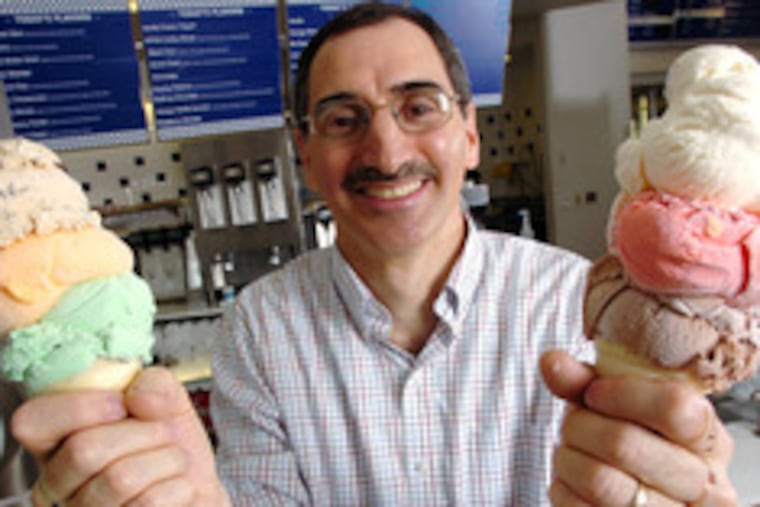
STATE COLLEGE, Pa. - You may not know it, but if you've ever indulged in Peachy Paterno, WPSU Coffee Break, or any other of the Penn State Creamery's signature ice cream flavors, you owe Tom Palchak thanks.
In 1986, when Palchak was hired to manage the historic Creamery, the tradition-bound ice cream industry was in upheaval.
Two Vermont hippies named Ben and Jerry, who learned the art of ice cream making through Penn State's ice cream short course, were creating a sensation nationwide with far-out flavor combinations like Cherry Garcia and New York Super Fudge Chunk. For many, especially college students, good old vanilla and chocolate just didn't sound that exciting anymore.
Enter Palchak, a Penn State dairy sciences graduate who had just returned to his alma mater. He'd been working as a production supervisor for a Safeway dairy plant in Denver and witnessed firsthand the excitement new flavors generated. Because he had spent his undergraduate years working in the Creamery, he was keenly aware of the place it held in the hearts of Penn Staters.
Still, he thought its customers were ready for something new, even if the powers that be were hesitant. "There was some hesitation, a question of, 'Is this something the Penn State faithful will accept?' " he said. "Because Penn Staters are very, very dedicated to the Creamery. There's a sense of ownership that I haven't seen anywhere else."
The first offering, cookies and cream, was a runaway hit, and a new era in Creamery history began.
In 1989, a food sciences class tweaked an old recipe and another Creamery favorite, Peachy Paterno, resulted. (The man himself prefers strawberry.)
"The business absolutely exploded," Palchak said. "We went from making 80,000 gallons a year to 200,000 gallons."
Recognizing a good thing, the Creamery got busy coming up with new flavors - 10 to 12 a year for the next 10 years or so. Some, like pumpkin pie, were good; others, like carrot cake, were not so great and were quickly retired. Today, there are more than 150 flavors of ice cream, frozen yogurt, sherbet and no-sugar ice cream on file at the Creamery, but only 25 or so on the menu at any given time.
That seems to be plenty for customers, who buy more than 750,000 hand-dipped cones at the store each year (45,000 are sold during the Central Pennsylvania Festival of the Arts alone). All told, 180,000 gallons are consumed just on campus every year.
If you can't live without a daily dose of Death by Chocolate, give Palchak a call and he'll give you the recipe. "The formulas are public," he said. "It's a public university, so technically, they belong to the public."
The Creamery, always a good place to stop, became a destination. "Before he arrived, the Creamery was not what it is today," said John Floros, head of the food sciences department. "The thing most people don't understand is the Creamery is part of an academic unit. But because he had the right training and experience, the Creamery became more like a business."
Despite Palchak's easygoing personality, keeping up with him is not easy. His pace is as brisk as the chilly air inside Penn State's new Berkey Creamery. It's clear that this gleaming, state-of-the-art facility, the crown jewel of the university's food sciences program, is his pride and joy.
Where the old Creamery, in the 1930s Borland Building, was cramped and antiquated, the new one has separate areas for processing milk, manufacturing ice cream, cheeses, sour cream, yogurt and sherbet, as well as quality-control labs, refrigeration equipment, dry storage, and separate wet and dry dairy processing plants. Space is no longer a problem.
"We don't operate under as much of a sense of panic as we did in Borland," Palchak said. "There we had a tiny hardening and storage area. We'd have a football weekend and literally be wiped out - flavors would be completely gone."
One look at a touch-screen monitor provides crucial information on every detail of every process - from cleaning and sanitizing equipment to mixing and packaging. The labs and equipment are so cutting edge that industry professionals routinely come here to conduct research on products and production.
"Five years ago we started a plan to renovate in the Borland building," Palchak said. "But when it became clear we wouldn't be gaining any space, which we desperately needed, we started asking ourselves, 'Are we really gaining anything other than a renovated old building?' That's how, thanks largely to a $3 million gift from the Berkey family that jump-started the whole project, that $16 million renovation turned into a $48 million new building."
Palchak was instrumental in the new building's design, Floros said. "Tom was responsible for everything in the design, right down to the smallest detail," he said.
Despite all the science behind it, what really makes Creamery ice cream special, Palchak said, hasn't changed in the 100-plus years students have been lining up to buy it.
"In some cases it's 24 hours from cow to cone," he said. "When you're making ice cream out of milk that was pasture grass just a few days ago, it doesn't get any better than that."