'Here all lived': Quecreek mine miracle, five years later
SOMERSET, Pa. - Sitting 30 feet from where he was hoisted to safety exactly five years ago, Blaine Mayhugh contemplated his brush with death.
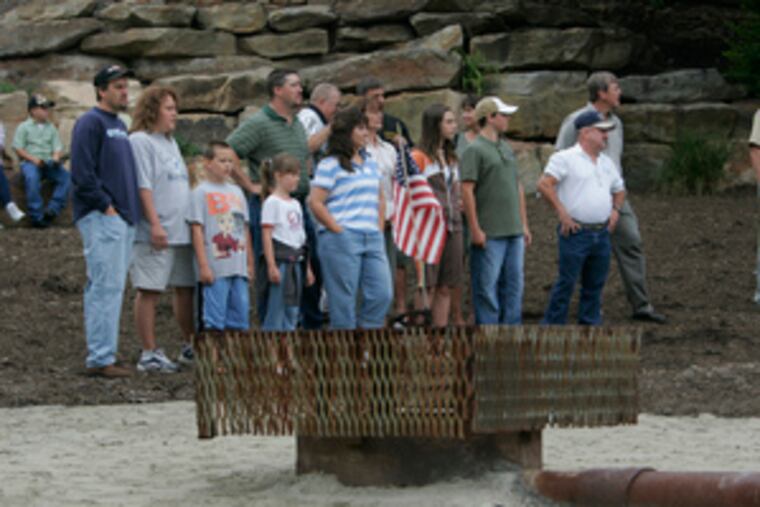
SOMERSET, Pa. - Sitting 30 feet from where he was hoisted to safety exactly five years ago, Blaine Mayhugh contemplated his brush with death.
"We thought we'd never get out," said Mayhugh, his eyes studying the rusted rescue shaft that is now part of a memorial park above Quecreek Mine.
It was here, 240 feet below the ground, where he and eight other coal miners were trapped for 77 hours with water rising and oxygen dwindling, and with one sandwich among them, as the world watched and waited.
Mayhugh and five of his fellow miners joined former Gov. Mark Schweiker and about 200 others yesterday to mark the fifth anniversary of the miraculous rescue - a tale of human endurance that is a landmark in mining history.
The low-key ceremony, at the dairy farm that is also a museum and memorial, featured child bell-ringers and "Mountain John" the poet, who paid homage to the miners and those who saved them.
The miners became trapped July 24, 2002, after a coal-cutting machine accidentally broke through a wall into a flooded mine, sending millions of gallons of water into the maze of rooms where they were working, blocking their exit.
Working around the clock, rescue teams struggled to find the miners, devise a way to deliver them air, and, finally, drill a shaft to reach them.
More than three days later, the drill poked through the ceiling above the miners, who were huddled together as the water rose around them and they braced for the worst.
With television cameras rolling, Schweiker hailed the victory, shouting "nine for nine," signaling all were alive.
"You stand a few feet away from industrial history," Schweiker told the crowd yesterday. "Where most die in mining accidents, here all lived."
An investigation revealed that outdated mine maps, showing the abandoned, flooded mine farther from the active mine than it was, had led to the accident.
As governor, Schweiker changed the way maps are catalogued and expanded the required distance for drilling between active and closed mines. Yesterday he called on the General Assembly to pass a long-stalled bill to improve and modernize the state's nearly 50-year-old mining law.
"I'd like to see the state legislature act on suggestions to strengthen the Deep Mine Safety Act," he said, to a round of cheers from a crowd that knows how vital coal remains to the local economy.
A special commission formed to study mine safety after Quecreek recommended 48 ways the state could improve mining conditions.
Since 2002, the General Assembly has failed to act on the mine-safety bill because the coal industry, the United Mine Workers, and the state cannot agree on its language, said David Hess, who was Department of Environmental Protection secretary at the time of the mine accident. The bill has yet to be introduced this legislative session.
At yesterday's event, Hess said legislation was needed to address unsettled issues, such as - paradoxically - the agency's ability to update regulations quickly without legislative approval.
"It's very frustrating," said Hess, who wonders why last year's Sago mine disaster in West Virginia, which killed 12 miners, didn't generate the momentum needed to send the bill through. "Five years later, it should have been done."
Mayhugh said that after the rescue, he had left mining behind and found a job as a technician in Somerset County's newest energy industry: windmills. Now every day he gets a bird's-eye view of the expanse of forest that stretches across the Laurel Highlands of Western Pennsylvania.
"I swore I'd never work underground again," Mayhugh said, turning to his wife, Leslie, sitting beside him. "We like to say I used to be 250 feet below the ground - now I work 265 feet in the air."