Globalization chipping away at Pa. sawmills
RALSTON, Pa. - Flecks of sawdust float like powdery snow around Bill Brooks' lumberyard after his saws slice through fresh logs.
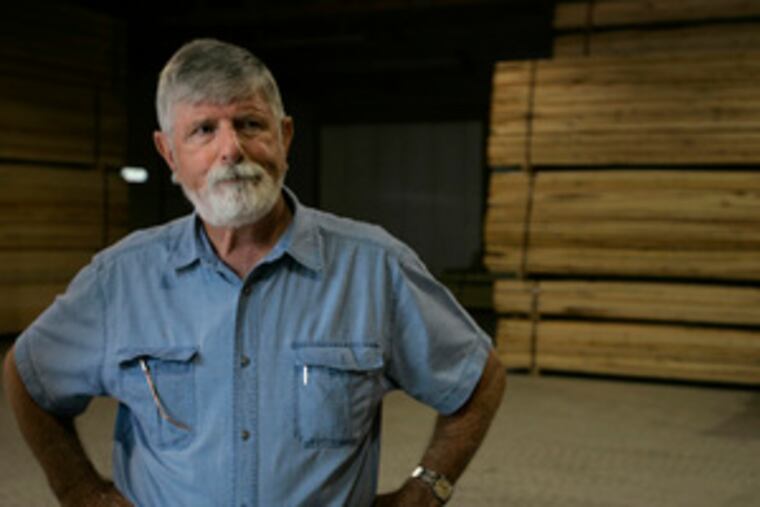
RALSTON, Pa. - Flecks of sawdust float like powdery snow around Bill Brooks' lumberyard after his saws slice through fresh logs.
But workers operate them just three days a week now because many of his longtime customers - furniture and cabinet makers - moved their plants to China.
Though he has had to cut his full-time staff from 50 to 24 in the last 18 months, Brooks considers himself fortunate. Dozens of other mills in the state have closed or have been bought out in recent years.
As the nation's largest producer of hardwood lumber, Pennsylvania is a bellwether for an industry facing challenging times.
Production nationally is down 25 percent since 2000 to just over 10 billion board feet, according to the Hardwood Review, a publication in Charlotte, N.C., regarded by many in the industry as the standard-bearer for economic forecasts. The publication predicts production will fall to 9.5 billion by the end of 2007.
Pennsylvania mills produce just over one billion board feet of hardwood lumber, or roughly 10 percent of the U.S. total, according to the state Agriculture Department. The state's hardwood industry generates more than $5 billion in sales.
Production since 2000 has been fairly constant in Pennsylvania, but the number of mills has declined by about 20 percent since 2001 to just more than 300, state figures show.
And that might be a generous estimate. An industry in which many deals are sealed with handshakes is filled with small, family-owned outfits. Some shops may simply be run by several workers sawing in a spare barn when times are good.
When things slow down, those saws sit idle.
"There are so many of these small ones that I don't even know about," said George Barrett, editor of the Hardwood Review. "Many of those have disappeared."
Brooks has owned his mill, considered average-size for the industry, since 1980.
"To give up a business is like giving up one of your children. That's tough. It's really tough," Brooks, 66, said as he stood in a warehouse filled with neatly stacked piles of lumber waiting to be sold.
"China and Asia have completely changed the landscape of the forest products industry in Pennsylvania and the United States," said Paul Lyskava, executive director of the Pennsylvania Forest Products Association. "The sawmill sector is losing a tremendous amount of its customer base."
Other factors are taking a toll, too.
For one thing, sawmills must pay for tracts of timber to harvest long before they sell the resulting lumber, meaning they can overpay.
Many mills hope to make money with more efficient practices, and by selling every part of the log.
At Brooks Lumber & Timber Harvesting, the best wood is cut into different-sized boards. Lesser-quality timber might be used to make pallets or railroad ties. A conveyor carries some large shavings to a mulch pile. Finer, smaller shavings are captured to sell to farmers as barn bedding.
Some businesses are catering to customers with more specialized orders. Others have invested in high-tech saws that can make more precise cuts.
"We can't afford the waste," said Ron Andrews, president of Deer Park Lumber Inc. in Tunkhannock.
Still the industry overall has historically been slow to change, Barrett said. Those that do change stand a better chance to survive, though having the capital to invest in upgrades becomes an issue, he said.
There are factors sawmills cannot control, such as the housing slump.
Barrett pointed to grabbing a bigger share of the export market as a way to get healthy.
But getting a stronger foothold overseas might be tough, especially for smaller sawmills that may not be able to afford to send sales representatives overseas.
Even the largest sawmills don't feel secure. Weaber Inc., based in Lebanon, does most of its sales domestically, though there is growing business in Europe, president Galen Weaber said. His company has 600 employees.
"Challenging might be a good word for the foreseeable future," Weaber said.