Death of ex-officer may bring murder charge
Philadelphia Officer Walter T. Barclay, shot in 1966, died Sunday. The gunman could face a murder charge.
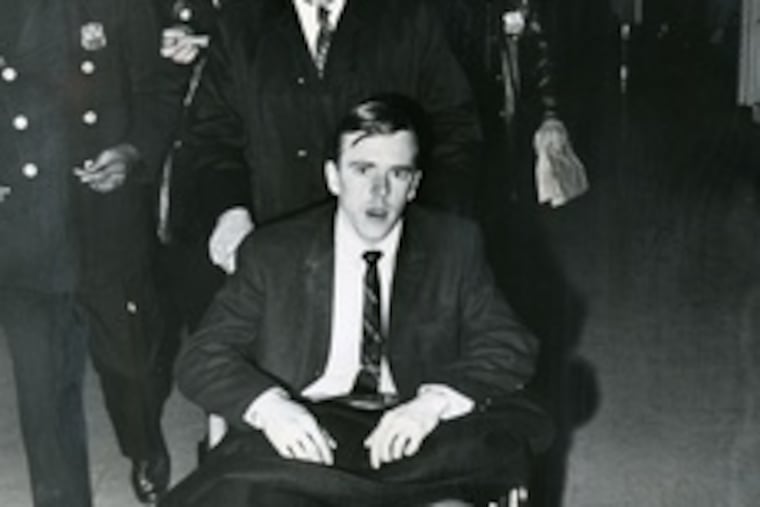
Forty-one years ago, a rookie Philadelphia police officer was gunned down trying to stop a career criminal who was burglarizing an East Oak Lane beauty shop. Officer Walter T. Barclay was left a paraplegic and spent the next four decades struggling before finally succumbing Sunday at age 64.
Now police are considering whether to charge his shooter - who was sentenced to 10 to 20 years in prison for attempted murder - anew with murder.
At a news conference yesterday at Police Headquarters, Chief Inspector of Detectives Joseph Fox said the Bucks County coroner had ruled Barclay's death a homicide, resulting from complications from the injuries he received on Nov. 27, 1966.
"We are in contact with the D.A.'s Office, and discussions are being held on whether to proceed with charges," Fox said, adding that the gunman, William J. Barnes, now 71, had not been arrested but that police knew his whereabouts.
The District Attorney's Office issued a short statement - "We intend to review all of the evidence before making a decision in this case" – and would not elaborate.
Barnes was being interviewed by police last night and could not be reached for comment yesterday. Homicide said Barnes was picked up by police yesterday afternoon at the Shop-Rite on Ridge Avenue in Roxborough where he works.
Lawyers contacted yesterday said that the district attorney would be on solid ground legally to pursue murder charges, but that getting a conviction could be daunting.
"In a criminal case, the act has to be a direct and a substantial factor in causing the death," said Dennis Cogan, a prominent criminal-defense attorney. "Time does not exclude it from being a criminal act. It is a question of proof."
Another well-known defense attorney, Frank DeSimone, agreed. "If he died from complications related to the shooting, the laws in Pennsylvania state that . . . the person who put the person in that position would be responsible," DeSimone said. "There is no statute of limitation on murder, but 41 years - that would be very difficult to bring."
Defense attorney Jeffrey Lindy, a former federal prosecutor, said refiling charges could raise questions. Would city taxpayers, he asked, want District Attorney Lynne M. Abraham to pursue a 41-year-old case against a 71-year-old man who has already done time for the shooting?
And a defense attorney could present medical testimony disputing the assertion that Barclay died as a result of being shot decades ago, Lindy said.
"Complications from a shooting 30 or 40 years ago don't take 30 or 40 years to surface," Lindy said. "A medical expert could say it could be from this or it could be from that."
Mark Cedrone, another veteran defense lawyer, said Abraham would "have a very serious issue of causation 41 years later. Seems it would be almost a political move. . . . If I were D.A., I wouldn't go forward. But the citizens didn't elect me."
Barclay's sister, Rosalyn Harrison, said yesterday that her brother suffered "horribly" after the shooting.
"You have no idea what a hard time he had," she said.
Three days before he died, he entered St. Mary Medical Center in Middletown Township because his health was failing, she said. At the time, he was living in Cornwells Heights, Lower Bucks County.
In the early hours of Nov. 27, 1966, Officer Barclay, 23, and his partner, Officer Robert Piatek, responded to a report of a burglary at a beauty salon at 6604 N. Fifth St.
When they arrived, they encountered Barnes at the bottom of some masonry steps. The officers were on top of the steps.
Barnes fired at the officers, striking Barclay in the left thigh, and in one shoulder. That second round became lodged one inch from Barclay's spine.
Barnes then shot at Barclay's partner but missed. Piatek fired twice at Barnes as he fled. The officer fired three more shots at Barnes, who was trying to climb a six-foot fence. Barnes fell, motionless. Piatek dashed back to his patrol car to call for assistance, then returned to help Barclay. Another officer soon arrived. But Barnes, who had faked being hit, jumped up, fired two shots, and escaped.
Three days later, Barnes was arrested in a house 100 yards from Eastern State Correctional Institution, where seven months earlier he had finished serving an eight-year sentence for robbery.
In 1968, Barnes was sentenced to 10 to 20 years for attempted murder and other crimes in the shooting of Barclay.
Barnes, who according to an article in Philadelphia City Paper last month lives in a halfway house in the city, spent much of the rest of his life in prison. After getting out of prison for the Barclay shooting, he was convicted of other crimes, including robbery.
Barclay spent the rest of his life struggling.
A slightly built, blue-eyed redhead with a sprinkling of freckles across his nose, he spent the rest of his life paralyzed from the waist down.
After the shooting, Barclay - who was engaged to be married - spent about a year at Albert Einstein Medical Center and Moss Rehabilitation Hospital, said Harrison, Barclay's sister.
Barclay's fiancee called off the engagement.
When he got out of Moss, Barclay moved out of his parents' home into an apartment in Cornwells Heights, his sister said.
"He wanted independence," his sister said. "He did not accept help from me. He cooked, drove a hand-operated car, and worked as a dispatcher at Police Headquarters several hours a day for a year until he went out on disability with a pension" in 1968.
He worked for Amtrak as an information clerk for a few years, and took up writing poetry.
He married three times, but each relationship ended in divorce, Harrison said.
"Life let him down," she said.
Born in Savannah, Ga., the second of three children of an Army officer, he moved to Roxborough with his family when he was 6. Soon, he got a job at the corner grocery store, making deliveries to neighbors with his red wagon.
He kept the job through high school, but by then he was a clerk, said Harrison, who lives in Roxborough.
After graduating from Roxborough High School in 1960, he joined the Army, spending three years in Germany as a radar tracer.
Soon after being discharged, he joined the force. He was appointed April 26, 1965, and was a patrolman in the 35th Police District for one year and seven months until the shooting.
In addition to his sister, Barclay is survived by a brother, William Sr.
Funeral services were being planned.
Donations may be made to Fraternal Order of Police, 1336 Spring Garden St., Philadelphia 19123.