For many, the end of August means a last chance to get down to the Shore.
I'm zigzagging across South Jersey, taking as many back roads to the Shore as I can. U.S. Routes 9, 40, 30 and 322; N.J. Routes 47, 49, 50 and 72; along with County Roads 542, 559, and 561. The ones I missed, including routes running north of the Atlantic City Expressway, I'll hit next week.
I'd like to wrap up the summer with some of your road-trip photos. Send me your jpegs as e-mail attachments to Roadtrip@phillynews.com. I'll post them here over the Labor Day weekend and run some in the newspaper with my final column.
Just north of downtown Woodstown, I miss a turn and end up facing a compound of warehouses along Woodstown-Mullica Hill Road. They're painted with aphorisms, platitudes, maxims, proverbs, folk sayings, and half-truths, all older than the aged Ford pickup parked outside.
Bob Moore, the manager of Helena Chemicals' Woodstown warehouses, has worked in the leased space for 15 years. He tells me that the writing on the walls hasn't been repainted or retouched for more than 30 years. The warehouses were built by Earl L. Erdner, starting in the late 1940s, and were painted through the 1960s.
I run into Marvin Katzer of South Hampton in the Ocean View Service Area's Visitor Center on the Garden State Parkway, as he stops to look at the history display on his way home from his place in Ventnor.
He first came to the Shore to work as a busboy between his junior and senior years in high school. He lied about his age. He'd been to the Shore before, as his father was a furniture sales rep in Philadelphia, and got one week of vacation a year. "We stayed in a boarding house," he says.
All through college, he continued to work summers - at the Chelsea, the Breakers - until he graduated. "The beach, Boardwalk, and make a few bucks for school - that was the life. That summer, 1967," he tells me, "I shared a house with six guys. We all had jobs, and five of us had steady girlfriends."
All five couples were eventually married - four remain so today, and will start celebrating 40th anniversaries next summer, including Marvin and his wife, Arlene.
The four couples also stayed at the Shore, eventually all buying homes in Ventnor.
I'd seen crabbers on previous road trips in Delaware and Maryland, but the catch didn't compare to the action on the Route 50 bridge over Cedar Swamp Creek. Pete Joslin and Grace Dolan of Williamstown each are pulling up a trap with two or three crabs as I drive by, and when I stop and walk up, they're hauling in another. "They're riding the top of the tide," Dolan tells me. "Outgoing," Joslin adds when I wonder whether it's coming in or going out.
On the railing all along the bridge are crabber's marks, carved when measuring the longest spikes on the shell, tip to tip. The minimum is 41/2 inches. Most of those that Joslin and Dolan pull up are wide enough and legal. "I only had enough rope to drop three pots," Joslin says as I admire his bucketful of crabs.
I don't know anything about the historic train station in Tuckahoe until I see the sign on Route 50.
I turn off to find the station closed and the lot empty, with some old locomotives and passenger cars on the rails nearby. I am shooting close-ups (which is what I tend to do when nobody's around).
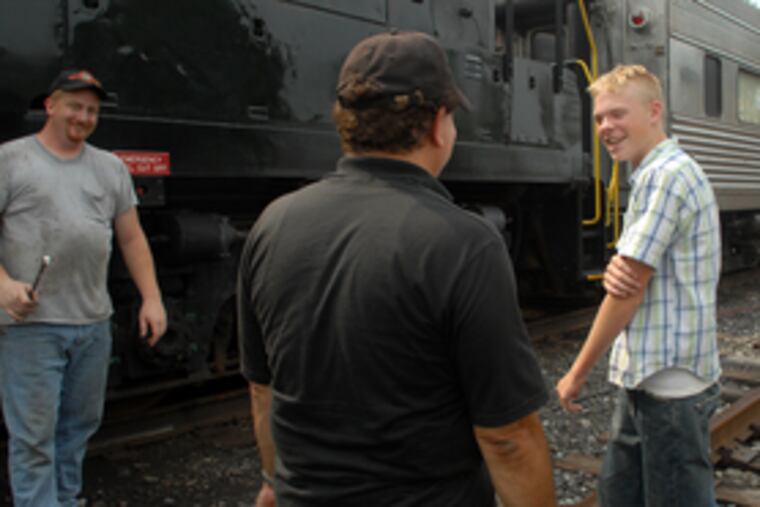
As I'm ready to leave, debating whether to walk farther down the tracks where more trains are parked, I notice the old locomotive doesn't have a single speck of rust, and I see a guy in a greasy T-shirt carrying a huge wrench. Hey, this is a real working railroad, I realize.
He's Mike Schreiber, a locomotive electrician and air-brake technician from Ohio, making one of his monthly stops at another of his railroad or grain-elevator clients around the country. His '99 Ford pickup has 459,000 miles on it. While not the Short Line in Monopoly, it is a short-line railroad, one of more than 400 around the country, 13 in New Jersey alone. Schreiber tells me I need to talk to the boss, who happens to be walking out of the old switch tower.
Tony Macrie is president and general manager of the Cape May Seashore Lines. He's long been a railroad man. "I've done other things in my life, but it's all reverted to this," he tells me as the men take a break. He offers two excursion services, both running on the old "Steel Speedway to the Shore" that once belonged to the Pennsylvania-Reading Seashore Lines. (Those railroads are in Monopoly.) There's a 30-mile roundtrip between Tuckahoe and Richland, and a 22-mile roundtrip between Cape May Court House and Cape May City.
Out of high school, Macrie worked at Philadelphia radio station "Famous 56" (WFIL-AM) in the early '70s and at the end of his shift would rush down to 30th Street Station to watch the big Silver Meteor, with its huge GG1 electric locomotive. "In those days, you could just wander around the station," he recalls. "There was real railroad camaraderie. You don't see that anymore." Unable to land a government job with Conrail, Macrie took the advice of one of those old-timers and went up to Bucks County, learning the railroad "from the ground up," working on the tracks for the New Hope & Ivyland Railroad. He created the Cape May Seashore Lines in 1996.
At least once a month, he says, "somebody comes up and says, 'My kid loves trains.' Now you heard that in 1940, even in the '50s and '60s, but not in 2007. It's Thomas the Tank Engine. A whole new generation is appreciating trains."
The words are barely out of his mouth when teenagers Tom Rinck and Max Gandolfo ride up on their bikes. Rinck, who lives right across the street, greets Schreiber by joking, "You here again?"
It's railroad camaraderie, I see. The teasing continues until Schreiber, carrying the worn slip ring he just changed on the 1955 Pennsylvania Railroad GP9 7000 locomotive, asks the 16-year-old to help carry an empty box - then slaps his face with a greasy palm as Rinck extends a hand.
"Aarggh, I saw that coming," Rinck yells as he jumps back. "That's locomotive grease," Schreiber deadpans. "The real thing. Clears up the skin. Smells good, too."