A fight over bid to move homeless meals indoors
The scene speaks volumes: Hundreds lined up on the Benjamin Franklin Parkway for a free hot dog or cup of soup.
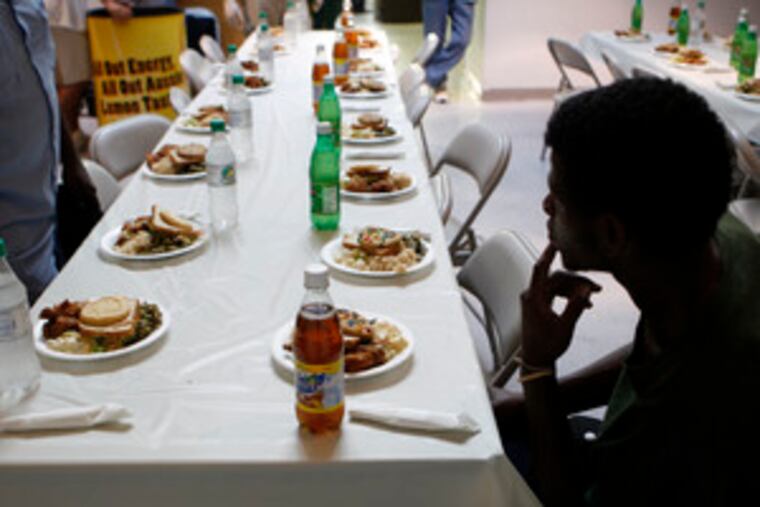
The scene speaks volumes: Hundreds lined up on the Benjamin Franklin Parkway for a free hot dog or cup of soup.
A year ago, the city set out to curtail these regular mass feedings for the homeless. It tried to play matchmaker, asking churches in Center City with buildings to host groups with outdoor feeding programs.
But in the year since, the idea has gone nowhere.
As the city sees it, if the groups move inside, they could better help the homeless, giving them not only food, but also help with medical problems or information on shelters and housing.
While some churches around the Benjamin Franklin Parkway have expressed interest in the idea, groups with feeding programs have resisted, said Dainette Mintz, director of Philadelphia's office of supportive housing, which deals with homeless services.
"We're very disappointed that many of these groups indicated a lack of desire to continue to dialogue with us on matching them with a church," Mintz said.
Friction between the city and feeding groups persists. In July, the city tried to shut down a meals program at JFK Plaza operated by students from a charter school.
A rumor swirled last week, meanwhile, that city officials would start taking legal action against programs - "completely false," said Loree Jones, Philadelphia's managing director.
The impasse over what to do about the feedings on the Parkway reflects mounting frustration over the rising number of people living on the streets.
According to a census this summer by Project HOME, there were 621 homeless individuals on the streets of Center City - up 13 percent from a year ago.
After dropping in 2001, the street population, which represents about 10 percent of the overall homeless population, has been steadily increasing.
The feedings on the Parkway are a vivid reminder to all who pass of the hundreds of people who live on the edge.
Alan Bruckner, who runs a nonprofit called Philly Restart that hands out chicken hot dogs and tuna pasta salad once a week on the Parkway, fed about 250 people last Monday.
Bruckner said he was approached a year ago by someone on the city's behalf about moving his operation off the Parkway - but he said he hasn't heard anything since.
"I've never really heard a good argument for going inside," said Bruckner, an assistant coach for the Philadelphia Kixx professional soccer team. "I get the feeling it's, 'Let's get this out of the way, let's get this out of the public's eye.' "
Mintz rejected the idea that the city was intent on moving feeding programs indoors because of complaints from the Center City businesses and residents.
"I don't like seeing the long lines of people waiting for food," Mintz said. "I don't think it's the most dignified manner for folks to be fed - on the Parkway and out in public. Every other group I know eats indoors and it should not be acceptable for us that homeless consumers are fed outside on the street."
Brian Jenkins, head of a ministry called Chosen 300, has run a meals program for the homeless since 1996. The group is supported by a network of 32 churches in the city and suburbs.
Three years ago, Jenkins moved the operation indoors to a building in the 1100 block of Spring Garden Street. Four days a week, the group serves meals inside - and one day a week, outside on the Parkway. Last week, they served about 350 meals per day.
"I can understand what the city is trying to do. You have political forces that consider it an eyesore," Jenkins said. But he added, "I'm not going to knock the people who are providing food on the street. Both things are needed - indoor and outdoor programs.
"There are some people who will not go inside unless you have developed a trust with them," he said.
Organizations with feeding programs are a diverse group. Some - such as the volunteers from a church in Souderton, Montgomery County - come regularly once a week. Others are more ad hoc, organizing giveaways whenever they get food donations. Not atypical, too, was a church group from Wisconsin that drove to Philadelphia to feed homeless on the Parkway.
Mintz said a meals program run by a coalition of churches in University City is an example of what the city would like to start in Center City.
Five religious groups - including two from the University of Pennsylvania - support the University City Hospitality Coalition. Meals rotate from one group to another, with about 50 to 100 homeless people served at a time.
On Saturdays, the coalition hands out sandwiches outside. On Wednesdays, it offers free medical help.
Bill Golderer, a minister with Broad Street Ministry, said his church would be willing to partner with one of the Parkway groups. Last winter, the church, located across from the Kimmel Center, started an all-night cafe where homeless people who resisted going to shelters could retreat for the night.
He said the cafe was successful, but even more could be done to connect people to services. He'd like to start "a weekly gathering over a meal in a non-embarrassing way with services available like getting a haircut, or toe-nail clippings, or serious mental-health engagement," Golderer said.
But it would not be called a feeding, a term many who work with the homeless dislike.
"It's dinner," he said.
For more photos, go to http://go.philly.com/dinner EndText
.