Final rounds for durable gun club?
The city wants, for training, the outdoor range used by a 77-year-old Holmesburg group.
For 77 years, the Holmesburg Fish and Game Protective Association has served as a refuge for law-abiding sportsmen and gun enthusiasts.
As the last of the city's civilian outdoor shooting ranges, it is a place where generations in families have been bound by a passion for target and skeet shooting.
"My grandfather was a charter member in the 1930s," said Bob Stott, a city police officer. "I come up here, and I've had my kids here. It's a nice environment where you learn sportsmanship, where the camaraderie is strong. . . . It's all good people."
Now its days are numbered.
The association has been notified that the city is terminating the club's lease, and that it must vacate the range on the Delaware River between the police and fire academies by Dec. 31.
But the closing of the club would not mean the sound of gunfire would no longer echo there.
The city says it needs the site to train a growing number of corrections officers for Philadelphia's expanding prison population.
Corrections officers already use the club's ranges several days a week, and association members said they did not see why the prison system needed a 24/7 facility along with the costs of its upkeep.
"We have to train more officers more often on the use of their weapons," city Prisons Commissioner Leon A. King II said, noting that a planned shift from revolvers to semiautomatic pistols will require more frequent training.
He said the prison system also would use the facility to train specialized units, and that the agency needed flexibility not available under the current arrangement.
Despite what some club members hope, the system could not share what should be a secure facility, King said.
The club, which is hoping to garner political support to stay open, was founded in 1930, when the Holmesburg waterfront was home to a waterworks with its brick pump houses and fields and forests.
Since then, the area has become home to the city's police and fire academies - and its prisons, one of which displaced the shotgun-only Quaker City Gun Club in the 1980s.
The Holmesburg club, which says it has 1,500 members, has a handgun, rifle and trap/skeet range and an indoor range that city police have used for training.
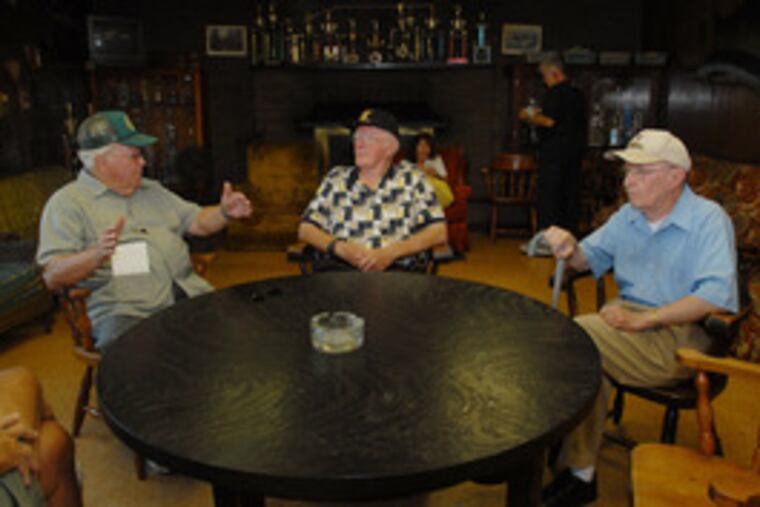
Its clubhouse is a social gathering spot for older members, some of whom no longer shoot but have not lost the gift of gab.
"All walks of life are here," said Joe Brady, 79, a retired teacher from Holmesburg who followed his father in becoming a member, joining in 1948 right out of the Navy.
They are doctors, lawyers, police officers, firefighters - blue-collar and white-collar, Brady said.
Membership costs $100 a year, but the trap/skeet range is open to the public.
The club holds a number of sharpshooting competitions, and some of its teams and individuals have won championships.
"We also do a lot for the community," said Kevin Kubacki, a club director.
He listed firearm safety and shooting programs for youths, women and Boy Scouts among the club's activities, and noted that the state Game Commission conducted hunter training courses there.
On Sunday, scores of people, including families with children, turned out for what might have been the club's last "outing," a day of shooting, talking guns, and examining weapons and military surplus from about a dozen tailgate merchants.
Among the club members there was John A. Mattiacci, dean of Temple University's School of Podiatric Medicine, who was upset about the eviction notice.
"It blindsided us," he said. "This is a passion. They're sportsmen. . . . There never have been any problems here."
Last week, John Sabo, a club vice president, wiped his brow after helping to unload 12 pallets of clay pigeons - about 116,000 total.
He is hoping that some arrangement can be worked out with the city, but realizes the club needs to be pragmatic.
The clay-pigeon shipment, he said, was not a full load.
"That'll take us until the end of the year," he said.