Princeton boosting rolls with its stately new dorms
It's the biggest increase since women arrived. Goal: Diversity.
PRINCETON - Princeton University is preparing for its biggest increase in undergraduate enrollment since it started admitting women.
The university wants to use its new capacity to add diversity to one of the most prestigious places in higher education.
With a $136 million complex of Collegiate Gothic stone buildings that feature huge, mahogany-trimmed dorm rooms, an art gallery and a 65-seat theater, Princeton has ranked in at least a tie for first in the U.S. News and World Report rankings of the best universities for each of the past eight years. It accepts only about 10 percent of the nearly 19,000 students who apply each year.
"By growing the student body, we'll be able to draw a little more fully on the talent in the pool," said Nancy Malkiel, Princeton's dean of the college. "We think, too, that if we have the capacity to educate a few more students, it would be a public service to do that."
Adding student living quarters will mean that in the next few years, 125 students who would have been rejected will end up going to the Ivy League school. Under the plan, by 2012, undergraduate enrollment will be about 5,200, up from the current 4,700.
University officials say the higher enrollment can come without compromising Princeton's high academic standards and without hiring additional faculty.
That's because over the last 30 years, faculty members have been added, especially in emerging fields, but the student body has not grown.
Officials at the private university say a main reason they wanted to increase enrollment was to boost the number of lower-income and minority students on a campus that before the 1960s was populated almost entirely by wealthy white men.
The school began opening up in 1969, when women were admitted. In recent years, the pace of change has been quicker. In the last decade, the school has not capped the financial aid available to international students.
In 2001, the university announced that it would no longer include loans in its financial-aid packages. If students needed financial aid for the tuition, room and board (which now runs about $44,000), they would get grants and on-campus jobs instead.
With the changed policy, it became possible for many students from families that were not wealthy to graduate debt-free, or with only loans for computers and the costs of the private eating clubs that many students join.
Also, starting with this year's high school seniors, Princeton is eliminating early-decision admissions, through which students who applied early had been claiming nearly half the spots in the class. Critics say early decisions programs discriminate against disadvantaged students.
This year, just over half Princeton's undergraduates are women, about one in three is a member of a racial or ethnic minority from the United States, and one in 10 is a foreign citizen.
First-year students started arriving at the new complex, known as Whitman College, last weekend.
To visitors who had not seen tennis courts in the space, Whitman College would not appear to be new at all.
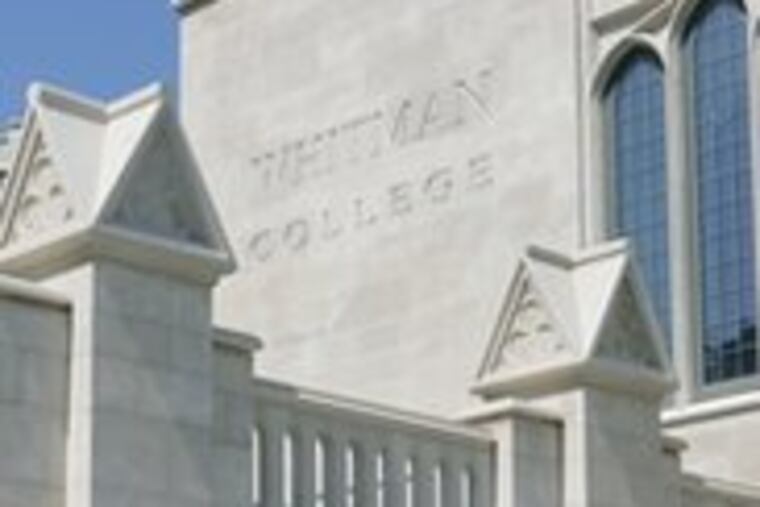
It is built out of limestone and fieldstone, just like many campus buildings. The engraved name "Whitman College" looks weathered. It has Latin wisdom etched on some walls. One says "Ignorantia mater metus est," or "Ignorance is the mother of fear."
The university transplanted mature trees instead of simply planting saplings, so the lawns and squares surrounding the buildings look lived-in.
Inside, there are plenty of electric outlets, wireless Internet connections and temperature controls for each room.
There are about 400 dorm rooms in the college - some doubles, mostly singles. But the corridors have built-in twists and turns, a feature that Harvey Rosen, an economics professor who is also in charge of administration for Whitman College, said keeps the buildings from "looking like a Holiday Inn."
Princeton spokeswoman Cass Cliatt said the buildings, designed by the architect Demetri Porphyrios and his firm, were not originally expected to be this grand.
But Princeton had more money than it expected because its $10 billion endowment has performed well and because alumni donors gave generously to the project. It bears the name of Meg Whitman, the president and chief executive officer of eBay Inc. Whitman, a member of Princeton's Class of 1977, donated $30 million for the project.
Since the early 1980s, first- and second-year Princeton students have lived in five residential colleges that offer academic advising and a strong sense of community, while older students have stayed in other dorms.
Now, some juniors, seniors and graduate students are allowed to stay in residential colleges.
Senior Rob Biederman, an economics and finance major and the president of the student body, moved into Whitman this fall after spending last year in a dorm for upperclass students.
One reason is that the suite he is sharing with three other students will likely be larger than the New York apartment where he will live next year when he goes to work for Goldman Sachs.
But he also liked the idea of living in a place with students of different ages and programs designed to pull them all together.
"There's a great community feel in the college already, even after three days," he said.
Classes at the university begin Monday.