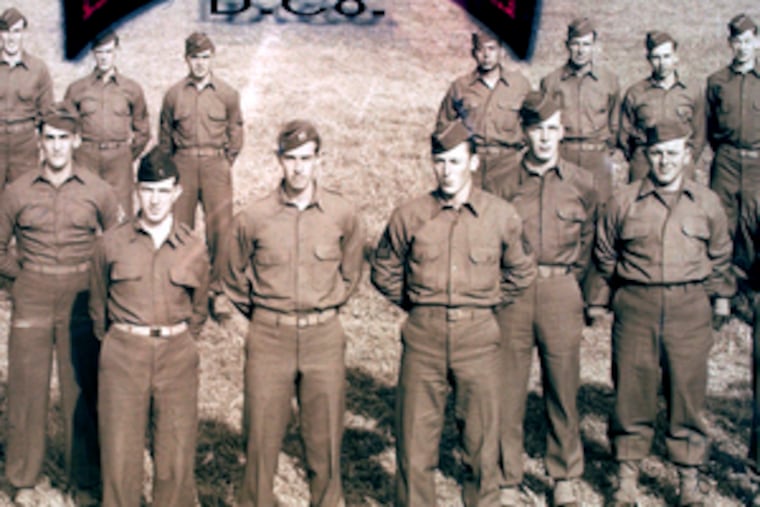
Leonard "Bud" Lomell was shot the moment he stepped off a landing craft during the D-Day invasion. The Toms River, N.J., man still managed to climb the 100-foot cliffs of Pointe du Hoc, France, under fire, and help knock out German artillery.
Milton Dank of Wyncote piloted a glider in an invasion of southern France even after a stray shot from a Navy ship blasted through the aircraft's tail section. He landed safely with two artillerymen and their jeep.
And Edgar Wolf Jr. of Mount Laurel kept military planes flying out of a Karachi airfield for 24 hours straight while news of Japan's surrender sent other service members into a frenzied celebration that threatened operations. In appreciation, his commander sent him home early.
Lomell, Dank, Wolf and many others are often asked by relatives, friends and community groups to tell and retell their stories. Colorful, first-person accounts from World War II have been in great demand as death whittles the ranks of veterans by an average of 1,100 a day.
And interest in the "Greatest Generation" is expected to surge in the coming weeks, with a new Ken Burns PBS series chronicling The War set to begin next Sunday on WHYY and Oct. 4 on NJN.
Now in their 80s, the veterans are heartened to see renewed interest in the war that shaped their lives. Many have spoken to classes at high schools, colleges and universities, to scout troops, and at patriotic observances. Wolf was interviewed for Burns' series.
Visits to the National World War II Memorial in Washington are up by 200,000 this year over the same period last year, according to the National Park Service. More people are also visiting the Battleship New Jersey in Camden and the USS Arizona Memorial at Pearl Harbor.
The study of the war years is also popular at Rutgers University, where a course focusing on oral histories from World War II has a long waiting list. The university has collected 700 oral histories and placed more than 400 online. The Web site has recorded nearly 270,000 hits.
Most university students are the age their grandparents were during World War II, Rutgers spokesman Greg Trevor said. "We are seeing a tremendous level of interest" in the war, he said.
Lomell, a former Army Ranger and retired lawyer, said the Burns series would place even more public focus on the war, much as Burns' 1990 PBS series on the Civil War ramped up interest in that period. The seven-part, 14-hour documentary on World War II took six years to produce.
"We're all geezers now but still a close fraternity," said the 87-year-old Lomell. "Whether we're in it [the Burns film] or not, we will be interested in seeing it."
Lomell, president of the Northeast Chapter of the Ranger Battalions Association, arranges an annual Christmas party in Atlantic City for the Rangers. He expects 40 or 50 this December. The number shrinks each year.
"Anybody who went to war was lucky to get out alive," he said. "I'm just one of those lucky guys."
First Sgt. Lomell was shot through the side by a machine gun as he exited a landing craft on June 6, 1944. But that didn't stop him from completing his D-Day mission of eliminating some long-range German guns.
With a stinging wound, soaked gear and slick ropes, he led his men up a 10-story cliff. There, they found the gun barrels - seen in aerial photos - were only poles or railroad ties.
Lomell and a comrade searched and found the guns in an apple orchard about a mile inland. While the Germans were being briefed by an officer, the two Rangers placed thermite grenades in the guns. The grenades made no noise or smoke, but their heat fused the traversing mechanism so the guns couldn't be aimed.
After two days of fending off German counterattacks at the top of the cliffs, only 90 of the 225 Rangers were left standing.
"It's so important that people know what kind of people came before them and how they contributed to making this a great country," Lomell said.
Another Ranger, Harry Fetterolf, 87, of Northeast Philadelphia, was also at Pointe du Hoc on D-Day and remembers the tough fight against an entrenched foe "who was throwing hand grenades over the cliff."
"It was pretty hectic at times," said Fetterolf, who carried a heavy Browning automatic rifle up the cliff. "There were a lot of Germans up there."
Decades later, Fetterolf saw the movie Saving Private Ryan and felt as though he had traveled back in time. "My heart started thumping," he said. "It was so true, the hail of bullets mowing down young boys on the beach. It was too horrifying."
Though often asked about the war over the years, Fetterolf finds it difficult to talk about and remains deeply affected by what he witnessed: "I saw too many tragedies over there. The Lord blessed me. I came home. Now there aren't many of us left."
Like Fetterolf and Lomell, Dank has also felt the loss of comrades over the years.
"I am 87. Get me while you can," said the combat glider pilot, author of The Glider Gang and other books. "I'm losing more and more of my buddies every day."
He still recalls sailing over the coast of southern France on Aug. 15, 1944, and feeling his glider shudder and quickly drop 150 feet. The aircraft had been hit by a stray shot from the cruiser Tuscaloosa. The shell obliterated a stabilizer that gave the glider its lift on the right side.
Instead of flying slightly above the tow plane in the normal position, Dank's glider was dragging below the plane and yawing to the right.
"We fought for 15 terrible minutes before we got to the landing zone," Dank said. "When we released, we didn't know if the glider would fly or not, whether we would nose over and plunge to the ground. We simply went straight ahead."
They landed safely in a vineyard, and, 19 years later, Dank was playing a bridge game at his next-door neighbor's house when he learned his partner was the antiaircraft officer on the Tuscaloosa.
"I said, 'Don't you know the difference between a C-47 towing a glider and German dive bombers?' "
Edgar Wolf, who served in the China-Burma-India theater of operation, also has spoken before many junior high and high school students "to spread this piece of history."
Wolf was the officer of the day when a raucous celebration broke out at a base in what was then Karachi, India. Soldiers were drinking and removed flare pistols from planes and were firing them.
"All hell broke loose," Wolf said, describing a party that was getting in the way of important flights. "I took some sober GIs and had them go through planes at the repair depot to collect flare pistols.
"I also had the flight surgeon come to the operations office to certify that all crew members were sober before they took off."
To reward Wolf for his steady hand, his commander sent him back to the United States on the first available flight. Wolf surprised his family when he walked through the door of his parents' home in West Philadelphia.
"I think the Ken Burns film will stir memories," said Wolf, 87, a former Cherry Hill councilman and former national historian for the China-Burma-India Veterans Association. "It will renew the interest of some [veterans] who haven't talked about it. . . . Once we're gone, there's nobody to shout about what we did."
Ken Arnold, a Washington Township man who operates a Web site with dozens of profiles of air-combat veterans of World War II, Korea and Vietnam, also has noticed an uptick of interest in the Second World War. He attributed it to the buzz caused by the Burns series and because "any opportunities to talk to the people who lived through those times are fast diminishing."
Today, Dank said he had a "vested interest" in telling the story of World War II.
"We want people to know what we did," he said. "It was an important part of our young manhood."
For More on World War II
WHYY will offer free 55-minute prescreenings of segments of The War across the region:
Today
Haddon Heights: 4:30 p.m., Haddon Heights Historical Society, Haddon Heights Public Library, 608 Station Ave.
Tomorrow
Bryn Mawr: 3 p.m., Ludington Library, 5 S. Bryn Mawr Ave.
Broomall: 7 p.m., Marple Township Library, 2599 Sproul Rd.
Princeton: 7 p.m., Princeton Public Library,
65 Witherspoon St.
Philadelphia: 7:30 p.m., Chestnut Hill Free Library,
8711 Germantown Ave.
Tuesday
Havertown: 2 p.m., Haverford Township Free Library, 1601 Darby Rd.
Wednesday
Ambler: 7 p.m., Ambler Theatre, 108 E. Butler Ave.
Bryn Mawr: 7 p.m., Bryn Mawr Film Institute, 824 W. Lancaster Ave.
Havertown: 7 p.m., Haverford Township Free Library, 1601 Darby Rd.
Doylestown: 7 p.m., County Theater, 20 E. State St.
Wilmington: noon and 7 p.m., Historical Society of Delaware, 505 Market St.
Thursday
Camden: 7 p.m., Battleship New Jersey Museum and War Memorial.
Next Sunday
Philadelphia: 5 p.m., St. Paul's Church, 22 E. Chestnut Hill Ave.
Also, present and retired military personnel, possibly joined by World War II glider pilots, will view a new film, Silent Wings: The American Glider Pilot of World War II, narrated by Hal Holbrook, at 6:30 p.m. Sept. 27 at McGuire Air Force Base.
Rutgers University has amassed hundreds of oral histories of War War II veterans at http://oralhistory.rutgers.edu/
A Web site by Washington Township resident Ken Arnold has dozens of profiles of air-combat veterans of World War II, Korea and Vietnam at www.geocities.com/
capecanaveral/runway/9601/EndText