Pittsburgh GOP hoping
The Republican candidate tries to capitalize on missteps by the young, unelected mayor.
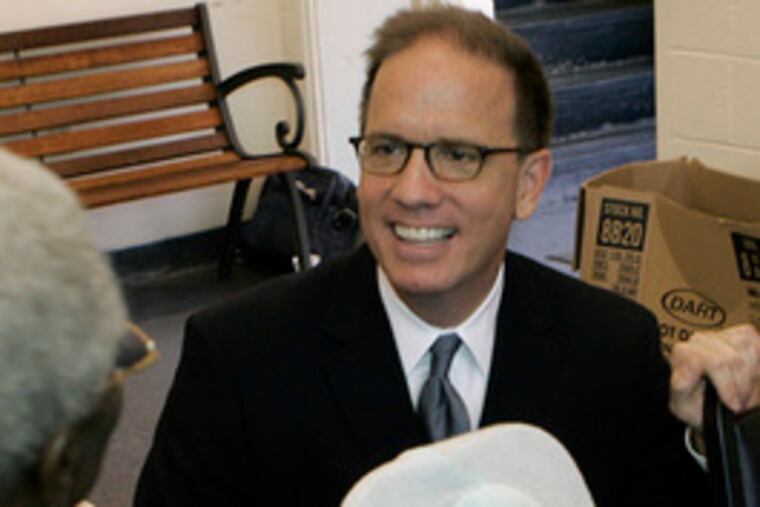
PITTSBURGH - This city's last GOP mayor served during the Depression, and Democrats outnumber Republicans 5-1, but business executive Mark DeSantis has emerged as a serious challenger to Democratic incumbent Luke Ravenstahl, in part because of the young mayor's missteps.
DeSantis, who won the Republican mayoral nomination as a write-in, has government experience, is wooing black voters - despite their history of overwhelmingly rejecting GOP candidates - and is benefiting from a unique set of circumstances.
Ravenstahl is only 27 and was not elected to office. As City Council president, he was next in line to take over when Mayor Bob O'Connor died of brain cancer in September 2006.
Ravenstahl landed feel-good spots on David Letterman's Late Show and other national media outlets as the youngest mayor of a major U.S. city, but since then he has stumbled - several times.
Most recently, Ravenstahl was criticized for using a special police SUV bought with federal Homeland Security funds to take his wife and friends to a Toby Keith concert. Ravenstahl said he did not know how the vehicle was purchased, and stopped using it when he found out.
"The fact that he went from 'Golden Boy' to Pinocchio, that is his biggest problem," said Joseph Sabino Mistick, a law professor and longtime political insider who served as top aide to former Mayor Sophie Masloff in the late 1980s.
DeSantis, 48, runs a high-tech firm, was an aide to U.S. Sen. John Heinz, and was a science policy adviser to the first President Bush and did similar work in the U.S. Department of Commerce.
The first mayoral debate last Tuesday attracted a standing-room-only crowd, a sign the GOP has put forward a serious candidate and not just its traditional sacrificial lamb.
Unlike many Republicans before him, DeSantis is actually spending a significant amount on ads, including a daring TV spot that compares him to the city's most famous ex-mayors, David L. Lawrence and Richard Caliguiri (both Democrats, by the way).
Still, no one is betting that DeSantis will necessarily take more than the 25 percent to 35 percent of the vote that Republican mayoral candidates typically manage in Pittsburgh.
"If all the stars aligned, there could be the making of an upset here, but it's against the course of history and against odds," Mistick said. "You just need a young mayor to keep making mistakes. The right one could be a deal breaker."
Ravenstahl declined to be interviewed for this story, but he has said most of the criticism directed against him has been because of his age, not because of anything substantial.
DeSantis said it was imperative to erase the city's $1.1 billion debt and right-size a city government that, despite cuts in recent years, still appears to be shrinking more slowly than the city it serves. Since 1950, Pittsburgh has lost more than half its population, going from 677,000 to about 312,000.
DeSantis' platform has received mostly positive press as Ravenstahl's peccadilloes have made his age more of an albatross than an advantage.
In March, Ravenstahl took a private jet to New York with Pittsburgh Penguins co-owner and Democratic Party heavyweight Ron Burkle just hours after the mayor helped negotiate a new state-subsidized hockey arena. Ravenstahl's political organization later reimbursed Burkle.
A city ethics panel grilled him after the Penguins and a hospital network paid his $9,000 entry fee at a charity golf tournament in June. Ravenstahl said he did nothing improper and would continue to appear at charity events because it's his job to promote the city.
Despite being handed such advantages, DeSantis won't raise the $750,000 he targeted for his campaign because the biggest donors are hesitant to back a long shot, said Jim Roddey, a Republican powerbroker and former Allegheny County executive who is backing DeSantis' campaign.
Meanwhile, critics say DeSantis can't possibly deliver on promises to start paying off the city's debt and cutting $193 million in spending over four years.
City Council President Doug Shields, a Democrat who was a top O'Connor aide when the mayor headed council in the 1990s, said that was unrealistic because costs such as gasoline and health-care premiums are beyond the city's control.
"We do backflips if health care only goes up 7, 8, 9 percent instead of the double-digit increases we usually see," Shields said.
DeSantis brushes off such criticism. "When I talk about right-sizing government, the response is 'What are you going to cut?' " DeSantis said. "What that presumes is that we are as efficient as we can possibly be."
"We're not even close to that," he said.