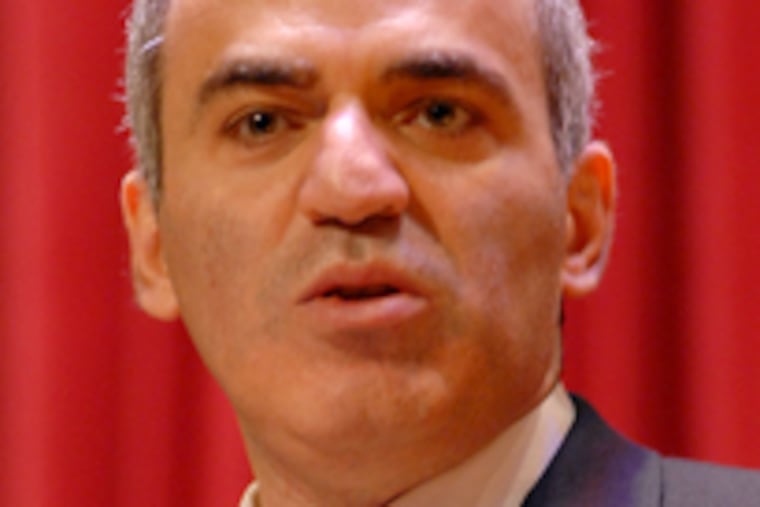
Hands in his pockets, trailed by a jostling horde of photographers and reporters, Garry Kasparov strolled around a long row of tables in the Central Library of the Free Library of Philadelphia yesterday, glancing over the shoulders of a few dozen Philadelphia teenagers engrossed in chess.
They barely looked up.
Few words were exchanged. The teens were in the presence of one of the greatest chess minds on Earth, but felt little more than the draft of fame as he passed by.
While these two dozen students have studied some of Kasparov's strategies, much of his contribution to chess theory is beyond their grasp, at least for now, said Steven Shutt, a chess coach and teacher at Masterman School.
"His games are a bit sophisticated for the kids," Shutt said. "There is such nuance in the moves he chooses."
Including the one he made, coming to Philadelphia for the day.
It was, in part, to promote his new book, How Life Imitates Chess. In part, to inspire the students from the after-school program Philadelphia Youth Chess Challenge.
And in large part, to serve his political ends. As a prominent member of Russia's opposition movement and a presidential candidate, Kasparov has had to struggle to be heard in his own country.
With virtually no hope of getting elected to office, he compares his candidacy to a chess game in which, even if victory is impossible, there is honor in keeping the opponent off balance to the end.
"Every day we survive makes life for the regime more annoying," he said.
Kasparov seemed interested in learning about the students - peppering their teachers with questions about which chess books they use, the number of children who play. And although he insisted that the skills that make someone a great chess player have no direct application beyond the parameters of the game, chess as metaphor was clearly the theme of his visit.
In his current political role, however, he is apparently engaged in a life-size match, the complex details of which were analyzed earlier this month in a profile in the New Yorker.
If he was furthering his strategic goals, along with his book sales, at the library, it registered little with the students.
Chins perched pensively on fists, they focused on their pawns and rooks moving across roll-up plastic chess boards curling at the edges.
The students had their own complex motives for playing. "It keeps you out of trouble. It keeps you occupied," said Tamir Kennedy, 14, a freshman at Vaux Roberts High School.
"I heard it could help with math, and I wasn't doing so well with that," said Maleek Singleton, 18, a senior. Since he took up the game in ninth grade, he's been getting straight A's, he said. Chess, he said, also taught him to "show good patience and poise."
You learn manners, too, evidently.
"Nice move," Charmaine Brown, 15, a Vaux sophomore, said in graciously praising her opponent.
Like most of the students invited to skip English, chemistry and the cafeteria for a chance to meet - perhaps even play against - the master, Brown said she knew little about Kasparov other than that he was a brilliant player and was involved in politics in Russia.
She had never heard of Deep Blue, the chess-playing computer that Kasparov defeated in Philadelphia in 1996 - when she was 4.
That was the last time the man who reigned for 15 years as world chess champion set foot in this city.
"It's good to be back," he said, shortly after he'd been whisked over from 30th Street Station, where his train had arrived 15 minutes late.
His remarks, delivered to an audience of several hundred, centered mostly on Russian politics. And in the question-and-answer period, only adults asked for the microphone, asking for his views on Armenian genocide (he's half-Armenian) and anti-Semitism (he's half-Jewish), if he misses being regarded as the world's greatest chess player (no), and whether he considers Mikhail Gorbachev an ally (emphatically no).
If, during his brief walk around Philadelphia's young players, Kasparov detected any incipient brilliance or imminent blunders, he didn't let on.
He had a bigger game on his mind.
A few kids left grumbling that they didn't have a chance to test their skills against the Big Guy.
But most, like Jacob Kelly, 13, an eighth grader at Masterman, had no hard feelings. Just getting to see Kasparov was worth the field trip, he said:
"It was pretty cool."