Annette John-Hall | Antiviolence man-up shatters stereotypes
Little ones in size-small "Stop Killin' " T-shirts clung tightly to their dads' hands amid the throngs of black men. Teens wearing earphones and "Dad made me come" looks leaned impatiently in the slow-moving line that circled the Liacouras Center. Older sons stood tall alongside their proud old heads, every one of them yearning to make a change.
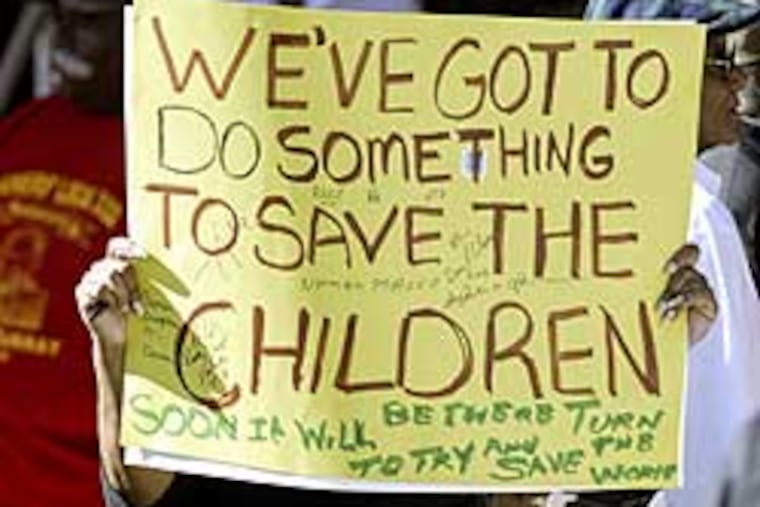
Little ones in size-small "Stop Killin' " T-shirts clung tightly to their dads' hands amid the throngs of black men. Teens wearing earphones and "Dad made me come" looks leaned impatiently in the slow-moving line that circled the Liacouras Center. Older sons stood tall alongside their proud old heads, every one of them yearning to make a change.
One of the most hopeful scenes among the many I saw in the stream of volunteers who answered the "A Call to Action: 10,000 Men" campaign over the weekend were the large numbers of African American fathers who came with their sons.
It was something I wish everyone could have seen, a scene that dispelled the perception that all black kids are gun-toting criminals, that all black men are uninvolved baby-makers.
But what brought them there - about 10,000 strong - was a crisis. The need to be part of the solution to restoring their poisoned communities, to save themselves, their families, and their endangered brothers.
Some fathers had personal lessons to teach.
"If he sees his father and other black men as a positive role model, it lets him know that this is the right thing to do," said Richard Leach, who was with his 8-year-old, Kyree. "It starts within the home. You can't blame everything on the police."
Others saw a more communal obligation.
"It's vital to bring the sons out," said Wendell Jenkins of Wynnefield, there with Wendell Jr., 12, who carries the weight of worry at such a young age. "I would hate to lose my friends to gun violence. I want it to stop. I'm scared."
His father could just settle for raising his sons, but is willing to man-up to a bigger mission.
"Every man who is a father has a responsibility to be a father for someone who doesn't have one. If a kid you know gets shot, that's blood on your hands, too."
Man of the house
There is something to be said for a man of the house's being
in
the house, even if it's only part-time.
My own father wasn't always at home. His job as a merchant seaman had him splitting his time between home and the freighter he called home for four to six months of the year.
But when Emile John was home, everybody knew it. My mother, usually the everyday disciplinarian, could finally pass the baton to her husband. Daddy didn't say much, but we could feel his unquestioned authority.
All he had to do was look over the bifocals he wore to study the Daily Racing Form and issue a steely warning - "Don't talk to your mother like that" - and we were quickly put in our places.
But, at the same time, we knew he cherished us, often spoiling us to make up for the times he wasn't there.
He completed our family.
Now imagine a whole generation of boys - and girls - who don't have that kind of accountability and love, because their dads have disappeared.
It's the little things that boys need to know to be men.
As simple as how to tie a tie. Where to carry your wallet. How to respect women. How to respect themselves.
And it's these life lessons that teach them how to negotiate the minefields of racism, and deal with an anger that comes from being demonized like no other segment of society.
But if being wiped out by systemic forces weren't bad enough, black men are also accelerating their demise by their own hands.
Startling numbers
In Philadelphia, half of last year's 406 homicide victims were black males 15 to 29, and overwhelmingly they were killed by other black males. That's a staggering number when you consider that black men make up only 4 percent of the population.
This year, the numbers are no better.
And all of this crisis has been met by apathy. A black problem. Let them solve it.
We can argue about whether it really is just a black problem created by black people, but that's a waste of time.
The 10,000 men who showed up Sunday know that.
For once, black folks aren't waiting for someone else to swoop in on a white horse as bodies continue to fall.
The next few weeks, when volunteers go through orientation at neighborhood sites, will determine whether the feel-good call-out will become a legitimate movement or just a consciousness-raising pep rally.
But it's a start. And nobody appreciated it more than the women who have lost their children to gun violence, many of them single moms who, as hard as they tried, couldn't teach their boys how to be men.
"I tried to raise my son the best I knew how - but there was a place in him I couldn't touch," said Dorothy Giddings, who lost her son, Andre, along with her mother and a family friend to a brutal triple slaying in 2005.
Addressing 10,000 men, Gidding said: "We gladly take a step behind you, where we should be. Women aren't supposed to be on the front lines.
"Please," she implored, "our sons need you."