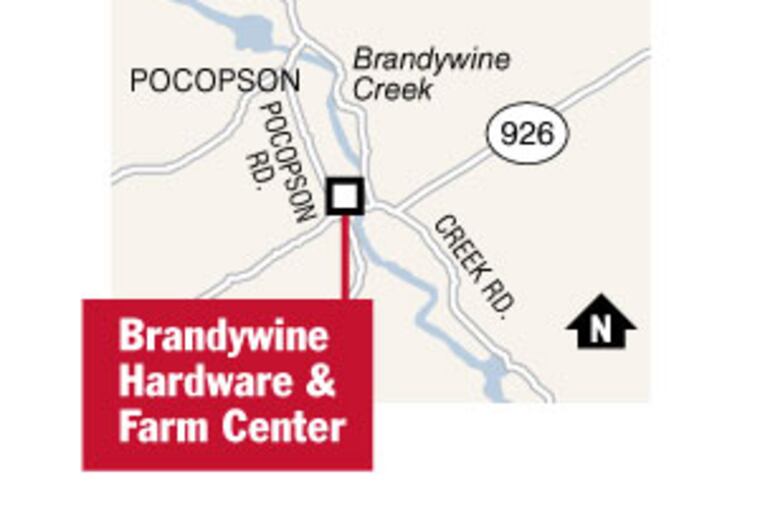
From whatever direction you approach, the Brandywine Hardware & Farm Center in Pocopson Township announces itself in an unmissable way. It's the place with the old cabooses out front.
The one nearest the road - a New York Central relic with bay windows - is as eye-catching as a billboard. It sports a fresh coat of white paint and is emblazoned with an Ace Hardware logo. Sharing the siding is a Tuscan red Pennsylvania Railroad boxcar that serves as a retail annex.
Railroad-station baggage carts function as stands for colorful mums and carry bales of peat moss. A red 1946 International Harvester Farmall tractor, which starts right up, bears witness to the agrarian roots of this pastoral swath of Chester County.
Those drawn inside are rewarded with more of the store's rural, railroad flavor. L-gauge locomotives circle on three loops of model-train track suspended overhead, endlessly hauling stock to nowhere but Delight. Hanging from every other square foot of ceiling are hundreds of eclectic objects that amount to a museum of Chester County material culture.
"This is not something you'll see at Home Depot or Lowe's," Richard Moore, the owner and manager of Brandywine Hardware, says with considerable understatement.
Moore bought the business 21 years ago and is de facto curator of its collection. Look up and you'll see lanterns, pulleys, boots, sleds, milk cans, yokes, pitchers, wheelbarrrows, walk-behind plows, lawnmowers, saws, pitchforks, and a chainsaw whose 6-foot blade required the muscle of two men.
Equally interesting are the walls, adorned with railroad and advertising signs; license plates; a poster for the 1940 film classic The Sea Hawk, starring Claude Rains (who resided in West Chester); and a framed feed bag from the Pocopson Mills, which once stood on the store's very site.
Brandywine Hardware was established in 1849, and has always been more than a place to buy bolts and seeds.
It was a farm and community center, and it remains one. In two shops out back, tractors are repaired and blades sharpened. The rear of the store also houses the Pocopson Post Office, which serves roughly 3,500 inhabitants on the ruburban frontier.
Moore, 54, is a bluff man who, by local standards, is a newcomer. Born and reared outside Chicago, he moved to these parts in 1967 when his father, helicopter pioneer Wes Moore, bought a historic 100-acre farm in nearby Birmingham Township. The manor house was built in 1740, the barn in 1790. During the Revolutionary War, Osborne Hill Farm was British Gen. William Howe's command post.
One of young Moore's first acts at his new home was to explore its barn. He found several treasures, such as an antique seed planter, that he insisted on restoring. That wooden planter now hangs from the store's ceiling. Enhancing the utilitarian decor of Moore's office is a hand-operated gasoline pump retrieved from a carriage house at the farm.
"I like the old stuff," he says. "When other people throw it away, I save it."
When he was a teenager, Moore worked for a couple of years at the hardware store. It was "really, really country," he says. "Very laid back."
He went to Unionville High, then West Chester State College, and for 15 years he worked with his father in the helicopter business. But the hardware trade was in his blood.
When the property became available in 1986, Moore bought it. He reopened the store, then defunct, and began rebuilding the business.
At the time, the adjacent railroad siding, alongside a spur line that runs from Coatesville to Wilmington, was occupied by decommissioned SEPTA commuter cars. To Moore, they were an inspiration.
After they were towed off, Moore called a Coatesville scrap yard that cut up old cabooses. He asked to buy one. The reply: "We won't sell you one, but we'll sell you five."
Which was how Moore came to possess five steel 20-ton cabooses. Since then, his collection has grown to six, plus the boxcar. "I've saved them from being chopped up," he says proudly.
Like many boys, Moore was enamored of Lionel model trains, but his older brother was more passionate about railroading. Moore has caught up. In the cellar of his home, he keeps hundreds of railroad lanterns. He also collects cast-iron rail signs and special tools, such as a pick to chip ice from trolley tracks.
The store's museum of farm and domestic implements began when Moore hung up a walk-behind plow, rescued from Bonnie Blink Farm in Exton. That property, which now supports a bumper crop of single-family homes and townhouses, was owned by William Parry, Moore's father-in-law.
Then a customer offered an old mop bucket. Up that went. As more gadgets and trinkets from the past were exhibited, more appeared.
Most pieces in his collection "have come from customers," Moore says. "When people move to retirement homes, they often bring me their old stuff."
"If it's old and rusty, I know my husband will love it," says his wife, Barbara, with a note of bemused resignation.
By design, 90 percent of the items have a Chester County pedigree. Some were made by ingenious farmers, mechanics and smiths. Others were produced by long-gone manufacturers.
To Moore, the devices are symbols of inventiveness and hardy exertion. As he explains the function of a Civil War-era walk-behind plow, he says, "Nobody would want to work that hard today."
Occasionally, especially around the winter holidays, customers ask if they can purchase one of the dangling antiques. Moore's policy is firm: "I don't get rid of anything."
Though his fondness for the past is genuine, Moore has a commercial motive. With many suburbanites patronizing big-box home centers, running a small operation is a challenge, he says.
So even though Brandywine Hardware is modern inside and out, he tries to re-create the friendly atmosphere of an old-fashioned country store. Scouts learn how to use tools at weekday seminars. On Saturdays and Sundays, customers enjoy free doughnuts and coffee.
"I try to make it fun," Moore says. "I try to get families to think about it as a destination. I like to tell people, 'We're on the right track,' with the trains here and all. . . . If nothing else, people can come and look. There's no charge to look."
Tim Cole, 75, a retired stockbroker, is a longtime Pocopson resident and loyal customer who lives about a mile from the store. He calls it "a vital community resource" and credits Moore with creating a thriving business.
"One thing he did not want is to have a chain hardware store," Cole says. "The accumulation of stuff is just amazing. Every time I go there I see someone I know and I wind up spending more time there than I intended. It's a place you enjoy being."
The model trains, of course, are a major attraction. They are activated for five-minute spells by a doorbell-like button at the rear of the store. There's no sign next to it. Kids from 5 to 85 just seem to know where it is. They find it irresistible.
One of those kids is Moore. Sometimes, after a long day, when the doors are locked and he's alone, he'll turn off the lights and push the button himself, bringing his high-flying railroad to life.
"It's kind of a neat feeling," he says.