Bucks firm says state trying to shut it down
Worth & Co., Pennsylvania's largest nonunion mechanical contractor, is accused of underpaying some of its workers.
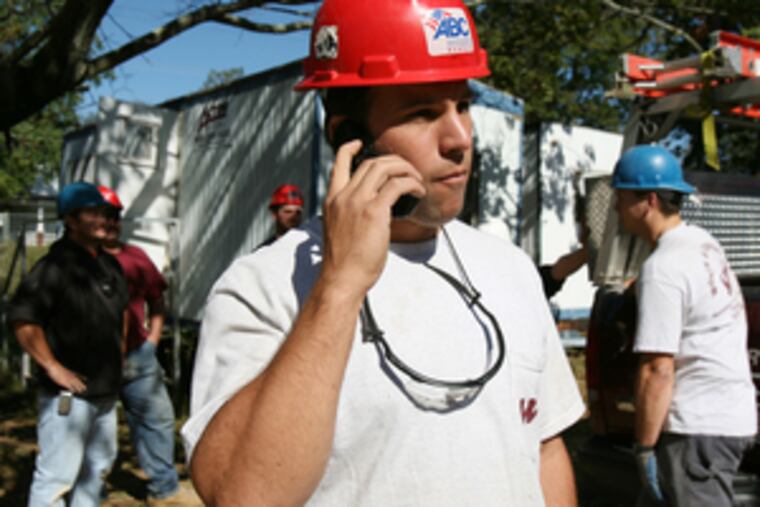
Worth & Co. could be the envy of any business. With nominations from its employees, the Bucks County company has won Pennsylvania's "Best Places to Work" award five years in a row. It employs 450 people and relies heavily on state and local governments: 80 percent of its business comes through publicly funded construction projects.
Worth's success as the state's largest nonunion mechanical contracting company has also made it a target of the construction trade unions, who have been trying, and failing, to organize its workers since the early 1990s.
Now, that long battle has become the backdrop of a dispute with the state Department of Labor and Industry, which has charged the company with intentionally underpaying 28 of its workers between 1999 and 2003. The sums range from $32 to $15,000. In most cases, less than $1,000 is at issue.
But the state's penalty would ban Worth from getting any publicly funded work for three years. Worth says that would force it to lay off most of its employees, if not close its doors entirely.
The state "is attempting to shut-down Worth," the company says in a civil lawsuit, which says the firm's payroll has been audited 14 times in the last three years.
The two key state officials in the case - the one who signed the complaint against Worth and the cabinet secretary who could bar the company from future state contracts - have long histories with the construction unions.
The director of labor-law compliance who signed the complaint, Robert V. O'Brien, worked for Sheet Metal Workers Local Union 19 before joining the department in 2003. Worth says the local has participated in organization efforts.
Attempts to reach O'Brien - now a deputy secretary - were not successful. The Inquirer made numerous telephone calls over more than a week to his state office. The reason for the calls was explained to his staff. Later, a fax was sent outlining the questions The Inquirer wished to ask. No response was received.
The secretary of labor, Steven Schmerin, who will decide the case based on a written report from the hearing, was previously in private practice and received income from the Laborers' District Council of Western Pennsylvania. Since 2004, Schmerin has received a pension from the Laborers International Union of North America.
Worth has petitioned to have Schmerin recuse himself; he has refused.
"I have made a conscientious determination that I have the ability to assess this case in a fair and impartial manner," Schmerin wrote in response to Worth's motion for recusal, "I do not believe that my continued involvement in this case creates an appearance or bias or impropriety."
Schmerin also did not respond to calls and a faxed letter outlining The Inquirer's questions. Schmerin's spokesman, Troy Thompson, answered a number of questions, but said Schermin was either unavailable or too busy for an interview.
The governor's office would not disclose what position Schmerin held at the Laborers union. The union also would not comment. Both men were appointed by Gov. Rendell.
The hearing is now under way. Worth, whose payrolls were audited 14 times in the last three years, said in a lawsuit that the state is attempting to "shut down" the company.
"They have us in a hearing we believe is predetermined. We are going to get debarred at the end of it without due process," John Marrinucci, Worth's chief operating officer, said in an interview.
A spokesman for Schmerin said Worth was being treated fairly.
"This is not an issue of going after someone because they are a union or nonunion shop but going after someone who intentionally violated the prevailing wage act," said L&I spokesman Troy Thompson.
If prevailing wage violations are found to be intentional, the penalty is always debarment, Thompson said.
He would not say specifically why the labor department feels Worth's actions were deliberate.
"That is part of case against them. [It is] information that will be presented at hearing and can't be discussed due to the fact it is in litigation," Thompson said.
As Worth faces debarment, the Pipersville company is also one of 100 firms being honored again by a joint partnership of the state's Department of Community and Economic Development and private agencies for "workplace policies, practices, philosophy, system and demographics."
"It's not very easy for them to win five years in a row; they must be doing something right," said Matt Zieger, director of initiative of the TEAM PA Foundation, which oversees the awards.
The alleged wage violations cited by the Labor Department occurred on six different projects from 1999 to 2003 and involved $143,000 in wages and 28 workers.
In one case, a worker was due $32.36 over a 26-month period. On another project, a worker was due $15,947.78 in a 28-month period. Fifty-five percent of the cases were for amounts less than $1,000.
During that time Worth officials say they had a total payroll of $54 million.
Marrinucci said that L&I auditors reclassified laborers as apprentices, which meant Worth then had to pay a different scale for the workers involved. Worth disputes L&I's conclusion.
Worth has paid the employees the difference in wages.
The state prevailing wage law follows federal law, which requires that when working on public contracts, companies must pay workers a minimum "prevailing wage" that is determined by the secretary of labor. It is usually the approximate pay a union worker would receive. The laws date back to the Depression era.
The requirement is fiercely debated in some quarters.
To some, prevailing wages keep unskilled workers from taking good jobs for less pay, said Stephen Herzenberg, an economist and executive director with the Keystone Research Center.
"Unions have to use all the tactics they can to keep their membership on the path of making a middle-class living," Herzenberg said.
To others, debarment gives the union an unfair advantage.
"This is a fantastic opportunity for the union to put out of business a main competitor once again, using government to advance its agenda," said Matt Brouillette, the president of the Commonwealth Foundation, a conservative think tank.
An early union effort by Steamfitters Local 420 in 1991 was defeated by a vote of 13 to 6, said Worth employee Pete Early of Abington.
"That's how small our company was back then," said Early, 39, who started out digging ditches for Worth at age 18 and is now a project manager.
The federal National Labor Relations Board has handled six cases involving Worth and local unions over the last six years, according to John Breese, assistant to regional director.
Worth faced another prevailing wage case in New Jersey in 2004. Worth subcontractors used apprentices not registered with the state on six job sites between 2001 and 2002. The case was settled, and Worth was not debarred.
Some of Worth's recent projects include Shannondell, a retirement community in Valley Forge, additions to the Garnet Valley High School, and a new middle school for the Quakertown Community School District.
Worth's employees have sent letters, and made visits to Harrisburg to bring the hearing to Gov. Rendell's attention.
Most could lose their jobs, Marrinucci said.
"The alleged crime, even if true, does not match the punishment," Marrinucci said.