Kutztown class takes on more than a language
Pennsylvania Dutch dialect is only part of studies about the early settlers' culture.
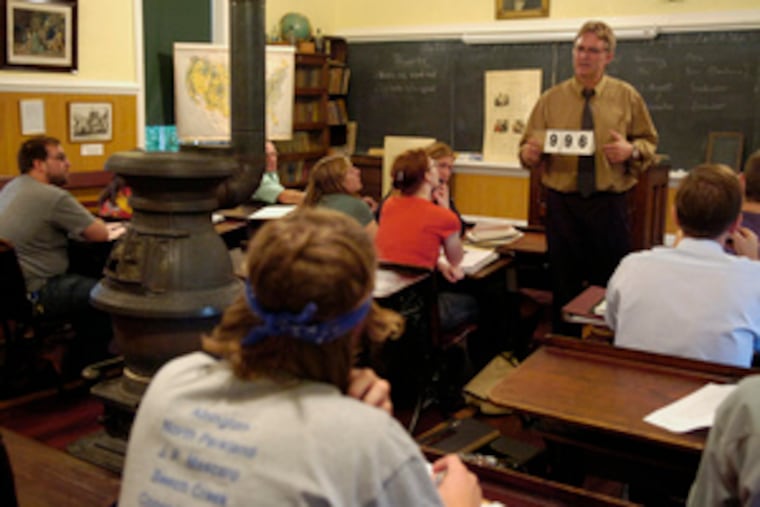
KUTZTOWN, Pa. - Students sitting on rows of hard benches behind wooden desks face teacher Edward E. Quinter of Allentown. Behind him are portraits of Washington and Lincoln on a wall above a long blackboard, and a potbellied stove dominates the center of the room.
What time is it?
It is the 21st century, and college students are learning Pennsylvania Dutch in a one-room, 19th-century schoolhouse at the state university in Kutztown.
For the second year, there apparently has been a resurgence of interest in the mother tongue of early Germans who settled in Pennsylvania and their culture.
Kutztown University offers a minor in Pennsylvania German studies, an interdisciplinary program that combines language, history, culture, art and internship offerings.
The one-room schoolhouse on campus "is just the perfect place where a Pennsylvania German dialect course should be," said Quinter, 57, a German teacher at Parkland High School in Allentown, who for the second year is teaching Pennsylvania Dutch at the university. The course has attracted about 20 students each semester.
Quinter, who earned a bachelor's degree in German language and literature at Juniata College, took German graduate courses at Muhlenberg College, Millersville University and the University of Pennsylvania and studied in Germany and Switzerland. He has taught for much of his career.
He also has devoted years to manuscript transcription and translation for various groups, including the Pennsylvania German Society, Northampton County Genealogical Society, Moravian Historical Society, Pennsylvania Heritage Commission, and Historic Bethlehem.
"I grew up in Nazareth" in Northampton County, "a self-contained little place at the time, where you heard the old Dutch, but it wasn't until I went to Europe that I gained a deeper appreciation of the language and the culture," Quinter said. "When I got into translations of letters, documents and learning about the extraordinary lives of ordinary people . . . well, it was like peeling off the layers of an onion, doing detective work, discovering mysteries that would have been lost and never known.
"For me, language is so intriguing. And it's so true, that to understand a culture, you really have to understand the language."
His passion for language influences his students, many of whom ended up in his dialect course through a more circuitous route.
"I guess I was the black sheep in Mr. Quinter's class last year," said John Karavage, 22, of Ashland, Schuylkill County, a senior history major who is student teaching. "I'm not a bit Pennsylvania German, but I started out with an interest in architectural preservation and began working on projects outside of town that just brought me in closer contact with people and the strong German culture around here.
"Really, I feel like I've been adopted just because I've shown an interest in the language, which is also showing an interest in the people."
In contrast, Zach Langley, 23, of Walnutport, Northampton County, who graduated from Kutztown last spring but remains assistant coordinator at the university's Pennsylvania German Cultural Heritage Center, said he grew up in a Pennsylvania German family, with three of four grandparents speaking Pennsylvania Dutch.
Langley said many students in the class appreciate that there is an outlet for expression of their heritage.
It was as if the language had skipped a generation, he said. "I'd hear bits and pieces of it growing up, but it wasn't like the people of my mother's and father's generation were encouraged to speak it."
But times change and new generations often pick up what older generations shed.
Karavage said he appreciates hearing the clip-clopping of the Mennonites' horses on a street where he lives, witnessing the work ethic of nearby farmers and craftsmen, and being privy to Pennsylvania Dutch expressions at markets and auctions.