Shops, growth bring hope
For most of its 78 years in North Philadelphia, La Salle University has been a somewhat detached neighbor in the decaying community surrounding its compact campus. But when Brother Michael J. McGinniss became president in 1999, he saw what the University of Pennsylvania was doing to revitalize sections of West Philadelphia and decided the Explorers should do the same in their part of town.
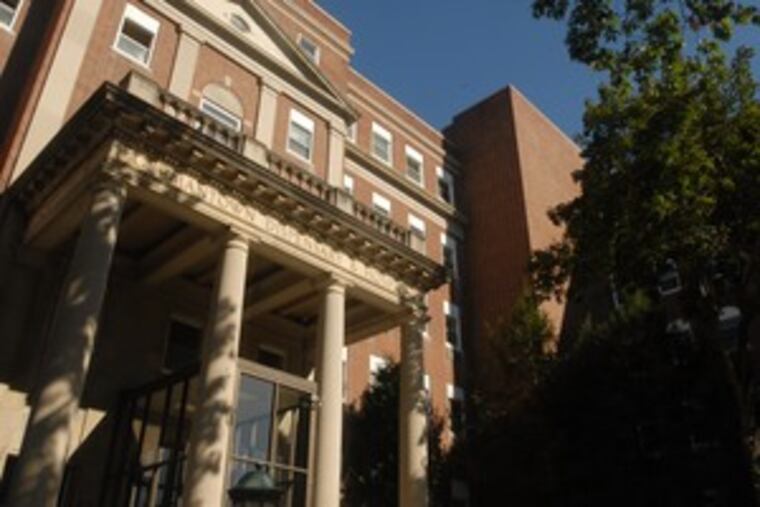
For most of its 78 years in North Philadelphia, La Salle University has been a somewhat detached neighbor in the decaying community surrounding its compact campus.
But when Brother Michael J. McGinniss became president in 1999, he saw what the University of Pennsylvania was doing to revitalize sections of West Philadelphia and decided the Explorers should do the same in their part of town.
Now La Salle is weaving itself into the fabric of the neighborhood by taking over an underutilized hospital and providing land for a much-needed shopping center and supermarket. The ambitious expansion - it also includes a new state-of-the-art science and technology center - is part of a $54 million plan that La Salle says will shape its growth and stablize the fractured community.
La Salle wants to "be a proactive neighbor in the community in terms of economic development," said McGinniss, who grew up in Olney and was president of Christian Brothers University in Memphis, Tenn., before returning to head his alma mater.
Shortly after taking office he met with Penn administrators to see how they transformed the landscape and image of their region, and learned they didn't do it alone.
"I came back and thought, La Salle could do this," he said.
Local organizers say it's about time.
"Some of the community people felt La Salle could be doing more," said State Rep. John Myers, whose district includes the 7,550-student university, which is hemmed in by Ogontz Avenue and Wister Street.
But now "folks are ecstatic because . . . there has been a lack of economic stimulus in that general neighborhood for over 40 years," he said.
These are high times for La Salle, founded by the Christian Brothers in 1863 on the estate of portrait painter Charles Willson Peale. In the last 10 years, enrollment has grown by 16 percent; its Newtown, Bucks County, campus has doubled in size; it built new dorms on the main campus; and it raised $84 million for scholarships, academic programs, and capital improvements.
Last spring, the land-starved school announced it had acquired the 24-acre former Germantown Hospital on Wister adjacent to the school, where it will relocate its School of Nursing and Health Sciences. A $53.6 million bond issue will pay for the $10 million purchase and renovations to the building and others on campus, as well as the new science center.
"Each institution has its own timing and its own internal issues to deal with," said McGinniss, who served on La Salle's religion faculty from 1984 to 1993.
La Salle was ready when State Rep. Dwight Evans came to the board of directors in 2004 with his idea to bring a Fresh Grocer supermarket to the area. The university agreed to lease an 8.2-acre tract on Chew Avenue to Moreland Development, which will build and manage the 80,000-square-foot center. The $15 million project is funded in part with $4 million from the state's Fresh Food Financing Inititative.
The supermarket is the third to be announced in a Philadelphia inner-city neighborhood in recent months. The Fresh Grocer chain will open a store in the Progress Plaza shopping center at Broad and Oxford Streets, and ShopRite will move into the proposed Park West Town Center at 52d and Jefferson Streets.
The stores are welcome additions to the communities, which have had trouble attracting supermarkets because of low income levels, high crime rates, and a lack of large plots of land for parking.
The La Salle groundbreaking was last week, and the opening is expected next November. In five years, the school hopes to begin collecting revenue from the stores, which also include a Starbucks, Kinkos, GameStop, bank and dry cleaner.
"There hasn't been a supermarket in that area in 45 years," said Evans. "The significance of that project is it becomes a tipping point, it becomes contagious."
The real measure of the neighborhood's transformation, he said, only half-joking, is the Starbucks.
"When you got a Starbucks, I guess you've arrived," he said.
And what's good for the community is good for La Salle, where two-thirds of undergraduates are residential. Getting to a supermarket now is 3.5- to four-mile trip.
"Students have a certain level of expectation of how a campus will be and how accessible things will be. I think this is essential," said McGinniss.
La Sallians are looking for an urban experience, but they also want ammenities, such as a Starbucks and a dry cleaner, said Brother Joseph J. Willard, who is overseeing the entire project, noting that the shopping center will also provide jobs for residents and students.
While the university has seen itself as a positive force in the community, providing education, counseling and health services to residents, administrators say it lacked the funds to do more.
Money wasn't the only thing holding it back.
"Universities used to be somewhat isolated.. . . Now the thinking is universities and their surrounding areas have a common cause," said Ed Turzanski, vice president for government and community relations.
At the hospital, now called West Campus, the school will use about two-thirds of the 50,000-square-foot complex with Einstein Health Network retaining a nursing home and doctors' offices. It previously acquired two small adjacent properties, increasing the campus by thirty percent to 130 acres.
To connect it with the main campus, the university plans to build a pedestrian walkway and bridge that will lead to an outdoor landscaped terrace and two-story glass atrium ending in an illuminated glass wall at the new facility.
The move allows the school to consolidate its nursing, nutrition and speech-therapy programs, now scattered in four areas, and give other programs room to grow.
"We are so excited about this," said Zane Wolf, dean of nursing.
The final piece of the plan calls for transforming a creaky 48-year-old science building into a 38,000-square-foot environmentally "green" structure with solar panels and rooftop vegetation to absorb runoff. Tom Keagy, dean of the school of arts and sciences, said a key innovation will be large windows on the labs so passersby can look in.
"It makes a huge difference if you walk down the hall and look in and get a feel for what students are doing in the laboratory," he said.
The windows could be a symbol of the college's new openness with its neighbors. It's a relationship that the school plans to nurture. In April, it received a $200,000 grant from the William Penn Foundation to develop a comprehensive plan for the community, from improving the quality of the housing stock to reducing crime.
For McGinniss, Penn remains a role model.
"I want to see La Salle be as much a magnet for this community," he said, "as Penn is in its area."