Daniel Rubin | Hieroglyphs of commerce
I'm sitting with Lawrence O'Toole - hunter of Philadelphia's ghost signs - at a Starbucks in Old City, but he's clearly somewhere else.
I'm sitting with Lawrence O'Toole - hunter of Philadelphia's ghost signs - at a Starbucks in Old City, but he's clearly somewhere else.
"There's a real prominent one for petticoats over here," he says, looking out the window, craning his head, scouring the tops and flanks of nearby buildings for his quarry.
Three stories up on Arch Street he finds what he's looking for, fading black letters on dusty red brick:
Klosfit Petticoat.
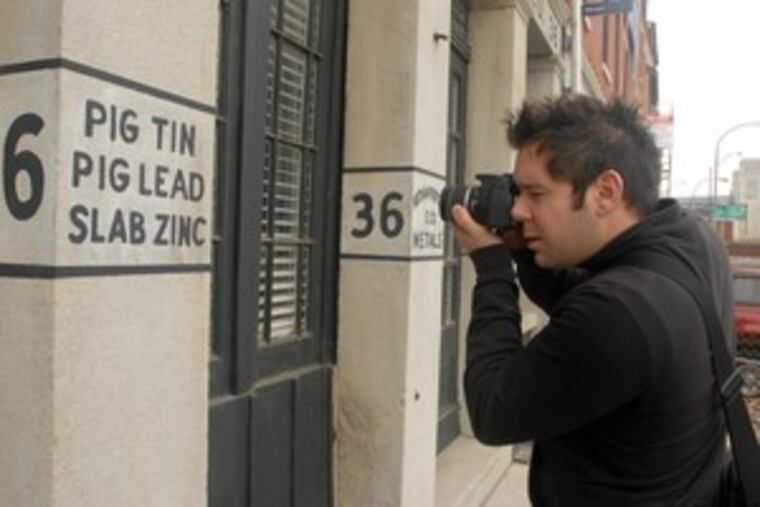
Stepping outside, O'Toole powers up his Canon Rebel camera and shoots the image for his photo blog, which captures the fleeting mercantile messages of an earlier era.
Just what era Klosfit represented, O'Toole is not sure. He's more interested in the texture, the typography, the sense that he's preserving something precious.
(Patented in 1907, the extraordinary Klosfit undergarment did away with those annoying draw-strings that puckered and gathered, an Internet search reveals. In Philadelphia, Greenwald Bros. Inc. sold them at 357 Arch.)
The thing about ghost signs, O'Toole says, is once you've spotted one, you can't stop seeing them.
At least he can't. The spike-haired, 31-year-old graphic designer is a soft-spoken study in black and white: black zippered jacket, jeans and Converse high-tops; white T-shirt and socks. He has been hunting these remnants of the mid-19th to early 20th centuries since his freshman photography course at Drexel.
The vanishing
Technically, he says - and apparently there are rules among lovers of the genre - a ghost sign can be seen only after something happens: a building is torn down, say, exposing long-covered letters, or the rain has penetrated old paint, making vanished words momentarily reappear.
O'Toole has captured more than 50 pictures on the blog, one of six he keeps up when not working for the design agency Primer. The blog is rich in faint imagery, lost logos and forgotten slogans.
There are giant keys from long-shuttered locksmiths, pulleys from now-immobile movers. The signs remind of the day when millwrights, stencilers and steam-engine repairers were at work in Philadelphia. You could find Gretz Beer, Cramp Shipbuilding, National Licorice Co.
"All of these pictures came out of the idea that I like hidden gems, and relate to things that aren't there anymore," O'Toole says as we walk down Third Street, eyes up.
On a brick wall down where Filbert Street becomes a cobbled alley, three spools of thread and the letters B. Schapiro & Bro. toy with O'Toole. An authentic sign, he wonders, or one made in Hollywood? After all, 10 years ago Third Street was done up to look like 1873 Cincinnati for the shooting of Beloved.
Going fishin'
We're on the way to O'Toole's favorite Center City ghostie. It rises three stories at 116 Market St., where the Franklin Fountain scoops homemade ice cream.
A delightful image dominates the building's western flank: a fisherman reeling in a big one. You can see the words Quick Relief.
What's being sold? Some fancy rod? An antacid? It's hard to tell. There seem to be several generations of signs on the wall, a lead-paint pentimento. Below are more words: shotguns, shells.
Eric Berley, whose family owns the building, says a hunting and fishing store named Roxy's stood there a half-century ago.
O'Toole moves on, up Front Street, to where the long-vacant Stephen Girard warehouses are being reborn as condos.
Someone has freshened up the old sign for Nathan Trotter & Co., a 19th-century importer that dealt in pig tin and slab zinc. O'Toole shoots the words, then looks up, to a frosting of white lettering still visible on the spiffy red-brick facade.
There's an O. An R and a D. The word wire can still be made out, ghosts hanging by a thread.
Daniel Rubin |
For photos of these signs, and links to signs in other cities, go to http://go.philly.com/ghostsignsEndText