An unlikely man, with a mission
A Nigerian pastor with a megachurch in Ukraine is aiming to spark an American revival.
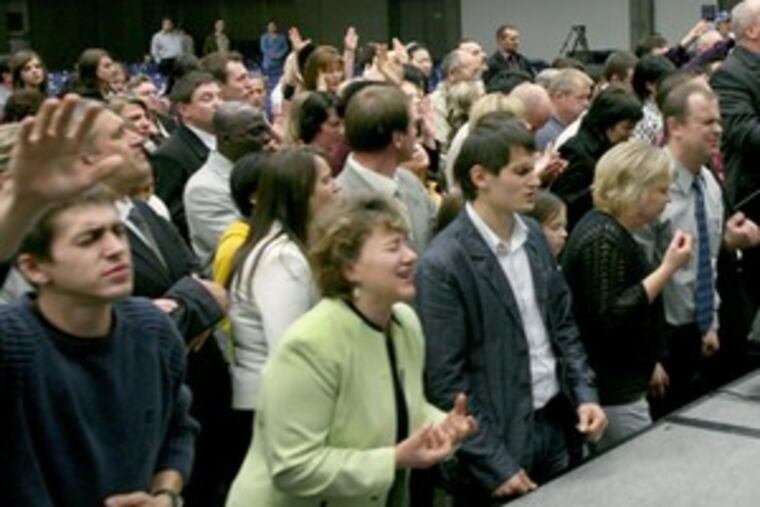
Nearly every week, new visitors arrive. They want to see the megachurch that was built in the unlikeliest of places by the unlikeliest of men.
The Embassy of the Blessed Kingdom of God for All Nations was founded 13 years ago by a Nigerian immigrant, Sunday Adelaja, in Kiev, Ukraine. In a predominantly Orthodox country where racism is pervasive, Adelaja created a Pentecostal church with 30,000 members.
But the church aims to be far more than a curiosity. Like the pastors who travel to Kiev to see him, Adelaja believes God's Embassy can be a model worldwide.
The next stop in his bid for global reach is the United States.
"America is fast becoming a mission ground again," Adelaja said in a phone interview from Sacramento, Calif., during his latest trip through this country. "We are surprised that the Americans who preached to us, the passion they had is almost already gone."
Adelaja is among a stream of pastors from Africa and other countries starting hundreds of churches in the United States. Their congregations back home are bursting with worshippers as Christianity wins adherents through the developing world. The clergymen see U.S. churches as floundering - focused more on money than God and filled with stale preaching and sinfulness.
They hope to save the country that brought them the faith.
"When the values are crashing, you have the largest number of abortions, divorce and school shootings. These things are very sad," Adelaja said. "As America goes, so goes the world. We shouldn't allow the Christian influence to diminish in this country."
His goals may seem unrealistic, but researchers who study global religion are already calling this the "African century" of Christianity. African churches - with their zeal and resourcefulness - are poised to become a force not just in America but around the world.
Adelaja trains mission workers in Ukraine, and through them, he says, he has already started more than 600 churches in dozens of nations. In the past few years, he has been traveling around the United States, building ties with pastors, especially leaders from the Pentecostal and charismatic traditions, known for spirited worship and speaking in tongues.
"At present, he doesn't have great influence" in the United States, but he has a "network of fans," said Tony Carnes, who studies African churches in the New York area and beyond. "This current trip is a sustained effort to bring Adelaja to the greater church audience."
God's Embassy claims 20 churches in America, built mainly through Ukrainian and Russian-speaking immigrants and their U.S.-born children and friends. Last year, Adelaja started History Makers Bible School in Sayreville, N.J., and says 200 or so pastors from around the country attend the weekend classes.
The Kiev megachurch funnels about $200,000 each year to its American offshoots, which serve an estimated 5,000 people, Adelaja said. In sharp contrast to other African-led churches in the U.S., Adelaja says his American congregations, usually called God's Embassy, are overwhelmingly white.
The pastor's big push comes in January when he joins a conference of American and overseas pastors and business leaders in Atlanta to improve leadership in churches. Shortly after, he plans to release his book and workbook called
Church Shift
to help U.S. pastors learn his strategies for reaching nonbelievers.
"I'm not bringing cultural particularities of Africa or Ukraine here," Adelaja said. "I'm using biblical principles to make headway."
Adelaja, 40, certainly sounds like many conservative Christians in the United States.
He says secular Americans are discouraging Christians from sharing their beliefs. "You want to give minorities the freedom to talk, but you want to make the majority quiet," he said.
Social ills - from teen pregnancy to government corruption - can be solved through the values that Christianity teaches, about love, purity, fear of God and honesty, the pastor said.
He considers Muslim extremism one of the biggest threats facing the world. In Nigeria, which Adelaja left as a young adult to study in the Soviet Union, the population is nearly evenly split between Muslims and Christians, and violence between the groups is common.
Despite the deep involvement of Christian conservatives in American public life, he also thinks U.S. churches should do more to influence government policy.
His Kiev megachurch played key roles in get-out-the-vote efforts and protests meant to strengthen Ukraine's young democracy. He says too many American Christians are focused more on career than creating a ministry for God.
"We're not saying we should go back to the medieval age when the Christian church used to be the government. That was a mistake of the medieval time in Europe," Adelaja said. "We're only saying, anybody who has a value system shouldn't be ashamed of it."
"If we don't engage the culture," he said, "the culture is going to overrun the church."