Birders answer the holiday call
Thousands of observers trekked into forests and fields to identify species and population trends.
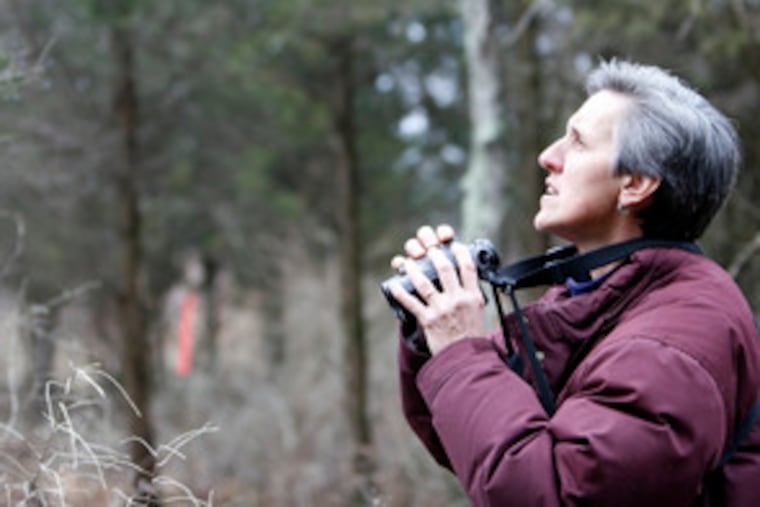
His eyes focused on a flock of purple finches feeding along the roadside, ecologist Steven Allison barely caught a glimpse of the bird that swooped low above them. But it was big and it was fast.
Allison's mother, Diane, saw it, too. "Buteo!" she called out, noting its fat wings. Within seconds, the pair had trained their binoculars on the bird, now poised atop a pine tree just off rural Mount Airy Road in Tinicum Township, Bucks County.
"Red-shouldered hawk!" she cried, and grabbed her Nikon to document the bird's presence for posterity - and the record books.
"You know they're around, but it's not something you see every time," she said yesterday. "And to have an opportunity to really study it - that was special."
The Allisons were taking part Sunday in the annual Christmas Bird Count, a National Audubon Society event that sends thousands of birders into fields and forests, mountains and seas during a three-week period around Christmas.
Count areas are circles, each 15 miles in diameter, divided into sections with at least one experienced birder per section. Observers start before dawn and go until dusk recording every species seen or heard, and how many of each.
"This is the oldest wildlife census in the world," said Audubon spokeswoman Delta Willis. "A whole team of scientists could never get this much help."
Frank M. Chapman, an ornithologist at the American Museum of Natural History and one of the early Audubon Society members, started the count in 1900 as an alternative to the turn-of-the-century custom of celebrating Christmas by shooting birds.
Twenty-five counts by 27 observers were conducted that year, six in the Delaware Valley. About 18,500 birds, representing 90 species, were seen. Last year, 57,851 observers counted nearly 70 million birds.
Now in its 108th year, with counts in every state, the Canadian provinces, Central and South America, the West Indies, Bermuda, and the South Pacific, the event is presenting scientists with a treasure trove of information to pick apart and analyze, said Geoffrey S. LeBaron, the society's count director.
The database has proved invaluable for conservation, whether it be for preserving habitats or signaling some type of environmental threat, such as pesticide poisoning or groundwater contamination.
"Our next big push for analysis of CBC data will be looking into what species have been changing their ranges over time as reflected in the CBC data, and then to postulate how birds may react to the effects of global climate change," LeBaron said by e-mail last week.
"This is a very important issue," he said, "and one that at least for now is all in the hypothesis stage."
However, that doesn't keep the amateurs from speculating.
Climate change could be behind the growing numbers of red-bellied woodpeckers - birds with a brilliant red head and a pale blush of color on the belly - whose range appears to be moving northward, said several observers.
The phenomenon could also explain why warblers, a species that should be in the tropics by now, are still hanging around, said Louise Zemaitis, compiler for the Cape May count, where observers tallied both a prairie and a Nashville warbler.
"They are lingering, and we are noticing that more and more," she said.
On the other hand, crop failures in the Canadian boreal forests are likely behind the explosion of fruit-eating finches, such as common redpolls and purple finches, that are showing up on this season's counts, LeBaron said.
Other birds, once common in the region, have pretty much vanished, said Barry Blust, compiler for the West Chester count. Development is part of the problem.
"Ring-necked pheasants and eastern meadowlarks are not even represented because they are so dependent on grasslands," he said. Eastern meadowlarks were identified by the Audubon Society last year as being one of the 20 species with the greatest population decline in the last two decades.
But Andy Fayer, compiler of the Wyncote count, could offer no explanation for what he saw around 11:30 a.m. one mid-December day near Morris Arboretum - a sandhill crane flying along Stenton Avenue toward Whitemarsh. A long-legged, long-necked bird with a six-foot wing span, it likes bogs and marshes - not city streets.
"That is not the kind of bird you expect to see on Dec. 15 in this area," he said. "You just never know what you're going to see."