Small arrests aim for major impact
During a patrol last week in Olney, something about the two men on the sidewalk caught Officer Henry Schoch's eye as he drove down Godfrey Avenue.
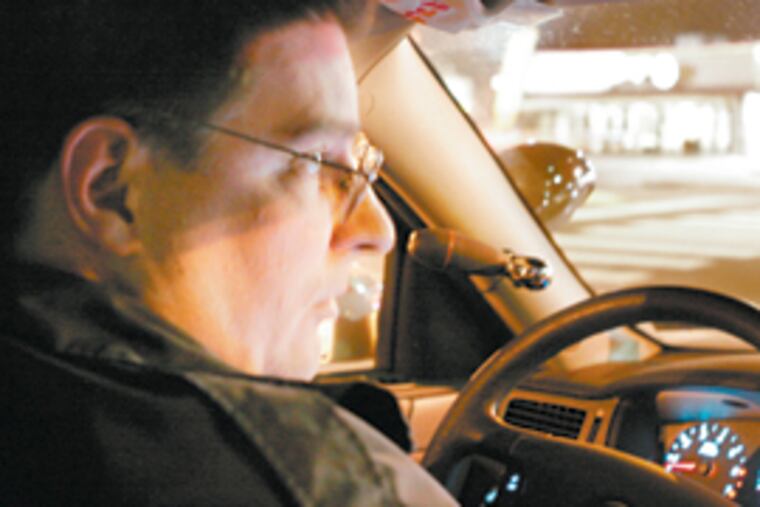
During a patrol last week in Olney, something about the two men on the sidewalk caught Officer Henry Schoch's eye as he drove down Godfrey Avenue.
It was the hands. Always watch their hands.
In an instant, Schoch swung a U-turn and cut off one of the men, who quickly pitched a small bag beneath a parked car. Then, while handcuffing him, the seven-year veteran radioed for backup to pursue the other man, who Schoch suspected had sold drugs.
In the two minutes a second patrol car took to arrive, the suspected seller ducked around a corner and then reappeared, pleading innocence. The officers found no evidence linking him to a drug sale, but he was arrested nevertheless, on an outstanding warrant.
"What took so long?" Schoch asked the backup officer. "He got rid of his stash."
The incident, Thursday evening in the 35th Police District, was a small example of what Schoch likes to do best - make arrests for offenses that detract from the "quality of life" of a neighborhood. The arrests also happen to be one of the critical elements of Police Commissioner Charles H. Ramsey's crime-fighting strategy.
The new commissioner aims to drive violent crime down 20 percent this year by focusing on fundamentals - shifting more officers from special units to basic patrol. A key tactic of the plan is to focus on quality-of-life issues - such as public intoxication, loitering and gambling - that sometimes escalate into violent crimes or drive law-abiding residents to move elsewhere.
By May 1, Ramsey wants to shift 200 officers into patrol units in nine of the city's hardest-hit districts, including the 35th, which runs along the city's border with Cheltenham. His plan was welcomed warmly at the district's headquarters, at Broad Street and Champlost Avenue.
"We're going to see more cops on the street, and that makes people feel more safe," said Capt. John E. McCloskey, commander of the 35th.
Encompassing 108,000 residents, the 35th is the third-most populous of the department's 23 police districts. Its 51/2 square miles cover all or parts of Olney, Logan, Fern Rock, Ogontz, and the three Oak Lane neighborhoods. McCloskey said his officers are stretched so thin that they have little time to pursue street-corner infractions. During busy periods, police are so overworked they sometimes take several hours to respond to lower-priority calls, such as automobile break-ins and burglaries.
"My officers now just go from job to job, running all over the district," said McCloskey, who has spent 14 of his 30 years on the force in the 35th.
When the new officers arrive, McCloskey hopes to cover the district around the clock with a dozen patrol cars and two wagons. Right now, he's fortunate to have seven cars on the street at a time.
He also hopes to double the four bicycle officers assigned to the district.
"I'm a big fan of bike patrols," McCloskey said. "The more cops on the street, the more information we get from the community."
Northwest Division Inspector Joe Sullivan said placing more officers on the streets would allow police to defuse volatile street-corner gatherings before violence breaks out.
"The idea is to get to the corners before the shootings start," said Sullivan, who supervises four districts, including the 35th and two others targeted by Ramsey for more attention.
Ramsey's plan, Sullivan said, is a "shot in the arm" for patrol officers, who statistically have the most dangerous job on the police force.
Officers in the 35th are acutely aware of the dangers of their work. Officer Chuck Cassidy, the gregarious patrolman fatally shot in October, worked in the district. His portrait is displayed at shrines throughout the district's offices. Sympathy cards fill a bulletin board across from the intake unit.
On Thursday, at roll call for the evening 4-to-12 shift, Lt. Bill DiGiuseppe addressed the 10 officers in one of the two squads on the streets that night. They were a young crew - half have a year or less as cops.
"It's been busy lately. We all know that," DiGiuseppe told them, running through a list of that day's orders. "Back each other up - make sure we come home. Be careful."
Schoch mounted up into car 354 - a beefed-up 2007 Chevrolet Impala with less than 20,000 miles on the odometer. Some of the district's vehicles are seven years old and have more than 150,000 miles, and Ramsey has promised to upgrade the fleet. Schoch (pronounced Shock) would be happy if the heater in his car worked.
Schoch, 34, a married father of two who lives in Fox Chase, said he had made four arrests in the previous days - three for drug violations, and one of a sidewalk vendor selling counterfeit DVDs.
He goes after any target of opportunity that presents itself in plain view.
"I concentrate on quality of life - have for some time," he said.
As Schoch patrolled the neighborhood, he looked for unusual behavior or groups on corners.
"Any time there's a large group of people, you have the potential for victims," he said. He was also on the lookout for pizza deliverers, who have been targets of recent robberies.
About an hour after he hit the road, driving east on Godfrey Avenue near Mascher Street while listening to the police radio and carrying on a conversation, Schoch jerked his head to the left. In seconds, he wheeled his car into a U-turn to intercept the drug transaction. The time was about 5:40.
"Come here," Schoch ordered the first man, who made a quick move away from the officer and tossed a wadded tissue under a parked car. Schoch forced him against his car. He told him to relax and extend his arms behind him for the handcuffs. The suspect, Ivory Jackson, 48, was still clutching a few dollars in his fist.
"I don't want to go through this again," said a bewildered Jackson, who wore a knit cap and an oversize coat.
After Schoch put the suspect into the back of the squad car, he explained what he had witnessed.
"Everything happens with your hands - a narcotics deal, a weapon. I couldn't even tell you what his face looks like. You watch the hands."
It's a small deal, a 1-gram bag of marijuana worth $10. A "dime bag" in the vernacular.
The suspected seller initially gave his name as Anwar Jackson. Using the mobile data terminal in his car, Officer Carmen Leva identified him as Anthony Jackson, 26, who was wanted on fraud charges.
A wagon was called to transport the two suspects to the district offices for processing.
At the station house, the alleged seller settled into a broken oak chair and fumed. At first professing his innocence - saying he was the victim of identity theft - he complained that the police should be targeting more serious crime.
"All I'm saying is that there's bigger stuff out there - murderers and rapists," he shouted. "I'm not a violent person."
In the nearby squad room, where he prepared the voluminous paperwork that accompanies every arrest, Schoch overheard the complaints.
"He's right," Schoch said out of Anthony Jackson's earshot. "There are more violent crimes going on out there."
An arrest in a minor drug deal underscores a continuing debate within law enforcement.
Some officers say the effort invested in making a case like this - Schoch and Leva spent two hours processing paperwork and evidence - removes officers from the street to hunt for worse offenders.
But Schoch said such arrests sent a strong message of intolerance for all crime. And it's impossible to say, until the arrest is made, when a minor stop might yield a bigger fish - somebody with a warrant for a violent crime, or somebody carrying an illegal weapon.
Sometimes these small arrests lead to information about bigger crimes, Schoch added.
"Some cops tell me I'm wasting my time with these arrests," he said. "I say I wouldn't want that stuff going on in my neighborhood."
For interactive maps of violent crime in 2007 in Philadelphia, plus previous coverage of the issue, go to: http://go.philly.
com/violenceEndText