Annette John-Hall: Cuba Libre? It's still just a hope
If restaurateur Barry Gutin had his way, Fidel Castro would be long gone, Cuba would be free and his ¡Oué Viva La Tradición! celebration would still be going on at Cuba Libre Restaurant & Rum Bar, Gutin's Old City ode to the forbidden island.
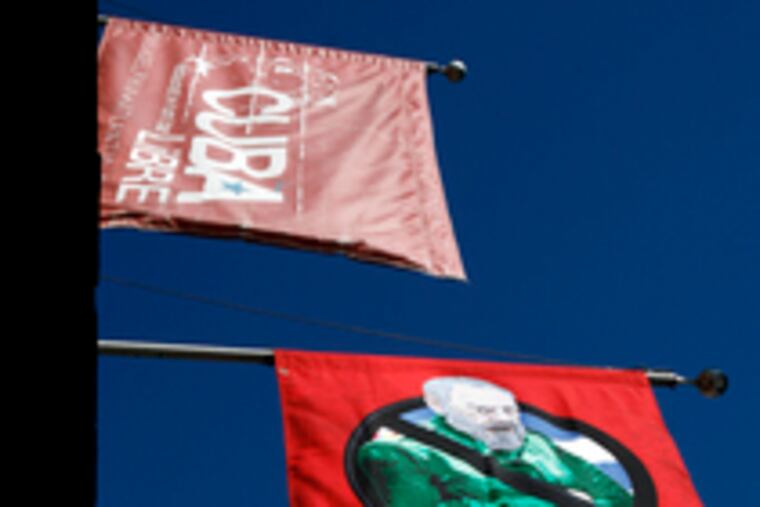
If restaurateur Barry Gutin had his way, Fidel Castro would be long gone, Cuba would be free and his
¡Oué Viva La Tradición!
celebration would still be going on at Cuba Libre Restaurant & Rum Bar, Gutin's Old City ode to the forbidden island.
Castro's obit may be written, but don't run it till he's dead.
Though the ailing 81-year-old dictator stepped down this week, his backup plan isn't exactly cause for celebration.
He officially handed down his unlimited power to dictator-in-waiting, 76-year-old little brother Raul, who's pretty much ruled Cuba since Castro took ill almost two years ago.
Yet it feels like political change is in the air, on the island as well as at home. But big news isn't automatically good news.
"This is a time when people are thinking a great deal about Cuba's future - a time to reflect about what might happen," says Gutin, 52, who is not Cuban but says that even as a kid growing up in the '60s, he was captivated by the richness of Cuban culture, so much so that he opened Cuba Libre eight years ago and another in Atlantic City.
Especially in the summer, his open-air restaurant evokes island heritage - Latin music filling the street while guests dine on fried plantain, seafood, rice and beans, and sip mint-filled mojitos.
You can almost imagine trade winds coming in off the Caribbean and Arturo Sandoval's trumpet wailing on the balcony.
Thousands have signed the Freedom Book at his restaurant, which Gutin started a year ago. He plans to deliver the book to the government when democracy arrives.
Close community
Philadelphia's Cuban community is a small but tight-knit group of professionals and working class, ranging from those who came over after Castro's takeover in 1959, to others who arrived in the 1980 Mariel Boatlift, to the newly immigrated. (Three sit on the board of the Hispanic Chamber of Commerce.)
The way Philadelphia architect Mario Zacharjasz (pronounced zack-a-RYE-is) sees it, the hope for his birthplace depends not only on a new Cuban government but on a more progressive U.S. response.
"What are we embargoing for? Who are we protecting?" asks the 48-year-old Zacharjasz, who has lived here since graduating from Temple over 20 years ago. "I don't think Cuba is a threat. The truth is, if our trade would have been open, it would have been the beginning of the end of Castro's regime."
Most on the island now were born long after the revolution. If trade had been been allowed, it would have given new insights to the world beyond, he says.
Zacharjasz's firm, PZ Architects L.L.C., designed the dreamy, open, colonial space that is Cuba Libre, based in part on his family's photographs. He has no personal memory of the island; his father, a well-to-do textile owner, fled with his family to Puerto Rico in 1960, when Mario was 2.
Carlos Eire remembers the Cuba of his youth all too well. The Yale professor and author, whose memoir, Waiting for Snow in Havana, was last year's One Book, One Philadelphia selection, doesn't believe that the shift from one Castro to another will have any positive effect on a people who are still oppressed, who live in abject poverty, and who still suffer color, yes, color discrimination.
"I tried to get across in my book [which is banned in Cuba] that Cubans are human beings, with the same hopes and aspirations. They long for the same kinds of rights and it's terrible to have that taken away from you.
"It's not like everything was pretty before the revolution," he says. "Cuba is just like the U.S. People are poor, there's crime and a corrupt government.
"But even with all its flaws, the U.S. is better than most other places in the world."
Eire and his brother were sent to Florida in 1962, when he was 11, his parents determined that their children would grow up free to speak their minds.
"I remember even the math problems were political," Eire recalls. "They would read, 'Before the glorious revolution Mr. So-and-So used to pay $30 to his scumbag landlord for rent.' I swear, it was like somebody trying to steal your soul."
Eire, who says he has no desire to see Cuba again, was the first to sign the Freedom Book at Cuba Libre.
In recent years, Zacharjasz and Gutin have traveled to Cuba on humanitarian missions. And each time they, like the Canadian and European tourists who flock there, see all of the island's promise - along with all of the despair.
Free medical care and free education aren't free when freedom of speech and freedom of choice are denied.
"It's a wonderful, wonderful culture with a lot of beautiful things. The music, the people, the art," Zacharjasz says. "It's like a missing piece to the puzzle of the Caribbean and South America. And it's a shame."
Annette John-Hall:
Go to http://go.philly.com/cuba for a slide show by Inquirer staff photographer Eric Mencher of photos that he has taken during five trips to Cuba since 1997.
EndText