Gathering to celebrate a dwindling culture
At Passover seders throughout the region last weekend, Jewish families gathered to retell the story of the Exodus from Egypt. Each generation keeps the story alive for the next.
At Passover seders throughout the region last weekend, Jewish families gathered to retell the story of the Exodus from Egypt. Each generation keeps the story alive for the next.
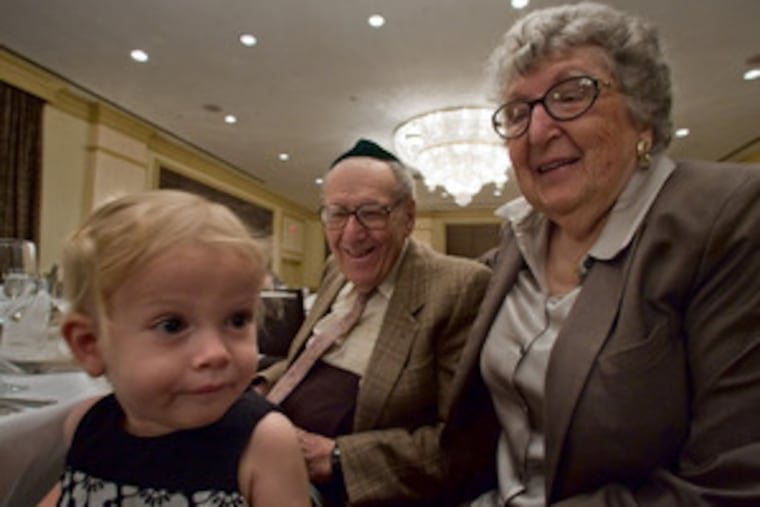
But for the family of Delcy Weinberg, 82, of Northeast Philadelphia, the seder has an additional significance. She is descended from a community of Turkish Jews whose native tongue, Ladino, is near extinction.
Nearly 100 of Weinberg's kin - some from as far as South Carolina and Florida - attended the family's 26th annual seder Sunday night at the Westin Hotel in Mount Laurel. All were members of the Hakim, Sady, Saul (Weinberg's maiden name) and Avayou families, who joined together to celebrate and preserve their distinct history with snatches of the Ladino language and melodies.
A blend of Hebrew and Spanish, Ladino is the language of Sephardic Jews - those who were expelled from Spain in 1492.
Only the 80-somethings in Weinberg's clan remember the old language, almost unknown today. Maurice Sady, Weinberg's cousin, who led the annual seder, recalls owning a Hagaddah printed in Hebrew with Ladino transliterations, but now the Passover seder is conducted mostly in English and Hebrew, with as many references and melodies as the older generation can remember in Ladino.
Sady remembers that his grandfather, as an elder in the community, was addressed as
señor
and older cousins were called
tio
, Spanish for
uncle,
as a sign of respect.
Sephardim, who made their way to countries such as Turkey and China, as well as to those in South America and the Caribbean, are in the minority in the United States, where most Jewish families are Ashkenazim - of German and Eastern European heritage.
Ashkenazic Jews blended Hebrew with the languages of those countries to develop Yiddish, while Sephardim blended Hebrew with Spanish to develop Ladino.
Unlike Yiddish, which gave us the linguistic gems
chutzpah
and
schlep,
no Ladino words found their way into modern English.
And while Jewish children can attend after-school classes to learn to pray in Hebrew or speak in Yiddish, children's classes in Ladino are almost unheard of.
"It's a dying language, unfortunately," says Weinberg, whose grandparents spoke Ladino at home. "I don't think there's anywhere you can send your children today to learn it."
As a substitute, Weinberg says, her children studied Spanish in high school and college. If you can understand Spanish, you can understand Ladino.
"I talk to Mexicans, I talk to Puerto Ricans," Weinberg says, "and they all understand me."
Weinberg's extended family traces its American roots from David Avayou, who left the coastal city of Izmir in Turkey and resettled in another coastal resort, Atlantic City, in 1904.
Norman Avayou, at 82 years the youngest of David Avayou's children, helps organize the annual seder. He says his father returned to Izmir briefly in 1906 to find a bride and later brought most of her family from Turkey to Atlantic City, too.
"The sea air and the promenade along the shore may have been the reason David Avayou picked Atlantic City," says nephew Maurice Sady, 84, of Mount Laurel, who leads the seder service, making certain to introduce as many Ladino references as possible.
The Sady and Avayou families founded Congregation Shaareh Zion in Atlantic City in 1920 and a Jewish cemetery in nearby Pleasantville a few years later. The synagogue closed in 1980, but the Avayou/Saul/Sady clan still schedules an annual bus trip to the cemetery every fall, just before the Jewish High Holy Days.
In the small, tight Sephardic community of Atlantic City, Sady says, men and women had to marry Ashkenazic Jews in order to avoid marrying cousins. So roughly half of those who attend the annual seder are Ashkenazic, and most do not know any Ladino.
"We may be the last generation to speak Ladino," Norman Avayou says.
Philadelphia's only Sephardic synagogue, Mikveh Israel, founded in 1740, owns a Torah donated by the Sady family.
One more thing, Weinberg notes with pride: Sephardic cooking is distinct (better, she hints) from Ashkenazic.
"We never made gefilte fish," she says, turning up her nose at the hard-to-fathom chopped-carp dish so routinely served as an appetizer at Ashkenazic Passover seders that some people think it's as mandatory as matzo.
"In our family," she says, "we made flounder Francaise."