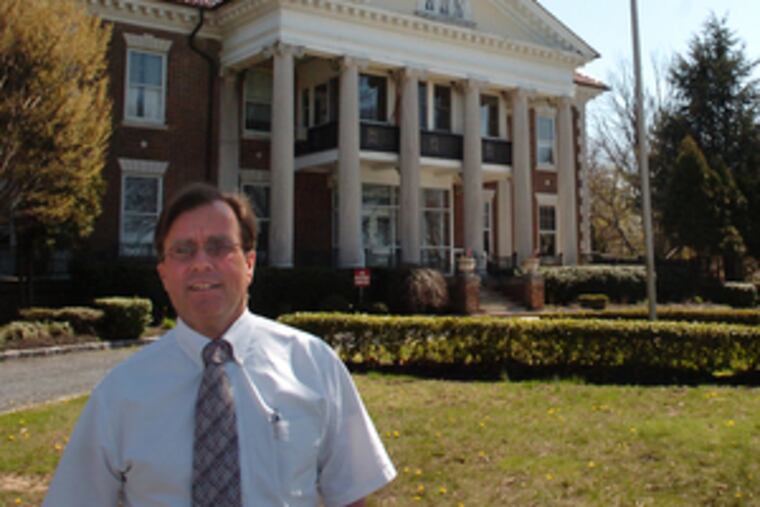
Struck by her beauty but ultimately unfit to commit, the many suitors who have expressed interest in the century-old mansion on the Delaware River in Delanco have time and again proved to be rakes.
There was the cheap man who offered just $7. There was the rich man who would have taken it - but for the fact that the river was too shallow to dock his yacht. There was the potential swindler whose business address was found to be a vacant lot in North Philadelphia. And there were the guys who abruptly backed out after months of talks.
Delanco purchased the Zurbrugg mansion for $2.1 million in 2005 after local officials won a legal battle to prevent it from being converted into a state-licensed home for troubled youths. Though residents generally applauded the purchase at the time, the mansion quickly became a burden when Delanco's plans for it collapsed and it began sucking thousands of taxpayer dollars for maintenance and repairs.
Distinguished for its Georgian-style architecture and six two-story columns, the mansion over time took on the role of a beautiful but burdensome daughter. Delanco has blown through more than $200,000 to support the stately home, and now, in a tough budget year, officials hope the latest suitor proves worthy.
On April 14, the Township Committee approved a redevelopment agreement with Zurbrugg Partners L.L.C. that would convert the mansion into apartments for senior citizens and result in the construction of townhomes on the grounds. Aspects of the deal still require approval in the next few weeks from the township's Joint Land Use Board and a state Superior Court judge, which Mayor Fern Ouellette described as about 50 percent likely.
Tim Dunn, a retiree who lives directly behind the mansion on Second Street, has had a front-row seat to what he described as a horror show.
"We don't get our streets cleaned," he said. "They're neglecting everything in the town to take care of this place."
The three-story mansion, at 531 Delaware Ave., was built in 1910 by Theophilus Zurbrugg, a native of Switzerland who founded the Keystone Watch Case Co. He commissioned renowned Philadelphia architect Frank Furness to design the home and imported the granite columns and roof tiles from Europe.
Delanco has long had a love affair with the mansion, which has 24 rooms and was last used as an assisted-living home. The township has arranged summer concerts on its expansive lawn, and in the winter the mansion was the starting point for horse carriage rides.
The saga began the day before Christmas Eve in 2004, when a fax arrived as the municipal building was preparing to close. To the surprise of everyone, Capital Academy, which had an application pending before the Joint Land Use Board, announced in the fax that it was taking the mansion from its financially distressed owner and would convert it into a rehabilitation center for troubled youths.
Doug Heinold, the township solicitor, stayed up past midnight drafting papers for an emergency injunction, which a judge granted Christmas Eve. A group of residents - including Ouellette, who was not yet mayor - ended up raising $65,000 for an attorney who fended off the sale.
"The residents in this town went berserk," recalled Kate Fitzpatrick, who was mayor at the time.
Things went awry almost immediately. Plans to keep the three-acre property for various community and government uses proved unfeasible. Once officials realized in 2006 that they had best sell it, the housing market was beginning to slow. They pressed ahead, paying a consultant $15,000 to mount a marketing campaign to promote the sale.
Advertisements ran in the Wall Street Journal. Glossy brochures advertising the township's request for proposals to redevelop the property were mailed near and far, featuring a large photo of the mansion and the slogan, "Bring your ideas; build your dreams."
Steven Corcoran, the township administrator, estimates he gave at least 100 tours. But the day of reckoning came, he said, when Delanco received only six proposals despite the marketing effort.
"Uh-oh," Corcoran said he remembered thinking. "They're not beating the door down."
The only serious proposal, which would have converted the mansion into a bed-and-breakfast and constructed townhouses, failed after the developer, J2 Associates, commissioned a study that questioned the feasibility of the project.
Ouellette, sitting on the front steps of the mansion after giving a tour, said he was shocked and disappointed when the deal fell through. Meanwhile, township officials had staked their hopes so high on a sale that they had allowed maintenance to lapse for four months.
The problems were not over. At one point, the mayor ran into an elderly man in town who used to fill oil tanks for a living.
"Did they take care of the oil tanks?" the man asked, referring to those at the mansion.
"What oil tanks?" replied the mayor.
Add $8,000 to remove buried oil tanks to the tab, which also included $20,000 to clean mold found in the basement, $8,000 to fix a leaky roof, and $60,000 a year for maintenance and utilities on top of the initial legal bills, Corcoran said.
Under the redevelopment agreement, Zurbrugg Partners would build eight townhomes priced between $400,000 and $500,000. It also would expand the mansion to accommodate senior apartments that would satisfy the state's municipal affordable-housing requirements.
The builder of the River's Edge development in Delanco is seeking to transfer affordable-housing units required by the state to Zurbrugg Partners because River's Edge was unsuccessful in marketing them, Ouellette said.
"It's not as fairy tale as it sounds," Henry Kent-Smith, an attorney for Zurbrugg Partners, said of the pending deal. "It's more a fortuitous circumstance of one person's adversity being another person's opportunity."
The agreement with Ryan Homes, the builder, hinges on approval by Superior Court Judge John Sweeney to transfer the affordable-housing units, the mayor said. The closing of the sale, if approved, is set for June.
Zurbrugg Partners would pay Delanco $1.8 million for the mansion, nearly $300,000 less than the township's purchase price, and $12,500 for each townhouse sold. An additional $1.2 million in financing would come from Ryan Homes, Kent-Smith said.
Mike Templeton, the only one of the five Township Committee members to vote against the agreement, criticized it for being too low-risk for Zurbrugg Partners, saying the company would have to put up only $450,000 of its own cash. He also objected to having deal hinge on the transfer of affordable-housing units.
"The township gets the hole in the doughnut, and the developer gets the doughnut," said Templeton, who was involved in the initial campaign to prevent the mansion from going to Capital Academy.
But resident Kathleen Melke, who was a receptionist and activities coordinator at the mansion when it was an assisted-living home, said she was happy it would revert to its previous use because "that's what it's kind of meant to be."
The township's quest for a suitor has been so taxing that some will remain skeptical until the sale papers are signed.
Of the impending sale, Dunn, the mansion neighbor, said: "I'll believe it when I see it."