Honoring a strong voice against hatred
Barry Morrison listened with a modest smile last week as one speaker after another extolled his "courage" and "passion" and "integrity."
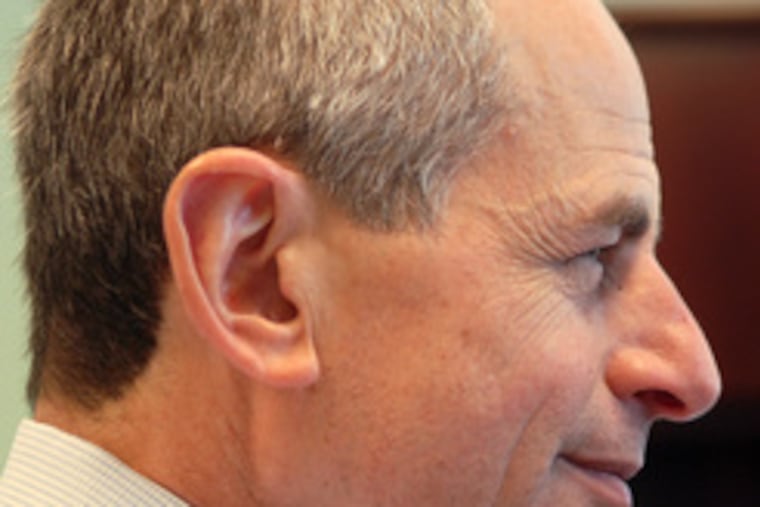
Barry Morrison listened with a modest smile last week as one speaker after another extolled his "courage" and "passion" and "integrity."
"He is a hero," Mayor Nutter told the audience of 500 at the Crystal Tea Room.
"I love you, Barry, for being my friend," said an emotional Tom Martinez, a former "white supremacist from Kensington."
It sounded like a farewell party, but no. Morrison, executive director of the regional Anti-Defamation League, was celebrating his 30th anniversary at the ADL and has no plans to leave soon.
"I found my world at ADL," Morrison told the crowd, which gave him a standing ovation Tuesday evening.
The next morning, he was back at his Center City office, striving as ever to douse embers of racism and intolerance before they catch fire.
Founded in 1913 as the Jewish Anti-Defamation League, the ADL today combats prejudice of all kinds - ethnic, religious, gender - while still keeping an eye on anti-Semitism and what it deems unfair criticism of Israel.
Morrison's first order of business Wednesday morning was a call about an area Christian group that recently compared Israel's treatment of Palestinians to the Nazis' treatment of Jews and to South Africa under apartheid.
"I'd rather not say who it is," Morrison said in an interview later. "I prefer going directly to the parties before going to the press."
He paused, then smiled.
"Of course, if we get no results, then we might want to go public."
It is this brand of gentle, behind-the-scenes firmness that has made Morrison, 59, a major force in combating ethnic and religious hostility, say his admirers, who credit him with greatly broadening his office's scope.
Patrick L. Meehan, U.S. attorney for the Eastern District of Pennsylvania, recalled watching Morrison arrive at the scene of a cross-burning or of distribution of hate literature and quickly impress on municipal officials the need to respond because "these were emotional and psychological assaults on a community."
Yet so many of Morrison's efforts have been out of the public eye that even his admirers at last week's banquet found it a challenge identifying his successes.
"How do you measure an incident that didn't happen?" wondered ADL board member Joe Goldblum.
But then speakers recalled how, when Morrison was head of ADL's Chicago office around 1990, he stood alone before the Chicago City Council and urged it not to rename a major boulevard after Elijah Muhammad, a founder of the Nation of Islam and a bitter critic of Jews.
They also cited his creation of the "No Place for Hate" program, now in 130 school districts, which seeks to reduce bullying, name-calling and intolerance.
"He sets the standard for regional directors all across the country," Glen Lowry, ADL's national chairman, told the audience.
Growing up in Brooklyn, the son of secular Jews from Palestine, Morrison had no reason to suppose he would one day be a champion of oppressed minorities - he had no sense of even being in a minority.
"When you stepped out your door, everything around you was Jewish," he recalled.
His first adult job was as an elementary school teacher in Bedford-Stuyvesant, one of New York's poorest and toughest neighborhoods.
"My approach was an 'iron fist in a velvet glove,' " Morrison said. He gradually imposed order and social skills on children no one else wanted by "showing them an adult cared about them."
In the process, he discovered "that I like working in adversarial conditions," he said. "I really do."
He showed no particular interest in the ADL - then an agency of B'nai B'rith - until 1978, when a uniformed neo-Nazi group announced plans to march and wave swastikas in Skokie, Ill., home to many Holocaust survivors.
"These were people who had lost their families to real Nazis," Morrison recalled, "and they had vowed 'never again.' "
The ADL's Chicago office successfully petitioned the courts to halt the march but soon found itself toe-to-toe with the equally determined American Civil Liberties Union, which insisted that even neo-Nazis had a right to free speech.
Both sides claimed victory when the courts ruled the Skokie march could proceed, only to see the neo-Nazis take it to Chicago instead.
"I was impressed," recalled Morrison, who joined the ADL that year. He served as assistant or executive director in the New Jersey, Nebraska, Philadelphia and Chicago offices before returning to Philadelphia for good in 1992.
With no plans to retire any time soon, Morrison said he would like nothing better than to "create some sort of vehicle - call it a clearinghouse, call it a forum" - that could publicly examine controversies related to race, religion and civil rights.
"There's a lot of ignorance on Islam. And look at the storm over Rev. [Jeremiah] Wright," he said, referring to the provocative remarks by Sen. Barack Obama's pastor.
"There's a lot still to do."