Trust offers advice to keep lands natural
Do not assume that nature will take care of itself. Untended, a pond can deteriorate from an inviting habitat for ducks and bullfrogs into an ugly brew of algae and bacteria. A neglected meadow can be quickly overrun by Canada thistle, Oriental bittersweet, or other invasive plants that choke out native growth and repel many birds.
Do not assume that nature will take care of itself.
Untended, a pond can deteriorate from an inviting habitat for ducks and bullfrogs into an ugly brew of algae and bacteria. A neglected meadow can be quickly overrun by Canada thistle, Oriental bittersweet, or other invasive plants that choke out native growth and repel many birds.
The physical and fiscal challenges of environmental housekeeping are looming ever larger in the region as communities rapidly amass open space. In the last 20 years, towns have issued more than $300 million in bonds and raised an estimated $109 million in new taxes to buy and preserve more than 52,000 acres in Bucks, Burlington, Camden, Chester, Delaware, Gloucester and Montgomery Counties.
To help ensure the maintenance of protected acreage, Natural Lands Trust in Media - the region's leading nonprofit land conservator - has opened a center to advise municipalities, institutions, and individual property owners who have put their land off limits to development.
The Center for Conservation Landowners aims to elevate open-space management to "a community priority," said Molly Morrison, the trust's executive director. "No management is really mismanagement."
A stewardship service is a natural next step in the local open-space movement, Morrison said, and the 45-year-old agency is uniquely qualified to lead the way. Natural Lands Trust has helped protect more than 130,000 acres in eastern Pennsylvania and South Jersey - an area the size of Delaware County - and operates 44 preserves totaling more than 20,000 acres.
The center is funded with $340,000 in grants from Pennsylvania's Department of Conservation and Natural Resources, the William Penn Foundation, and the McLean Contributionship, a Bryn Mawr foundation that promotes environmental awareness.
Some services will be free, such as educational material on the center's Web site, www.conservationlandowners.org.
But the heart of its work - inventories of properties' flora and fauna, maintenance regimens, and on-site monitoring - will carry fees ranging from several hundred to tens of thousands of dollars, depending on a tract's size and complexity.
Haverford Township is one of the first clients. In 2001, the Delaware County community bought the former Haverford State Hospital's 209-acre campus for $3.5 million. Forty acres have been sold to developers for a 300-unit upscale complex of condominiums and townhouses, and 45 acres have been set aside for ball fields. The remaining 124 are being preserved for passive recreation.
The township has yet to figure out what form that will take, said Commissioner Jan Marie Rushforth, whose home backs up to the site - a mix of forest and grassland crossed by three streams.
Should there be hiking trails? If so, where? Should the deer herd be thinned? How pervasive are invasive plants?
"We're in the process of figuring out what we have," Rushforth said, and "what's special about it."
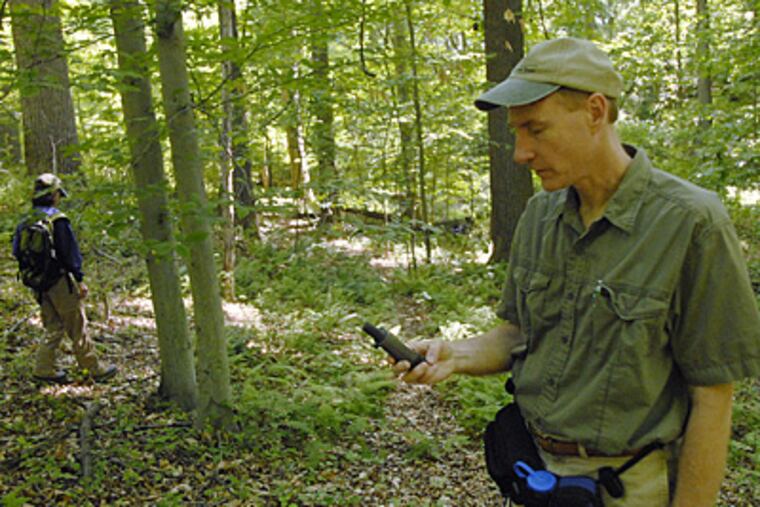
For $33,000, the center is conducting a yearlong assessment. One morning this month, Andrea Stevens, the center's director, and David Steckel, senior stewardship planner, inspected the parcel.
To the accompaniment of a pileated woodpecker's hammering and the whoosh of traffic on nearby I-476, the pair jotted notes and took photos as they trudged through forest underbrush.
They gathered samples of unfamiliar plants for further analysis back at the office.
Some of what they saw was "good" growth, they said. But there was plenty of "bad." In just one three-square-foot patch of forest, Steckel pointed out five invasive plants: garlic mustard, Oriental bittersweet, multiflora rose, privet and Japanese honeysuckle.
Close by, Oriental bittersweet climbed a tree. Although its orange berries are a delight to birds, the vine so weakens trees that they topple easily in wind and ice storms.
In what ideally should have been open grassland, invasive Scotch pine sprouted - off-putting for indigo bunting and other birds that would otherwise thrive there.
"People see an area like this, see it's green, and say, 'What's the problem?' " Steckel said.
While open-space management has its costs, there also are savings, Stevens said. For instance, converting a field from standard turf grass to a meadow could save a municipality the expense of mowing. Meadows need to be cut twice a year at most, Stevens said.
The center already is generating enthusiasm in conservationist circles. Its opening has gladdened Dulcie Flaharty, director of Montgomery County Lands Trust, a small, 15-year-old nonprofit that has worked with Natural Lands Trust on conservation deals.
The center will be most useful, Flaharty said, if it remains mindful of communities' strained budgets and gives them "a menu" of stewardship options.
"I don't want anyone to be so burdened," she said, that they would "have to lay off police to have open space."