Solar-powered trash units get trial run in Phila.
City leaders cut the ribbon on a new solar-powered trash receptacle yesterday and then, appropriately, threw the ribbon away. The ribbon-cutting in Center City came during the unveiling of the BigBelly, a trash receptacle and compactor that can store four times the volume of ordinary litter baskets and cut fuel use and greenhouse emissions from trash collection by 80 percent.
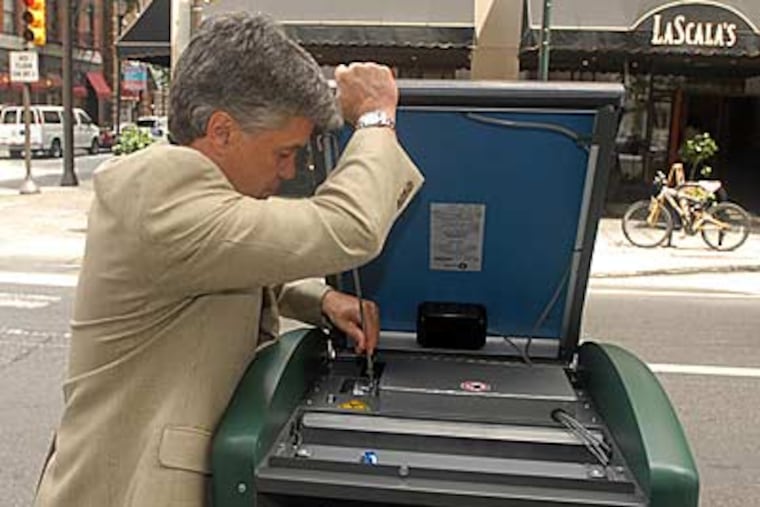
City leaders cut the ribbon on a new solar-powered trash receptacle yesterday and then, appropriately, threw the ribbon away.
The ribbon-cutting in Center City came during the unveiling of the BigBelly, a trash receptacle and compactor that can store four times the volume of ordinary litter baskets and cut fuel use and greenhouse emissions from trash collection by 80 percent.
To top it all off, the waste container can run daily on the amount of energy needed to toast a slice of bread.
"They require less energy, which means potentially they're a lot more cost-effective," said Paul R. Levy, president and chief executive officer of the Center City District.
The receptacles are being tested in 30-day trials at three locations in Center City: Seventh and Chestnut Streets, Broad and Walnut, and 18th and Walnut.
If the trials show an increase in cost- and energy-efficiency, the city would "be interested in doing a larger purchase" from the manufacturer, Streets Commissioner Clarena I.W. Tolson said. "We're looking forward to a successful [trial period]. We think this is going to be a winner."
The garbage accumulated inside the unit gets compacted when internal sensors detect that the receptacle is full. It doesn't require direct sunlight, and its 12-volt solar battery can last three weeks without recharging, said Rick Gaudette, vice president of sales for BigBelly Solar, the Massachusetts company that invented the device in 2004.
Different and older models have already been in use in other parts of the city, including the campuses of Drexel University and the University of Pennsylvania. The receptacles are also common in cities such as Baltimore, Boston, and Sacramento, Calif.
Tolson said the BigBelly is more proof that the city government is serious about going green. Yesterday's unveiling came after Monday's announcement that single-stream recycling is now available throughout the city.
The receptacles "should be something really quite great for our city," Tolson said, "in terms of litter prevention, in terms of sustainability, in terms of all our focusing on the environment."