Pa. legislative workers arraigned on conspiracy charges
HARRISBURG - The man who walked into a cramped Harrisburg courtroom yesterday to be arraigned on a raft of political corruption charges bore none of the signs of power he once wielded from his fifth floor office in the Capitol.
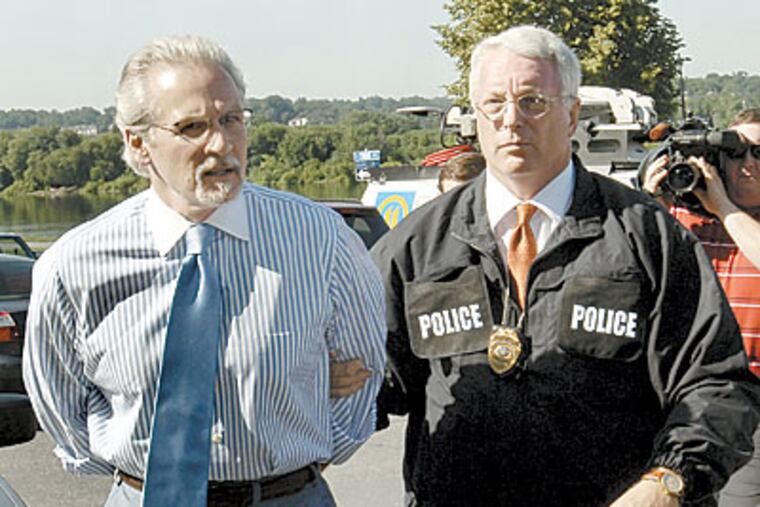
HARRISBURG - The man who walked into a cramped Harrisburg courtroom yesterday to be arraigned on a raft of political corruption charges bore none of the signs of power he once wielded from his fifth floor office in the Capitol.
Former House Democratic Whip Michael Veon was grim and quiet as he was led into the courthouse by state law enforcement agents. His hands were cuffed behind his back. And his legs trembled slightly as he faced District Judge Joseph S. Solomon and heard the charges against him. Conspiracy. Conflict of interest. Theft of services. Theft by deception.
Before the day was over, Veon and nearly a dozen other defendants had been formally charged with misusing public funds, and were left to await their fate in one of the state's largest public corruption cases in recent memory. The charges were announced Thursday by state Attorney General Tom Corbett's office.
Prosecutors allege that Veon, once the second-highest-ranking Democrat in the House, used his power and position to mastermind a massive scheme to use taxpayer money and resources for political campaigns, including his own.
Those staffers were often rewarded with generous bonuses paid for with public dollars.
"Our investigation uncovered the illegal use of millions of dollars in taxpayers' funds, resources, and state employees for political campaign purposes," said Corbett.
Veon's attorney, Robert Del Greco, has said his client plans to fight the charges.
And those charges are extensive. Corbett's indictments describe how Veon and 11 others allegedly ran a well-oiled, tightly-organized political operation out of his Capitol suite and his district office in Beaver County. The scheme is said to have involved hundreds of legislative workers on the House Democrats' payroll who did everything from stuffing envelopes to running campaign phone banks out of government offices.
Most of the 12 defendants in the case were arraigned yesterday morning, including Michael Manzo, the former chief of staff to House Majority Leader Bill DeWeese. Manzo is charged with, among other things, creating a "ghost" job for a 21-year-old graduate student with whom he was having a fling.
Manzo had to post $10,000 bail in cash, which his wife, Rachel, brought to the courthouse mostly in $20 bills. Rachel Manzo also is charged in the case, allegedly having participated in the conspiracy.
Here is how prosecutors say the conspiracy worked:
When new employees were hired onto Veon's legislative staff, they were told that campaign work would be part of the job.
When they did such work, it was expected - and accepted - that it would be done on government time. At least throughout 2004 and 2005, legislative employees frequently didn't take compensatory time or other paid or unpaid leave to perform political duties, the charges state.
Employees were urged, sometimes even browbeaten, into working on campaigns, according to the charges.
They describe how Veon's former chief of staff, Jeff Foreman, would move from desk to desk asking each employee to "volunteer" for campaign work.
One former employee who testified before the grand jury described how she dreaded Foreman's approach, and envisioned him as the Grim Reaper "spreading sorrow by asking employees to give up portions of their lives," according to court papers.
Another Veon employee allegedly cried when Foreman asked her to volunteer for campaign work one year, because she knew she would miss spending Halloween with her young son.
The pressure to work on campaigns was not limited to Veon's office. Staffers in the House Democratic caucus routinely were asked to do political work, according to the charges.
Much of the work was done on government time, using government printers, faxes, phones, computers - even paper and envelopes. Staffers were usually not required to take leave or even take care to separate their campaign duties from their government ones, the charges state.
Until 2006, that is.
That was the year that many incumbent lawmakers, including Veon, were up for reelection and still dealing with the fallout from 2005's unpopular legislative pay raise.
Foreman, also charged, explained to staffers that Veon was "under a lot of scrutiny," and that they needed to be more careful taking comp time when doing political work, the court papers state.
So staffers were kept at work late on legislative days - though they had nothing to do - to artificially build up comp time.
"Thus Veon had at his disposal a stockpile of political campaign workers, paid for by the taxpayers," the charges read.
Nonetheless, Veon lost. Soon after, he opened a lobbying and consulting firm in Harrisburg with which he is no longer affiliated.
At the courthouse yesterday, Veon was asked by reporters whether he had anything to say to taxpayers about the allegations against him.
Initially, he was mute. But as he briskly walked away, he said he intended to do so at "another time, another place."