Not-fun in the summertime is no hit with college officials
Some would rather see personal growth than prep camps, classes.
Zachary Fox considered a typical teenage summer of carefree fun, but then he had a realization - that wouldn't get him anywhere.
"I wanted to do something valuable before I go to high school," said Fox, 14, who lives in Berwyn and will soon enter Conestoga High. "I really got my priorities together. I didn't want to be sitting around."
For many hyper-scheduled, ultracompetitive teens, gone are the days of scooping ice cream and lying on beaches. Summers are for biological anthropology and heavy SAT prep, making contacts and getting an edge on an Ivy League application.
Business is booming for get-into-college camps and other enrichment programs across the nation and in the area, where students are shadowing doctors, delving into international relations, and cultivating A-list references.
The trend toward precollege achievement is, in fact, so pronounced that it has produced a backlash, with admissions officials and child psychologists wondering if such intensity is good for children.
In a paper aimed at prospective students, three Harvard University officials beseeched youngsters to "bring summer back."
"Students need ample free time to reflect, to re-create . . . and to gather strength for the school year ahead," they wrote.
Marlyn McGrath, Harvard's director of admissions, said some students' compulsion to spend the summer polishing resumes might not help them.
"We have no evidence in Harvard admissions decisions over time that shows a consistent favorable judgment on packaged summer programs," she said. "You could just be a lifeguard, or spend a whole month reading Dostoyevsky, or visit your grandparents. All of those things are so rich in human terms."
Indeed, admissions officers and child psychiatrists warn that activities designed only to bolster a teen's credentials are problematic at best, unhealthy at worst.
Jeannie Borin, president of College Connections, a college-admissions counseling firm in Los Angeles, said that teens needed to know how to find balance, and that enrichment impressed only if it matched a student's genuine interests.
By the same token, Borin said, ambitious students need to do more over the summer than play video games.
"GPA and test scores are no longer sufficient no matter how high they are," she said. "Colleges are looking for standout features."
Fox, the Berwyn teen, settled on a business camp at Haverford College. On a recent day, the gregarious boy said he figured studying venture capitalism and stocks at a Julian Krinsky enrichment program would give him a jump on his future career.
Down the wide wooden table from Fox, Sonny Gindi, a 16-year-old from Brooklyn, N.Y., said he wasn't big on school, but was big on achieving and soaking up all he could during the summer so he'd be ready for college.
"I just don't think subjects I take in school will help me in life," said Gindi, fresh from quizzing developer Bart Blatstein, a class speaker, on real estate strategies.
The University of Pennsylvania's dean of admissions, Eric J. Furda, is all for horizon-broadening, but said he wanted students who know how to relax.
"People shouldn't feel that this is another box they need to check - 'Summer experience, check, I did that, now how does it look on my application?' " Furda said. He looks for motivation - what a student gets out of a program and how he or she articulates it.
Fancy summer pursuits are by no means a must, he said.
Still, parents are clamoring for them, said Wil Burns-Garcia, director of residential life at Summer Discovery at Penn. In that four- or six-week program, students from around the world take classes for credit or pursue noncredit courses in subjects such as physics and forensics.
Parents "cross their fingers and hope a rigorous program at Penn will get their kids a leg up on acceptance to Penn or a school like it," Burns-Garcia said. Summer Discovery programs, held all over the country, have gained in popularity every year, he said.
Years ago, Julian Krinsky camps focused on sports. Now an internship camp promises "important references for college," there's a model United Nations program, and a precollege program at Princeton University allows students to declare majors.
"The kind of kids we get, the Ivy League kids, they're not sitting by pools," said Tina Krinsky, the company's director of marketing.
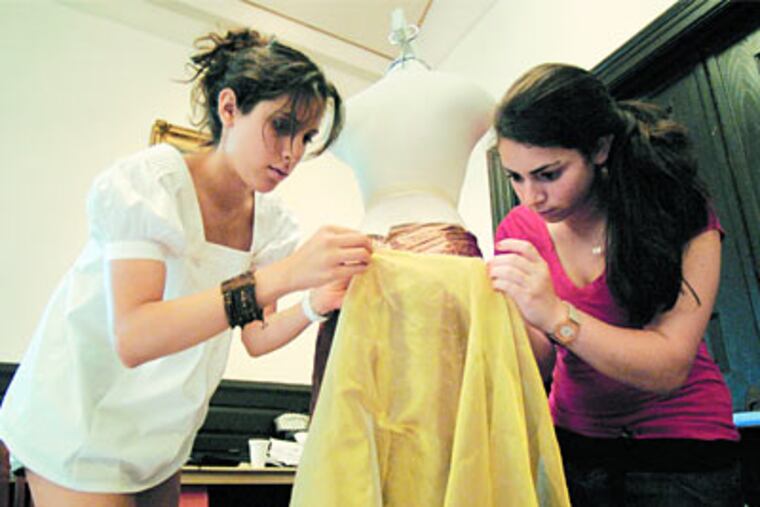
The company's camps do offer such pursuits as dance, art and yoga. ("When they do yoga, they retain knowledge better. They stress less," Krinsky said.) But teens as young as 14 can also narrow their focus and pick majors, including business or fashion design.
"You can't play around until you're 30 anymore. You've got to get on track. These students are on their career paths already," Krinsky said.
Programs throughout the region and around the world offer opportunities for students looking to achieve. You can enroll in A+ Summer Camp at Stanford University, shadow doctors at the Drexel University Medical School, or perfect your French in Paris.
Entry fees for many programs are steep; Krinsky prices, for example, range from about $1,000 for one week for a day student to more than $12,000 for a residential student staying eight weeks.
Achievement is fine, said Eileen Bazelon, a local child and adolescent psychiatrist, but students also need balance and time to explore.
Whether such pursuits are healthy "depends," Bazelon said. "Is it just a means to an end as opposed to, God forbid, learning something? It needs to be done in the right context, like taking general college chemistry to see if you're really interested in science, not just to pad your resume."
Bazelon takes issue with parents who push students "just so they can get into the right school. If that's the attitude, once kids arrive at college they don't understand they're there to learn something and enrich themselves."
That's not her, Cherry Hill teen Marie Smithgall said.
Today, Smithgall, 17, heads to Drew University for three weeks at the prestigious Governor's School for science.
Smithgall, a senior at Cherry Hill High School East, is an old hand at summer enrichment. She joined the Johns Hopkins Center for Talented Youth program as a middle schooler and has been busy ever since - online courses, programs on human nature and technology at Princeton, a forum on leadership and medicine.
"It looks good on applications, but I'm not doing it just for that," said Smithgall, who is also going on a family vacation to Mexico and practicing with East's marching band. "It's not just a line on a resume. It's giving me an insight on what I want to do with my life."
Lincoln Bitting, a senior at Central Bucks East, is devoting much of his summer to heavy SAT prep. His college short list includes the University of Virginia, Clemson University, and Penn, and his first SAT score - 1,800 - needs a boost, he thinks. "My grades are good, but colleges really look at SATs," said Bitting, 17, who lives in Plumstead Township. "I work so hard in school, and I don't want to nullify my chances, so I'm working hard this summer, too."
Bitting is taking a Princeton Review course, spending six hours a week in class, and devoting probably double that to homework. He has more college visits scheduled this summer but hasn't found a job yet, so the work fits his schedule.
"It's pretty intense," he said.
Bitting's mother, Duane, suggested her driven son take the course.
"I want what's best for him, and I thought it would help alleviate stress," she said. "He'll feel more prepared."
Like her son, she is fretting over college admissions, and said she felt that a summer spent studying for the SAT would give him an edge.
"It's just scary," she said. "There's so much competition and pressure for these kids. We've heard so much about how hard it's going to be to get into the school you want."
But while Lincoln Bitting's pressure is self-imposed, Christin Lee, a 16-year-old from Great Neck, N.Y., feels different. She's spending six weeks at the Summer Discovery program at Penn, taking courses for credit.
"My parents forced me to do this," Lee said, pulling her rhinestone-festooned baseball cap low. "But I didn't say no. I want to challenge myself with college courses."
Lee plans to make good use of her time, preparing for the SAT and writing her college essays, for Penn and other Ivies.
"That's what my parents have in store for me," Lee said, shrugging and heading off to study.
More on Summer Enrichment
Eric J. Furda, dean of admissions at the University of Pennsylvania, says summer enrichment need not cost a lot. Here are some of his suggestions for ways students can broaden their horizons:
Get a summer job. "Showing up at work on time and being accountable is really important," Furda says. "In some ways, it's even harder than what you'll do at school... ."
Make a reading list. Tackle books you have always wanted to read without the pressure of writing papers and worrying about grades.
Bone up on science. Check out exhibits at the Academy of Natural Sciences, the Franklin Institute, or other local spots.
Learn about art. "You don't have to go to Europe to see masterpieces of Renaissance art. There are plenty at the Philadelphia Museum of Art."
Three Harvard University officials, including the longtime dean of admissions, make a case "for taking summer back" at www.admissions.college.
harvard.edu/prospective/
applying/time_off/
timeoff.html.
SOURCE: University of Pennsylvania; Harvard University
EndText