Cecil B. Moore rec center proudly holds on
On a sun-soaked afternoon at North Philadelphia's Cecil B. Moore Recreation Center, a lone kid pumps his legs and flies high on the swing.
On a sun-soaked afternoon at North Philadelphia's Cecil B. Moore Recreation Center, a lone kid pumps his legs and flies high on the swing.
The basketball court, a patch of steamy concrete, is deserted. Nearby, two boys walk their pit bulls, one off the leash, across dry patches of grass. A mature couple sit on a bench, close, waiting for a breeze, while a van on the street blasts the immortal words of Tupac Shakur.
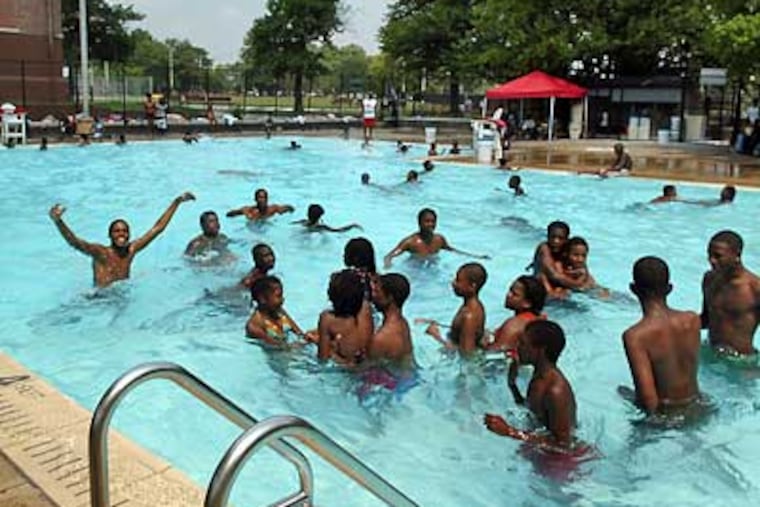
The center's pool is the main attraction. There, the lifeguard, enduring his seventh summer, is perched on his tower, while dozens of eager kids line the pool, quietly waiting.
For generations, recreation centers have served as a haven, a second home, where confidences were built, friendships sealed, and lifelong memories born.
The movement started in the early 20th century, mostly with summer sports for idle boys. By the 1950s, programs expanded to entire families.
Today, some of the city's recreation centers seemingly offer everything, while others crumble from neglect. In the last five years, the city has lost three.
Yet for better or for worse, the kids still come.
On any given day, throughout the city, you find boys running the court, drumming the ball onto the concrete, their shirts dripping with sweat.
You hear the crack of a bat, the tap dancing of a double-Dutch rope, the swoosh of a tennis racket, and the wild laughter.
On this sticky day at Cecil B. Moore, at 22d Street and Lehigh Avenue, the lifeguard soon blows his whistle and goes over the rules. The swimmers yell them back, in call and response.
No running. No diving. No pushing. No potty in the pool.
The lifeguard blows the whistle again, and the kids erupt in squeals and splash into the cool, blue-tinted water.
Not long ago, the sprawling, 84-year-old Cecil B. Moore recreation center was slated for closing - a grim prospect in a neighborhood battling poverty, blight, drugs and gunshots.
In 2004, to fill a projected budget gap, the city threatened to close, sell or transfer 20 of its 82 pools and 33 of its 162 rec centers.
For Cecil B. Moore, members of the community rallied.
They stood in the middle of 22d Street and blocked traffic to show their need and commitment.
The needs were great: a cracked court, missing swings, peeling paint, a shoddy roof, piling trash, homeless men sleeping on benches, community indifference.
With a new manager, new advisory council, and donations of time and money coming in, the center is showing promise.
"It's been a long road," says council member Millicent Davis Walker, "but we're here."
To date, the roof has been fixed, and the gym redone. The outdoor basketball court has new nets and backboards.
The basketball league is back, along with organized football. And the pool, now fully staffed, is open seven days a week.
New program offerings include rookie baseball, a drill team, a chess club, a senior fitness program, and a gardening club. And there's hope for a soccer team in the fall.
There are still challenges, Walker says. The basement is uninhabitable. The stage needs lighting. More and more, residents are asking for job training. And, as always, there's the desperate need for money, money, money and volunteers.
But the pride of the recreation center is still holding on.
"It's bringing people back to the center," Janet Williams, president of the advisory council, says of the renewed commitment, "people who haven't been here in years."