‘Do more,’ Phila. schools chief urges staff
Amid the balloons and the applause, the banners and the music of a ceremony launching a new school year for School District of Philadelphia principals, Superintendent Arlene Ackerman stepped in with a sobering message.
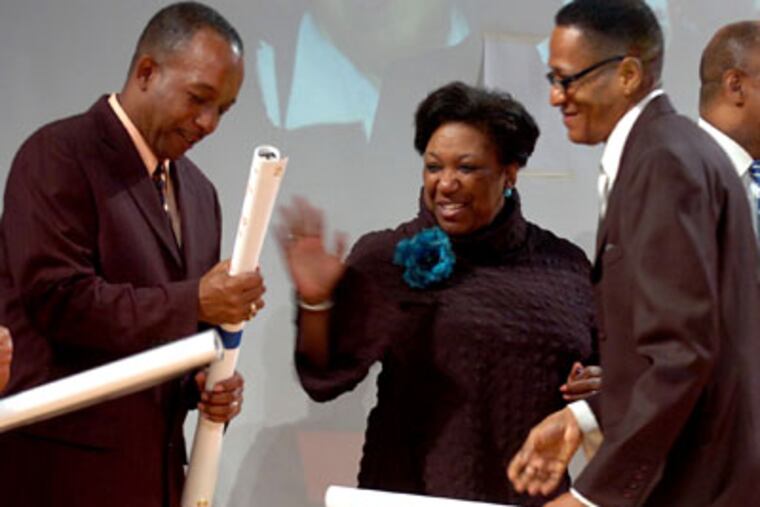
Amid the balloons and the applause, the banners and the music of a ceremony launching a new school year for School District of Philadelphia principals, Superintendent Arlene Ackerman stepped in with a sobering message.
"All is still not well with all of our children," the new schools chief told an audience of several hundred administrators yesterday. "We have to do more."
Consider: Though 112 district schools made "adequate yearly progress" under the federal No Child Left Behind standards, 153 did not. Philadelphia schools have one of the highest dropout rates in the country. More than 80 percent of Philadelphia's special education students are African American and Latino boys.
Some city schools and classrooms, Ackerman said, appear to be "wastelands for human potential. I want us to be a little uncomfortable. If we continue to be satisfied with steady progress, it will take us more than 30 years to close the achievement gap."
"Keep doing what you're doing," she told the crowd gathered at the High School of the Future. "Do more of what you're doing."
Ackerman, who took over as head of the 167,000-student district in June, already has shaken things up - eliminating some positions, creating new ones, adding regional offices, and changing the job descriptions of regional superintendents.
Expect more change when school begins Sept. 4, she said.
For the first time, every school will have performance goals apart from the state test benchmarks already in place. Principals' and regional superintendents' evaluations will be tied to hitting targets such as graduation rates, attendance, and percentage of students in gifted programs.
For the 23 neediest schools, $12 million will mean targeted interventions - from coaching for new teachers and a parent liaison, to home-learning packets for students and more volunteers.
The district is still technically in a deficit situation, with $5 million more in cuts to be made on a $2.3 billion budget, but the new efforts will not deepen the budget hole, Ackerman said. Cash for the extra help comes from new federal money and a reallocation of existing federal dollars to poor schools.
"Lots of money is going into those schools, but it's targeted. Lots of support, but lots of monitoring," said Ackerman, who said these poor-performing schools can expect visits and instructional help from central office staff every other week.
These measures must help - or else.
"If not, we have to go to radical interventions," Ackerman said, which could mean wholesale shake-ups of schools and their staffs.
Ackerman said she was also concerned about some of the district's high-performing students, pupils who score in the 80th to 90th percentiles on standardized tests.
"Some are sliding backward," Ackerman said.
Over the next few days, the superintendent's Summer Leadership Institute will help principals look at data for their schools and think about new ways to lead. The goal, Ackerman said, is to ramp up achievement for every student.
The school district has increased test scores for six consecutive years, and leaders yesterday celebrated the schools that met their goals. But that's not enough, the superintendent said.
Take risks, Ackerman urged the principals. Approach this year with "a sense of urgency.
That urgency "is what got me out of bed for 38 years now," said Ackerman, a former teacher and principal who stepped down as a professor at Columbia University. "It's what brought me out of retirement to the city of Philadelphia to be a superintendent one more time, against the advice of everybody I knew."
Some in the audience said they welcomed the challenge.
"We knew what the marching orders were going to be," said Richard Jenkins, principal of Roxborough High. "There are achievement gaps."
Roxborough, designated as one of the 23 so-called "empowerment schools" that will receive additional support, is on the rise, Jenkins promised.
"If teachers teach, students learn, and that's what's expected, nothing less," said Jenkins. "We're trying to make it happen. The next thing is to focus on making" adequate yearly progress.
Northeast High assistant principal Bob Lemoine, a 36-year veteran of the district, was philosophical about Ackerman's message.
"Change is good," Lemoine said. "There's a lot to do. We have to acknowledge the fact that we have a long way to go."