Ben Franklin Bridge paint job to shift to south side
The final phase of repainting the Ben Franklin Bridge will shift to the south side of the bridge on Oct. 6, giving commuters a glimpse of the new paint job on the north side.
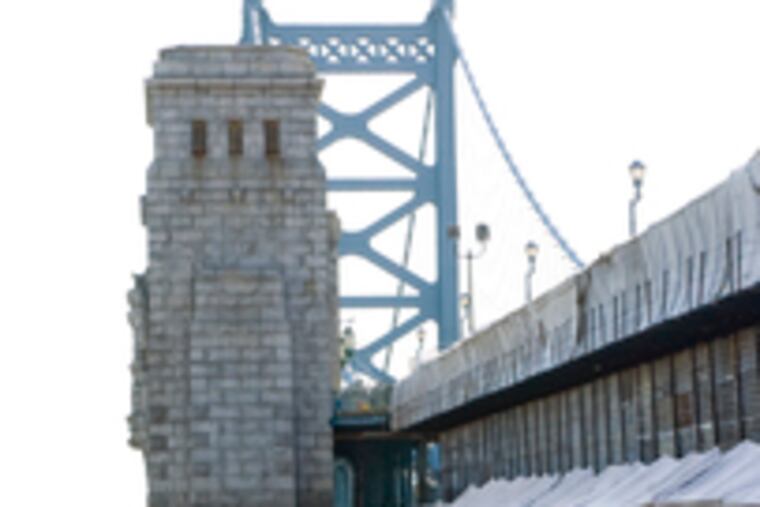
The final phase of repainting the Ben Franklin Bridge will shift to the south side of the bridge on Oct. 6, giving commuters a glimpse of the new paint job on the north side.
The $22 million blasting and painting project on the Philadelphia end of the bridge, which began in April, is to be finished by Dec. 15, 2009, and workers are ahead of schedule, Delaware River Port Authority officials said yesterday during a tour of the project.
Repainting of the bridge started on the Camden end in March 2000. By the time the five-phase project is finished, the price tag for the repainting will be about $88 million, more than double the $37 million cost of building the bridge in 1922-26.
"It's more than just a paint job," said John Matheussen, chief executive officer of the DRPA. He said workers have to blast off 25 coats of lead-based paint before spraying on two undercoating layers and a final coat of "Benjamin Franklin Blue" lead-free paint.
The 45 painters doing the work are laboring about 60 hours a week, making $43 an hour, plus overtime, said project manager Vijay Pandya.
Wearing respirators and protective gear, they work encapsulated in a tent-like enclosure designed to contain old paint residue and new paint splatters. They're using about 35,000 gallons of paint to cover one million square feet. And they're blasting off 1,200 tons of old paint and rusty steel, which is to be buried in a Pennsylvania landfill, Pandya said.
The contractors are Liberty Maintenance Inc., of Campbell, Ohio, and Alpha Painting & Construction Co. of Baltimore.
"This gives us an unprecedented opportunity to take a look at the underlying steel," said William Brooks, chief engineer of the DRPA. He said no major problems have been found.
The bridge was last painted in 1989. This coating is supposed to last 25 years, with a touch-up required in 15 years.