Classes are presidents' privilege
Teaching keeps universities' top officials in touch with students and ideas.
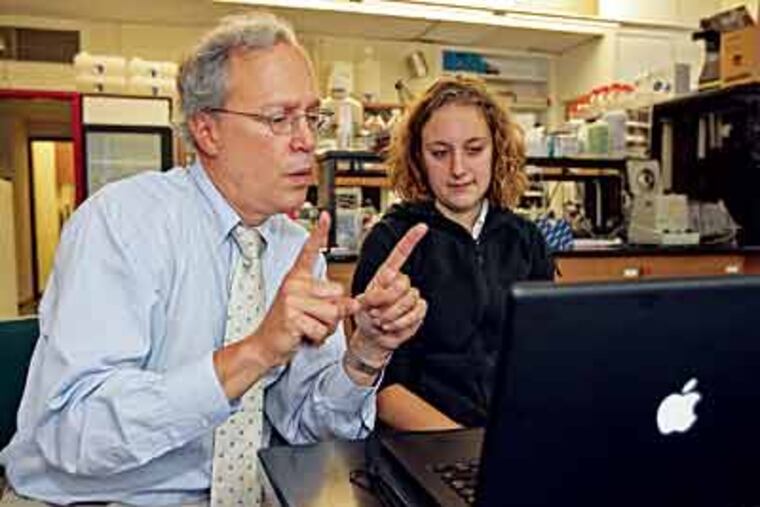
Stephen Spinelli Jr. looked every bit the professor, standing before his class on entrepreneurship at Philadelphia University one night last week. But, at that moment, his classroom charisma had given way to pique.
Why hadn't his colleagues in the industrial design department posted their work - work his students needed - on the Web?
"I don't know why the PDFs didn't get posted, but they will get posted," Spinelli promised his class of 24 undergraduate and graduate students.
He would make sure of it.
"There is some privilege the president has," he quipped.
He wasn't kidding: Though Spinelli moonlights one night a week in the classroom, he runs the 2,400-student school in East Falls by day, as president.
And he wouldn't have it any other way.
"What president would I tell not to get closer to their customer?" said Spinelli, 53, an entrepreneur who co-founded Jiffy Lube International in his earlier life. "I've told airline executives they should be flying planes or serving drinks."
It can make for a busy schedule: He sometimes finds himself preparing for class up until midnight the night before and dashing back from the airport after a meeting with a donor in a far-flung city to make it on time.
When the class is over, Spinelli - whose presidential salary is $280,000 - isn't done. He then goes home and grades himself on his performance over a glass of wine.
Though Spinelli is in the minority, he has company.
Twenty percent of college presidents nationwide teach a class, and 14 percent team-teach, according to a 2006 survey by the American Council on Education.
The council has no position on whether presidents should teach but it says those who do seem to enjoy it.
"As a former college president who used to teach, I think it's an excellent idea," said Martin Snyder, director of external relations for the American Association of University Professors, which also takes no official position on the matter. "Administrators who lose touch with reality of the classroom get themselves in hot water sooner or later if they don't know where the students are coming from."
He cited the case of a president at one university, which he declined to name, who unknowingly scheduled a faculty meeting during final exams.
Several other colleges and universities in the area, including Rutgers, Lafayette, La Salle and Haverford, also report that their presidents regularly teach a class.
"I never want to leave it," Steve Emerson, president of Haverford College, said of the classroom. "The reason one comes to run a college or a university is because one believes in the mission of the place and the best way to do that is to stay in touch with it."
Emerson, who has a medical degree and a doctorate in cell biology and immunology, teaches a class in stem-cell biology and opened one of the nation's first undergraduate stem-cell biology labs at Haverford last year.
He holds class in his living room, which has a movie projector and a screen that rolls down from the ceiling.
Rutgers University president Richard L. McCormick teaches a once-a-week seminar, Rutgers and the Challenges Facing Higher Education in the 21st Century.
"Teaching provides a valuable opportunity to find out what's on the minds of our students. . .," he said in a prepared statement. "Their insights are refreshing and help clarify my thoughts as we set priorities for Rutgers."
Dan Weiss, president of Lafayette College, teaches an art history class, Pilgrimage and Crusade in Medieval Art, which deals with such dicey subjects as the cartoons of the Prophet Muhammad.
He says he was inspired by William G. Bowen, the former president of Princeton University who taught an introductory economics course every year of his presidency.
"I thought that was a great signal to send about your commitment to the learning enterprise," Weiss said.
John Strassburger, president of Ursinus College, has made a conscious decision not to teach - out of deep respect for the profession.
"When I did try teaching, I found myself too often in the awkward situation of telling a student who wanted to stay and talk after class that I really had to run to an appointment instead," Strassburger said.
He added: "There is one last reservation about teaching that I have as a historian: I recognize that the historians now teaching at Ursinus are better professors than I could be."
Strassburger says he stays in touch with students in other ways, such as inviting small groups of seniors to his house for dinner.
For Philadelphia University's Spinelli, serving on the front lines is his modus operandi. When he ran Jiffy Lube, he went into underperforming stores on a regular basis, ducked into the bays and changed oil.
He's learned a few things since beginning the entrepreunership course a few weeks ago. For one, the cafe in his classroom building closes after class starts. He plans to make it stay open for when the class has a break.
Teaching, as well as serving as president, can make for a diverse day. Before class last Wednesday, Spinelli had a breakfast meeting with faculty over new curriculum for the engineering department, attended a board meeting at a local pet food company where he is a board member, reviewed a new strategic plan to be presented during his inauguration festivities over the next week, and met with a company about nanotechnology.
That night, in a tie, white shirt and dress pants, Spinelli - who co-wrote the textbook for the course - circulated about the room, engaged students in discussion and dialed up a real-life entrepreneur from Baltimore whose case the class had studied.
"It seems they're a lot like us, only they have the experience under their belts," James Sandham, 22, an MBA student, said of the entrepreneurs the class has met.
"You're at least as bright as any of them you talked to," responded Spinelli, who has an undergraduate degree in economics and an MBA. "Part of the decision is not do I want to make a lot of money? The bigger part of the decision is: Is this the life I want to lead. . ."
"You make choices. Part of this class is to help you make the choice. Remember, you get rich. I get famous."
The course, which also allows the class to partner with industrial design students to develop new products, is popular among students, so much so that its size was bumped up from 15 to 24, with some students still turned away.
"He's got lots of experience and lots of success that I think I can learn from," Sandham said.
At the end of the three-hour class, Spinelli graded himself as usual. He gave himself a B. All issues covered. Good discussion. But a little too much lecturing, he concluded.
Even college presidents have room to grow.