Despite rain, band festival goes on
ALLENTOWN - In crisp cherry-and-white uniforms, Temple University's Diamond Marching Band marched in place, lips poised on brasses and reeds, and awaited the signal from their drum major perched on an eight-foot stand. Then, the water-logged sky let loose with fat raindrops that quickly grew into a downpour.
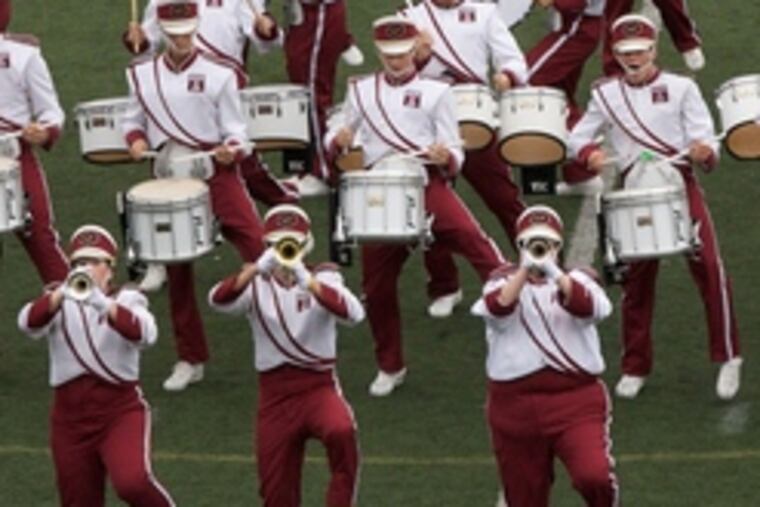
ALLENTOWN - In crisp cherry-and-white uniforms, Temple University's Diamond Marching Band marched in place, lips poised on brasses and reeds, and awaited the signal from their drum major perched on an eight-foot stand. Then, the water-logged sky let loose with fat raindrops that quickly grew into a downpour.
Without hesitation, the 180 bandsmen and bandswomen moved into their routine, gliding cat-smooth into the shape of a guitar while they played the music from the Guitar Hero and Rock Band video games. Pointed brass notes pierced the air, darting past like flaming arrows. When the band finished its 15-minute routine, a soggy crowd of about 3,500 people cheered.
Despite a rain yesterday that would have cancelled a baseball game and, at times, might have frightened Noah, the 13th annual Collegiate Marching Band Festival, showcasing 22 marching bands of all sizes and styles, went ahead at J. Birney Crum Stadium, a 60-year-old football field renowned as a venue for band and drum-corps performances.
John W. Villella, chairman of applied music at West Chester University and the founder of the festival, spent the morning checking weather reports and looking at the sky. "This is the first time since we started in 1995 we've had weather this bad," he said, his forehead creased with worry beneath rain-matted wet black hair. "It's really tough on the equipment. But these are hardy people, and the show will go on."
Villella established the festival as a way of encouraging high school band members to continue their music careers in college. Busloads of high school band members began arriving around 10 a.m., stepping off yellow school buses, chattering excitedly, bristling with undischarged energy, shooting off in all directions like untended plants. They are among some two million middle and high school band members in America.
One of them was Julie Hayman, a member of the color guard for Council Rock South's high school band. "I'm a senior, I want to continue in a marching band in college, and I've come here to sample the bands. I have to make a decision in a few months. This is neat because people have come here to see the bands, not to see the football team."
Other high school bands came from Upper Dublin, Plymouth-Whitemarsh, Upper Merion and Pottsgrove.
Collegiate marching has a long history, but in the past was little more than an adjunct to football - providing halftime entertainment while the real fans headed for the rest rooms and concession stands. But more recently, the bands have developed strong followings of their own, with their tight arrangements of popular songs, athleticism, crisp uniforms, and flawless formations.
"Many students actually choose to come to a certain institution because of its marching band," says Villella. "Marching bands have taken on a life of their own."
By noon, a line long enough to fill a train snaked out from the ticket booth, where families three generations deep waited patiently in the rain.
First up was Bloomsburg University, which was greeted with a warm blanket of applause by the crowd huddled under shared umbrellas as it began playing George Gershwin's "I Got Rhythm."
The bands got bigger and louder as the afternoon wore on. Music ranged from Beethoven to the Beach Boys. Moravian College played Brahms; East Stroudsburg University did music from Earth, Wind & Fire; Cheyney University's dance team drew raves for its acrobatics. Lebanon Valley College played the music of English composer Gustav Holst. The sun put in a cameo appearance while the Boston University band belted out Ozzy Osbourne's "Crazy Train," but then an army of dark clouds marched in as Temple took the field.
Watching the high-stepping Morgan State University's Magnificent Marching Machine, Villella said being a marching musician is demanding. Routines are complicated, requiring on-the-field precision. The players must memorize the written music, as well as the routines. In a given season, band members may be required to memorize up to a hundred songs and more than 20 routines. "It's like thinking about a symphony while running a marathon," he said. There's also quite an athletic component. "Marching around with a 50-pound tuba is not for everyone."
The stadium's artificial turf was getting soggy when the 380-member Minuteman Marching Band of the University of Massachusetts completed the performances around 6 p.m. By tradition, the festival was closed with a rock-and-roll concert by some 60 tubas from all the bands.