Mormon temple planned for North Broad Street
The fast-growing Mormon Church will build a temple on North Broad Street, where members can conduct the most sacred rituals of their faith out of public view.
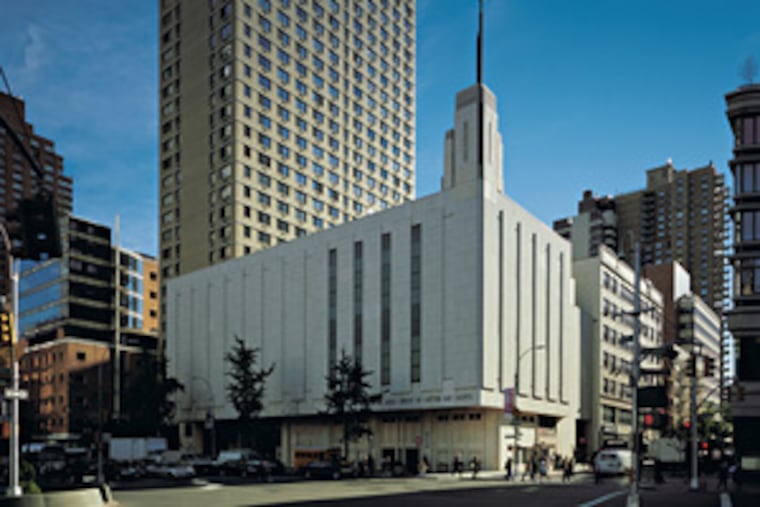
The fast-growing Mormon Church will build a temple on North Broad Street, where members can conduct the most sacred rituals of their faith out of public view.
The Church of Jesus Christ of Latter-day Saints confirmed plans yesterday to build a temple on a one-acre parking lot in the 400 block of North Broad Street, across from the Philadelphia School District headquarters.
Kim Farah, a spokeswoman at the Christian denomination's headquarters in Salt Lake City, said no details or building plans were available, but that most temples were built within three to five years of an announcement. The church has 128 temples worldwide, including 61 in the United States, but none in Pennsylvania, New Jersey or Delaware.
Local church members welcomed the news, saying the construction of a temple here would spare them journeys to Washington or New York to participate in the ordinances and covenants central to their faith.
"We are all very excited in the area to have this temple," said Gerald Prue, director of the Latter-day Saints Family History Center on Red Lion Road in Northeast Philadelphia.
The LDS faith has expanded dramatically, from 2 million to 13 million members worldwide in the last 45 years. It claims 48,000 members in 111 congregations in Pennsylvania, 30,000 members in 58 congregations in New Jersey, and 4,600 members in Delaware.
Though Mormon chapels and meetinghouses are open to the public for Sunday worship, only members in good standing may enter temples.
According to the church Web site, Mormon temples are places "where church members make formal promises and commitments to God" and where the highest sacraments of the faith occur - marriage and the "sealing" of families for eternity.
Mormons also believe that ceremonies such as baptism and eternal marriage can be performed on behalf of those who have died, but that the rites can be conducted only at temples.
Prue said the Philadelphia temple likely would resemble the temple that opened four years ago on Manhattan's West Side. The six-story granite structure on Columbus Avenue contains a meetinghouse, a baptistry and offices on the lower floors. The temple itself is on the top three floors.
"We've been told it will be a multi-level building," Prue said.
The Philadelphia temple will be built on church-owned land between Noble and Hamilton Streets, near Spring Garden Street.
According to city land records, the church paid $4 million in October 2007 to the estate of Moses Goldsmith for three lots totalling 39,000 square feet - a little less than an acre. The land, formerly occupied by a fast-food restaurant, now contains a private parking lot surrounded by a chain-link fence.
The site is on the Avenue of the Arts' northern stretch, which has been undergoing a subdued revival in recent years with the relocation of the school district headquarters and several residential and commercial projects.
Mormon Church president Thomas S. Monson had said last Saturday that the church planned to build five temples worldwide: in Philadelphia; near Kansas City, Mo.; in Calgary, Canada; Cordoba, Argentina; and Rome. Twelve other temples are under construction or in the drafting stage.
Temples typically are white buildings with tall steeples and may include a trumpet-blowing golden statue of the angel Moroni, who Mormons believe provided church founder Joseph Smith with the Book of Mormon, the faith's central text.
Prue said temple interiors usually are free of ornamentation.
"It's utterly magnificent how plain and simple it is," he said.
Prue said many Mormons travel around the world to visit temples in a pilgrimage akin to that practiced by some sports faithful.
"People just like to see how many they can get to, sort of like baseball fans who try to see games in many ball parks," he said.
Some landmark events in church history occurred in Pennsylvania, according to a church Web site.
Smith and his wife, Emma, lived in Harmony, now Oakland, Pa., from 1827 to 1830. There he translated much of the Book of Mormon. Members also believe Smith received the priesthood on the banks of the Susquehanna River, resulting in the first church baptisms.