Episcopal Academy will sell historic print
A rare 1754 engraving of the Philadelphia riverfront hung for years on walls at the Episcopal Academy, a buried treasure in plain sight.
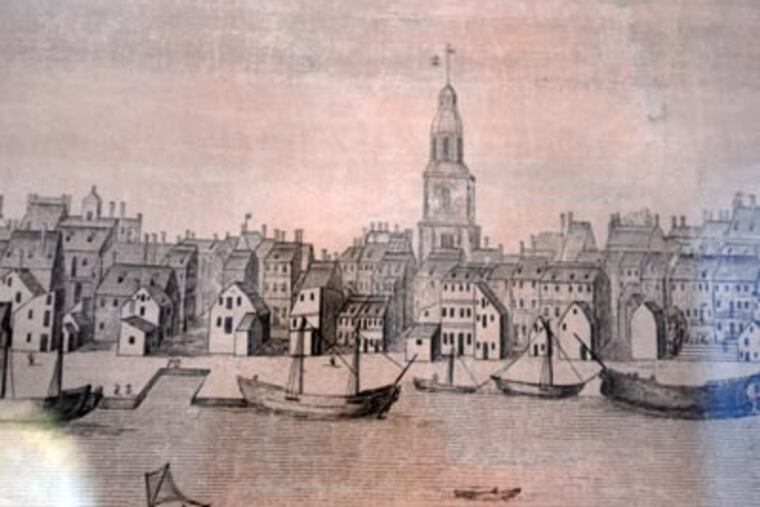
A rare 1754 engraving of the Philadelphia riverfront hung for years on walls at the Episcopal Academy, a buried treasure in plain sight.
No one knew its origins or that it was probably one of only six dating back to the French and Indian War era.
But the school's business manager did realize the print needed to be cleaned, so off it went to a conservator five years ago. That's when Episcopal found out it owned an important piece of artwork.
The engraving, An East Prospect of the City of Philadelphia, has since been valued at between $250,000 and $350,000. It will be auctioned at Christie's in New York next month.
School officials had been keeping the engraving in a safe, instead of putting it back up on the wall, ever since they found out its value.
Episcopal's recent move from Merion to Newtown Square, coupled with concerns about how to secure such a valuable piece, prompted the decision to sell.
"It's a wonderful thing to have, but in terms of our ability to maintain it and care for it properly versus what else we could do with those funds to further our mission . . . it seemed like the smart thing to do is to put it up for sale," said Ham Clark, head of school at Episcopal Academy.
The engraving, which measures 82 inches by 20 inches, depicts the Philadelphia riverfront in a view from New Jersey. The colonial cityscape includes the State House (later named Independence Hall), Christ Church, and the Academy School, which became the University of Pennsylvania.
Thomas Penn, William's son and then chief proprietor (landowner and governor) of Pennsylvania, intended the engraving to market Philadelphia as a thriving port city. He initiated the effort to produce a panoramic rendering of the Philadelphia waterfront in the early 1750s.
"He was promoting his city," said Christopher Lane, of the Philadelphia Print Shop Ltd., a dealer in old prints and maps. "As people came over and brought land and developed it, he made money."
Penn commissioned a rendering of the riverfront but was disappointed in the work of two artists he had retained, wrote historian Martin P. Snyder in his book City of Independence: Views of Philadelphia Before 1800.
Artist and map-maker George Heap, who had earlier produced maps with surveyor Nicholas Scull, created his own view of the waterfront and was sailing to London to have the work engraved when he died enroute. Scull, surveyor general of Pennsylvania, purchased the drawing from Heap's widow and turned it over to Penn.
London engraver Gerard Vandergucht, using four copper plates, made a total of 697 prints for shipment to America. Another 53 were sold in England. The price was one pound each.
Six are believed to survive, said Chris Coover, a Christie's senior vice president and senior specialist in books and manuscripts.
In addition to the Episcopal print, one hangs on a second-floor landing at Independence Hall. The Historical Society of Pennsylvania, Winterthur Museum in Delaware and the New York Public Library also each own one of the engravings.
The last time ownership of one was transferred was in 1980, when Wilmington lawyer William Prickett donated his print to Independence National Historical Park, said W. Graham Arader 3d, a leading dealer of maps, prints and rare books. Back then, the engraving was valued at $100,000, Coover said.
Arader said he convinced Prickett to donate the print nearly 30 years ago, and thinks that Episcopal Academy should donate its print to a Philadelphia institution like the Independence Seaport Museum, rather than put it up for auction.
But school officials decided to sell the engraving because "like many nonprofits we're looking for whatever financial support we can to sustain our mission," Clark said.
Episcopal did not offer the print for private sale to local institutions because the school does not have expertise as an art broker, Clark said. School officials retained Christie's because of connections there: a former Episcopal Academy student and a parent work for the auction house.
Talks with Christie's began in the spring, before the current economic downturn. The decline may translate into a sale price lower than six months ago, Clark said. But a minimum sale price has been set. If that isn't reached, the print will be returned to the school.
The engraving was donated to Episcopal Academy in the early 1900s. Current school officials don't know much more about the print except that it was lent to the Philadelphia Museum of Art during the Bicentennial.
Several prints based on the 1754 original were published later. Some of the versions were smaller, others were in color. Episcopal Academy has a reproduction of the 1754 engraving, along with a later engraving of the 18th-century waterfront.
In the absence of the historic original, Clark says the school will display the two that it retains, and hope that the original will find a home in a place more suited to display history.