Fire Department plan causes worry
Medical emergency? Call 911. But in Philadelphia, where the ambulance system is increasingly overburdened, the first vehicle dispatched very likely will be a fire truck. Trained to provide first aid, firefighters call these assists "shoe runs" because they don't don their firefighting boots.
Medical emergency? Call 911.
But in Philadelphia, where the ambulance system is increasingly overburdened, the first vehicle dispatched very likely will be a fire truck. Trained to provide first aid, firefighters call these assists "shoe runs" because they don't don their firefighting boots.
As Mayor Nutter tries to head off a projected billion-dollar shortfall in the city's five-year plan by shuttering facilities and slashing expenses, the "deactivation" of five fire engine and two ladder companies - saving $10.5 million a year - is drawing heat from the firefighters union and some residents who worry they won't be adequately protected in emergencies.
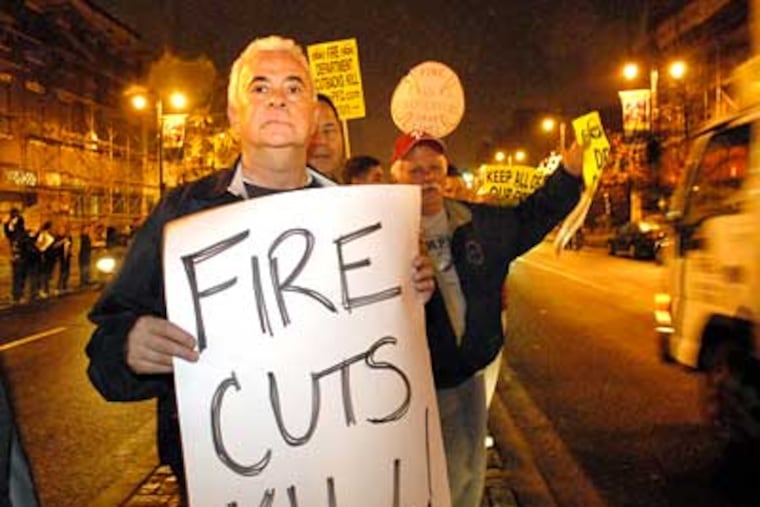
"Fire Department Cuts Will Place You In Danger!" screams the headline on the neon-yellow fliers illustrated with a skull and crossbones that are distributed at demonstrations.
"The city says I will continue to be safe, but I don't see how I can believe this," said Tom Algeo, manager of MAB/Duron Paint, whose store at 700 S. Broad St. is across the street from targeted Engine Company 1. "Maybe I'm spoiled. But I like having them there."
Engine companies pour water on fires. Ladder companies provide equipment for rescues. Both are first-aid responders. According to department data released Monday, the seven targeted companies - two in Center City, and one each in South, North and Northeast Philadelphia, Kensington/Port Richmond and Roxborough/Manayunk - responded to a total of 5,761 fires, 6,016 "shoe runs," and 16 false alarms last year.
Under the restructuring, which takes effect in January, the department will shrink from 61 engines and 29 ladders to 56 engines and 27 ladders. About 148 firefighters in the affected companies will be reassigned, creating savings because 148 existing vacancies won't be filled. January's scheduled Fire Academy class has been canceled.
Ahead of the cuts, proponents and critics are scrutinizing the department's workload in fine detail, combing through statistics on the overall decline in structural fires, the explosive growth in "shoe runs," and other data.
Though the city will use perimeter companies to absorb the workload of closed companies (and maintain response times), fire union president Brian McBride is skeptical that can be achieved without lengthening response times. Under National Fire Protection Association standards, response is supposed to be five minutes or less - one minute of "turnout time" to suit up, plus four minutes to drive from the firehouse to the emergency.
"We live and die, and so does the public, by travel time," said McBride, who heads Local 11 of the International Association of Fire Fighters. "If the cut means it takes six minutes to get there, not four, that's when it matters."
In a city dominated by rowhouses, he added, a minute's delay can mean the difference between a containable, one-bedroom fire and a blaze that engulfs several homes.
Department policy prohibits firefighters from talking to reporters without permission.
John, an eight-year veteran who asked that his last name be withheld, cited a fire this week in Roxborough.
"Engine 39 [a targeted company at Ridge Avenue and Cinnaminson Street] was first in on a ripping bedroom fire on Freeland Street" in a two-story twin, he said. "If they waited another couple of minutes, they would have lost the whole floor. Engine 12 [4445 Main St.] was second on the scene, and they were just getting there after Engine 39 put the fire under control."
Under the reconfiguration, Engine 12 and Engine 66, at Ridge and Shawmont Avenues, will absorb Engine 39's coverage area.
McBride pointed out that Engine 12's firehouse is on the flat ground of Manayunk's Main Street. If Engine 66, near Andorra, is occupied on another call, Engine 12 would have to climb the steep hills of Manayunk to reach Engine 39's old territory in the heart of Roxborough.
"Are they going to get there in four minutes? I don't think so," he said. "What kind of assumptions are you making? That Engine 12 is going to climb [the Manayunk Wall] with a 20-ton truck at 40 miles per hour? Let's throw in some bad weather. Are these kinds of things factored in? I would suspect not."
McBride said he wants "an independent, scientific study" before cuts are made. Last week, City Council asked the Nutter administration to undertake such a study.
The administration said its internal study was sufficient.
"All the factors taken into consideration were shared, and all relevant indicators [geography and response time] were produced and mapped and included," mayoral spokesman Doug Oliver said yesterday. "There is nothing more to add."
Fire Commissioner Lloyd Ayers, in releasing the data, had assured residents that "budget restraints will not compromise . . . service, response or dedication."
Everett Gillison, deputy mayor for public safety, said the addition this year of five ambulances to the fleet of 45 would alleviate some of the demand for "shoe runs." He noted that under the restructuring, the 2,400-member department would lower overall operating costs by nearly 6 percent without layoffs, demotions or a firehouse closing. Though the targeted engine and ladder companies will be deactivated, their firehouses, which usually contain other firefighting or EMS equipment, will remain open.
"We are keeping everybody in their jobs and keeping them safe," said Gillison, adding that it didn't make sense to send a $1.2 million ladder truck to tend what could turn out to be relatively minor medical needs.
Firefighting may look simple - just douse the flames - but it requires careful coordination, McBride said. Without a ladder company to ventilate an engulfed building, pouring water onto raging flames could result in steam burns to firefighters and occupants. Ventilate too early, without hose lines to supply water, and you stoke the fire with fresh air.
"These units operate on a complementary basis. They need each other," McBride said. "In a lot of cases, [perimeter coverage] will work. But in a lot of cases, it's not going to work."
Roe Gallo, owner of Alphabet Academy, a day-care center at Passyunk Avenue and Dickinson Street in South Philadelphia, has a special fondness for targeted Ladder Company 11 at 12th and Reed Streets. On Feb. 7, 2005, it helped evacuate 59 children and 18 adults when an electrical short-circuit set her center on fire.
At a protest last week, Gallo and her daughters, Amanda, 23, and Jamie, 19, wore fire-engine red sweatshirts emblazoned: "Ladder 11 Saved Our School."
"Since this happened to me I learned a lot more about fire than I knew before," Gallo said. "We ask [firefighters] every day to put their lives on the line. Why should they be put in more danger than they already are?"