Mother Bethel's new pastor loves its history
If the Rev. Mark Kelly Taylor says a particularly long grace over a cooling turkey today, may he be forgiven.
If the Rev. Mark Kelly Taylor says a particularly long grace over a cooling turkey today, may he be forgiven.
Just last week, the fifth-generation preacher became pastor of Mother Bethel A.M.E. Church in Society Hill, a site he used to visit with near-reverential awe. He calls it "Ground Zero for the civil-rights movement."
"President Obama's election pushed forward by one more inch the stone that Richard Allen and Absalom Jones started moving right here," he said in an interview, pointing to the ground at Sixth and Lombard Streets.
"I love the history of this place. I just never thought I'd be its pastor."
Allen, a freed slave, started Bethel Methodist in 1794, seven years after staging the nation's first anti-segregation sit-in at St. George's Methodist Church on North Fourth Street.
Allen and Jones - not only members of St. George's but ordained clergy, as well - arrived one Sunday morning in November 1787 and were told that black members would henceforth sit in the upstairs gallery, apart from the white congregants. When the two insisted on remaining in the sanctuary for prayer, they were seized by angry white trustees, who ordered them out.
Allen and Jones led a walkout of the black members.
By 1792, Jones had started the historic Episcopal parish St. Thomas, now in the city's Overbrook section. But Allen's Bethel Methodist went on to become the "mother" church of African Methodist Episcopalianism, now with 2.5 million members worldwide. He was its first bishop.
The site - its official address on a narrow lane is 419 Richard Allen Ave. - is also the "oldest continuously owned property held by blacks in America," according to Tyler, 42, a church historian.
As happens in the Methodist church, Tyler was not called by the congregation but assigned by the regional bishop.
A native of Oakland, Calif., whose great-great-great-great-grandfather was a Methodist circuit rider, Tyler pastored in California, Missouri, Ohio (where he also picked up a Ph.D in education) and Pennsylvania before landing at little Macedonian A.M.E. Church in Camden in 2004. He and his wife, Leslie - former assistant news director at Fox29 - have four children.
He learned last month that he was moving to Mother Bethel as its 52d pastor just half an hour before the congregational leadership got the news.
"I do believe God answers prayers," he said happily.
Scholarly in appearance - bald, bearded and bow-tied - Tyler recently had lost a national election for the post of historian of the A.M.E. denomination. But he now believes that Mother Bethel offers greater opportunities. "Here," he said, "I can be a pastor and a historian."
As the new steward of an old church, he inherits the usual challenges: How can he grow membership? How might the neighborhood be better served? And should air-conditioning be installed in the sanctuary?
Mother Bethel, with 400 active congregants, is also a shrine.
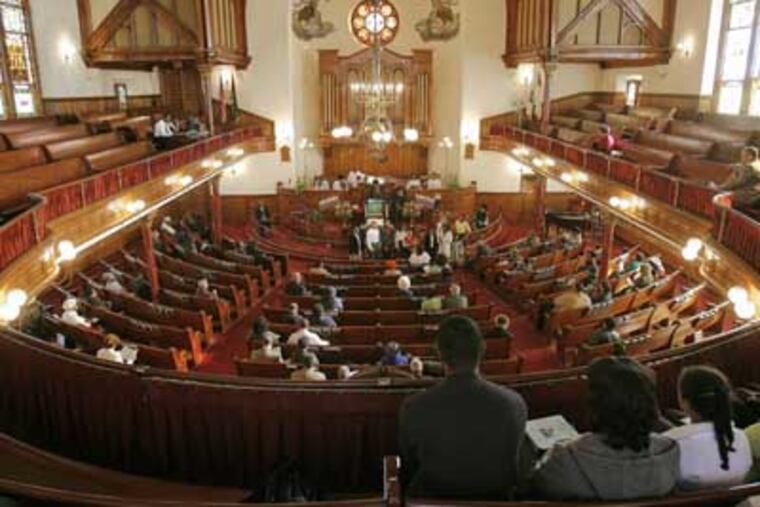
Step out of the luminous oak sanctuary, with its 1,200 seats and splendid stained-glass windows and brass chandelier and organ pipes, and make your way down to the basement.
There you encounter a small, white room illuminated by a single candle. Within lies the tiled tomb of Richard Allen, who died in 1831. Past the doors is a three-room museum.
Although a regular visitor over the years, Tyler found a few surprises as he strolled last week through the collection.
"Oh, I don't know if I've ever seen that," he said and laughed, pointing to a display case containing a row of red bricks. Painted on the bricks was an image of a church facade, which Tyler recognized as the predecessor of the current stone-and-brick structure built in 1890.
On an opposite wall stood an early oak pulpit from which Allen is thought to have preached. Nearby were some early hymnals, prayerbooks, cookware and collection boxes, and a clock from 1805.
Back in his office, Tyler spoke of his hopes for expanding the exhibit, perhaps even building a new museum next door on what is now a parking lot. "There are so many untold stories," he said.
With a modern facility, he said, Mother Bethel could be a major visitor center in Philadelphia's historic district - the site of traveling exhibitions on black history, oral-history projects, and home to a "first-class" collection of A.M.E. archives and African American historical artifacts.
"In this church you have one of those rare places where what we do here is bigger than us," he said.
"It's the struggle of African Americans to live in this society. This church is a metaphor for what it means to be black in America."