In Phila., dental program brightens smiles
The dentist had arrived at Ellwood Elementary School in East Oak Lane, and Omar Carter could not wait. Seriously. The gregarious sixth grader ticked off reasons on his fingers: It doesn't hurt, his teeth look clean and shiny afterward, the dentist is nice.
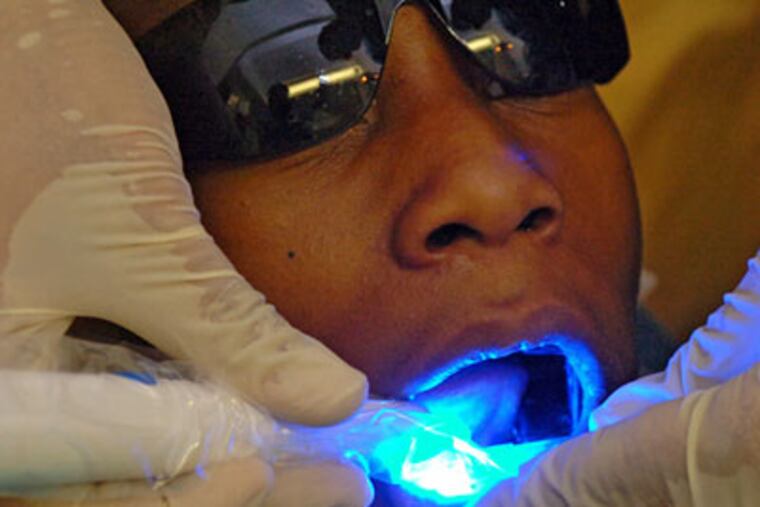
The dentist had arrived at Ellwood Elementary School in East Oak Lane, and Omar Carter could not wait. Seriously.
The gregarious sixth grader ticked off reasons on his fingers: It doesn't hurt, his teeth look clean and shiny afterward, the dentist is nice.
"He's fun, and he likes to tease me a lot - especially that guy," said Omar, 12, pointing to Lawrence Caplin, a fast-moving blur in scrubs and sneakers who waved at the boy.
Caplin, 44, is the founder of the Oral Health Impact Project, which provides free, comprehensive dental care to at-risk students in more than 100 public elementary, middle, and high schools in Philadelphia. Many of the children served have never seen a dentist.
It's a complex problem. According to a 2000 report by the Surgeon General, students lose 51 million hours of school time each year to dental problems, which often go untreated in lower-income children. Families enrolled in government-assistance programs qualify for dental care, but many dentists do not accept patients covered by Medicaid.
Caplin, who grew up in Northeast Philadelphia and now lives in Bucks County, has worked in public dental health since graduating from dental school at the University of Pennsylvania. His main business, Dentrust Dental International Inc., has millions of dollars in contracts to do dental work with the military, prisons, and foster-care children.
But the school program is his passion. Although he has stepped away from day-to-day dentistry in schools since launching the project last year, ceding hands-on care to dentist Sanford Roth, Caplin still checks in to make sure things are running smoothly.
"We're changing perceptions of oral health," Caplin said recently. "We're becoming the dental home for these children."
A traveling troupe of a dentist and two dental assistants had arrived at Ellwood, a kindergarten to sixth-grade school, where more than half of students live in poverty. They set up before the first bell rang, lugging in a fold-up chair, sterilizer, digital X-ray machine, computers, and cartons of instruments into nurse Susan Duffy's office.
The team performs everything from root canals to routine cleanings.
Patients - even the root-canal patients, Caplin said - are typically calm, comfortable in their familiar school, with their friends outside and their teachers down the hall. Records are kept electronically, and the aim is to follow a student from kindergarten through high school graduation, even if they change schools multiple times.
Last school year, the project's first year, they saw about eight percent of students in each school they visited. This year, that's tripled in most schools, thanks to word of mouth and more parents filling out permission forms.
Three other programs offer similar services, but Caplin's is the largest one providing comprehensive care, not just cleanings.
"This is about compassionate care, lifelong care," said Caplin. "They see their classmates being treated, and they're not scared."
The project team spent two days at the school, seeing 15 patients a day. If more permission forms come back later in the year - and they often do, Caplin said - they'll fit Ellwood into their schedule again.
In the middle of a busy morning, dental assistant Qiana Gallman pulled up one child's record, and asked Caplin to take a look at it. He zeroed in on a baby tooth with decay and no root - very loose, he said.
"There's no sense in us putting a filling in a tooth that's going to fall out in two weeks," he said. "But it never should have gotten to this point. This child should have been seen and treated months ago. That decay's been there maybe two years."
Roth, the other dentist, bent over a boy relaxed and excited at the prospect of Batman stickers at the end of his cleaning.
"Open real wide. I'm not going to hurt you - it's just water and air," Roth said, preparing to squirt water in the fifth grader's mouth.
Three little boys waited outside the makeshift dental office, bouncing up and down on a green pillowy bench and whispering about who got the privilege of going first.
"Yes! The dentist!" one girl shouted as she walked past, peering inside at Roth working on a classmate.
Ibrahim Ahmad, 10, swung open the door, his smile wide and bright.
It didn't hurt, Ibrahim said, and the dentist was nice.
"He told me to brush my teeth and make them real shiny, because that's good," said Ibrahim. "And my mom was happy, because she didn't have to pay for this."
Programs such as Medicaid pay the project directly for the children's care. School nurses help with outreach, getting forms signed and directing parents who qualify but do not have medical assistance to program staff for help filling out forms.
A complicated procedure, such as an exam and a filling for which a private dentist might charge $225, typically nets the program a $65 medical assistance reimbursement, so the Oral Health Improvement Project staff must be remarkably efficient in order to make the math work, Caplin said.
That doesn't trouble Roth, who previously worked as director of the Philadelphia prison dental system.
"It's just gratifying to work on children who, if not for this program, wouldn't see a dentist," said Roth, a patient man who explains procedures to children in a steady, light voice. "You teach them, you take the fear away, you get them started in the right direction."
Caplin's got another goal, beyond good dental health. He wants to show inner-city kids that dentistry is a career option.
So when he jokes with Omar, the conversation flows from why chewing on bottle caps is a bad idea for your teeth to job plans.
"Omar, you should be a dentist," Caplin said. "Make a lot of money. Help kids."
Omar is a pretty determined guy, and he thinks he wants to be an American Sign Language interpreter, but he said he'd consider it.
Duffy, Ellwood's nurse, sat outside on a bench, reassuring students their turn in the dentist's chair would come.
"When your tooth hurts, you're not going to do well on a standardized test," Duffy said. "They're terrific with kids, and it's really quality dental care."