Enjoy the expressway ice formations
When rush-hour traffic slows to a glacial pace on that tedious stretch of the Schuylkill Expressway between Conshohocken and Belmont Avenue, Laura Toran has this advice for motorists:
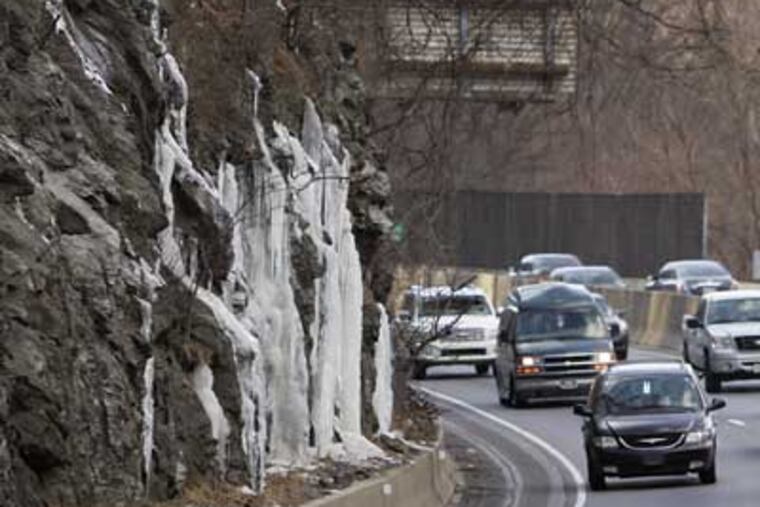
When rush-hour traffic slows to a glacial pace on that tedious stretch of the Schuylkill Expressway between Conshohocken and Belmont Avenue, Laura Toran has this advice for motorists:
Savor the view.
And she's serious. Thanks to the coldest weather in four winters, these days drivers can admire dramatic ice formations on the modest slopes just above the inbound shoulder. That ice, geologists tell us, is the result of the collision of modern life and 1.1 billion-year-old rocks that are remnants of one of the great upheavals in natural history.
With the right attitude, says Toran, one might even consider a good traffic jam a stroke of luck. And if this suggests she has rocks in her head, she would readily admit that's true, given that she's a geology professor who teaches at Temple University. She is also an unabashed connoisseur of what she calls "groundwater outcrops," those ice formations that appear to ooze magically from rocky hillsides.
They can be found elsewhere in the area, but that stretch of the expressway is one of the region's best-view corridors, and it is traveled by more than 100,000 not-necessarily-willing visitors a day.
In the last few weeks, a harvest of ice has transformed normally brooding hillsides into a poor man's White Cliffs of the Schuylkill.
Although snow has been scarce so far this season, with only 1.5 inches measured officially through Saturday at Philadelphia International Airport, generous precipitation has kept nature's ice machine cranking. After falling atop surfaces about 300 feet above the expressway, water ponderously works its way through the soil. When it's cold enough, it freezes after it meets the frigid air.
The water actually would prefer to drain right into the river, but humans have intervened. The expressway cuts through the drainage pathways, observes Jeff Featherstone, a Temple professor who is a water-resources specialist.
Geologists have documented that those rocks, known as Baltimore gneiss, came to be through an immense, complicated and almost unimaginable saga. The short version is that the rocks are the leftovers of a collision of land masses in an epoch when most of the Earth became one continent.
Roughly 1.0999 billion years later, give or take a few million, mankind decided to build the Schuylkill Expressway.
By then, the rocks, over the eons, had developed fractures that allowed precipitation to seep through, said Paula Callahan, geologist with the Pennsylvania Department of Transportation's Philadelphia district.
The fractures in all likelihood widened as the hills were blasted to make way for the road, she added. As the land above was developed, trees and their water-absorbing roots were removed, and that has accelerated the flow of subsurface water, she said.
Though it may interfere with drainage, an upside is that road-cutting provides a visual smorgasbord for appreciators of geology.
The expressway acts as an access ramp climbing into the Piedmont Plateau, which begins at the Falls Bridge that connects the city's river drives.
It may lack the aesthetic drama of the elevations along the New York Thruway or Route 287 in northwestern New Jersey, but the Philadelphia region is rich in geological diversity, Callahan said. Its visible rocks range from Baltimore gneiss to what Temple geologist George H. Myer calls the 500 million-year-old "babies," including a spectacular formation at the end of the expressway's Gladwyne exit.
If you haven't noticed the expressway ice, you still have time. The ice can hang on until late March or early April, depending on the weather, said PennDot maintenance chief Nick Martino. Usually, it is not a serious hazard, he said, but crews do try to keep it under control.
It is not certain what the rest of the winter will bring, but geologists do see a 100 percent chance of rocks, and they are likely to be admiring them, even while behind the wheel.
"I will tell you, the most serious car accident I had was when I was looking at the rocks," Bryn Mawr College geology professor Maria Crawford said.
"I've tried to reform."