Trial set to begin in alleged bribery case
Taking a $1,000 check and a rent-free apartment from property owners who badly need City Council's help with a mega-project is likely to get a municipal employee in trouble with the city's Board of Ethics.
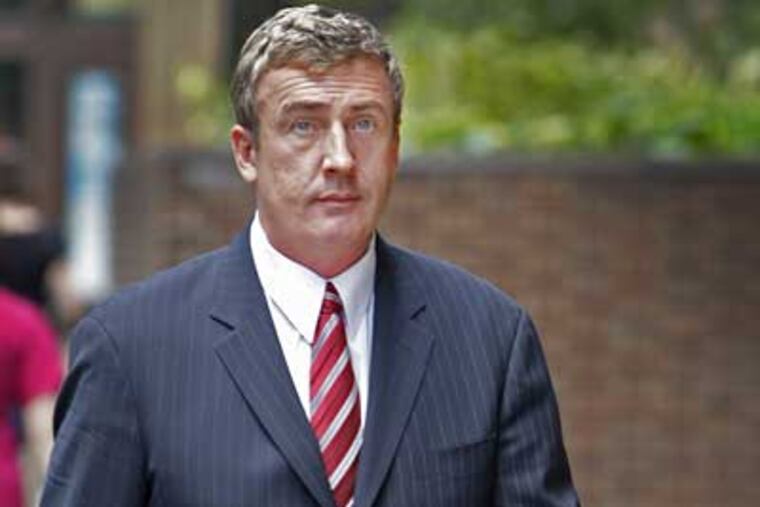
Taking a $1,000 check and a rent-free apartment from property owners who badly need City Council's help with a mega-project is likely to get a municipal employee in trouble with the city's Board of Ethics.
In the case of Christopher Wright, chief of staff to Councilman Jack Kelly, it won him a federal indictment.
But was Wright's behavior criminal? Did he exchange private favors from his boss' campaign contributors for public ones? Or did Wright, down on his luck, simply take some ill-advised help from people he regarded as friends?
Today, a jury in U.S. District Court in Philadelphia will begin what is expected to be a two-week trial centering on those questions. Jury selection is today, with opening arguments probably following late today or tomorrow.
Wright is to appear before U.S. District Judge Eduardo C. Robreno alongside Hardeep and Ravinder Chawla, Huntingdon Valley-based real-estate entrepreneurs who were among Kelly's most generous campaign contributors.
Andrew Teitelman, who doubled as counsel to the Chawla brothers' companies and as campaign treasurer to Kelly in the 2003 and 2007 elections, is also a defendant. His friendship with Wright will be cited as evidence of guilt or innocence.
The government will argue that the relationship was purely mercenary on both sides. Teitelman's lawyer, William DeStefano, will say "you don't have to bribe a friend" to do a favor.
The four were indicted in August in an alleged scheme in which the Chawlas and Teitelman became Kelly's "primary constituents" by bribing Wright.
Wright's perks from the men included:
A $1,000 check from Hardeep Chawla in December 2005, described by Wright on city disclosure forms as a Christmas gift.
Ten months rent-free in a Rittenhouse Square apartment, valued at $15,000 by prosecutors, with a free parking spot.
Free legal representation by Teitelman in Wright's personal affairs.
In return, according to the indictment, Wright helped the Chawlas resolve tax bills, saving them $11,000; drafted successful legislation the Chawlas sought to allow for a unstaffed parking garage; and had Kelly introduce them to Councilman Darrell L. Clarke, who represented the district where the Chawlas sought exemption from height limits to build the $3.5 billion River City complex on 8.5 acres along JFK Boulevard and the Schuylkill.
The thirteen-count indictment charges the men with conspiracy, wire fraud, mail fraud and bribery.
Few facts are in dispute. The case will come down to what the defendants' intentions were, which is why public corruption cases are tricky for prosecutors.
"A lot of the case is going to be: What was in the mind of the defendants when they engaged in the actions?" said Lisa Mathewson, Wright's attorney.
Wright's defense will be the ordinariness of the requests and the relative lack of results he achieved.
The inquiries on taxes and to other departments are done for constituents every day, the defendants' attorneys have argued. The legislation for automatic parking lots has been backed by other Council members, who see it as a necessary change. And Clarke never introduced a bill that would have helped the Chawlas.
"The constituent services that Kelly's office did for the Chawlas were normal constituent services that every city councilman's office performs on a routine basis," said DeStefano.
Teitelman has described Wright as a close friend whom he gladly helped out with legal issues when Wright was going through a divorce, and was kicked out of his home and faced foreclosure.
Teitelman arranged for Wright to stay in Apartment 3W at 2000 Delancey St. Ravinder Chawla's company, World Acquisition Partners, had agreed to buy the property, but flipped its interest in the building. Wright was allowed to move in before the new owners closed on the property under an agreement between the Chawlas and the seller.
One thing is clear from authorities' view: Wright should not have been accepting gifts from the Chawlas and Teitelman, whether he declared them or not. Prosecutors want to present testimony by both the state Ethics Commission and the city Board of Ethics to explain why to jurors, though the defendants are trying to block that testimony.
The rule on gifts is simple, said J. Shane Creamer, executive director of the Board of Ethics, which in 2006 received a complaint about Wright and passed it on to the FBI.
"The ethics code prohibits city officials and employees from asking for or receiving any substantial gift, favor or service that would cause a reasonable person to think that it could influence how they do their city job," Creamer said.
Kelly has not been accused of wrongdoing and, when confronted by the FBI about Wright in June 2007, agreed to secretly record conversations with Wright and Ravinder Chawla in which he urged them to tell him anything they had done.
Kelly placed Wright on unpaid leave two weeks after the indictment.
Kelly maintained a close relationship with Hardeep Chawla even after he was convicted of a federal felony in 2006. Hardeep Chawla admitted lying to the IRS, which was renting space at one of his properties, about tax credits due as part of the agency's lease.
Kelly wrote to the judge asking for leniency for Chawla. Prosecutors say Teitelman authored the letter and Wright had Kelly approve it, in another example of the special treatment made possible by Wright, prosecutors allege. Hardeep Chawla received a five-month prison sentence.
That relationship, with Teitelman arranging for campaign contributions both as the Chawlas' lawyer and Kelly's campaign treasurer, provided a backdrop for Wright's actions, one critic says.
"Assuming the allegations are true, Councilman Kelly had to be brain-dead not to be aware at some level that this was going on in his office," said Zack Stalberg, president of the Committee of Seventy, the nonprofit government watchdog. "He was clearly too close to them, and it's not going too far, in my mind, to say that he set the stage for whatever Wright did wrong."
Kelly has refused to discuss the case, relaying comments through his acting chief of staff, John Cerrone, who said Kelly planned to sue Stalberg for libel.
"The councilman feels that Mr. Stalberg's vacuous propaganda has little credibility given that his only source of information is what he reads in the newspapers, not the actual facts," said Cerrone.