Car builder had help from the beyond
Sometimes his wife would hear him talking in the garage. "Who are you talking to?" she would ask her husband, who was alone.
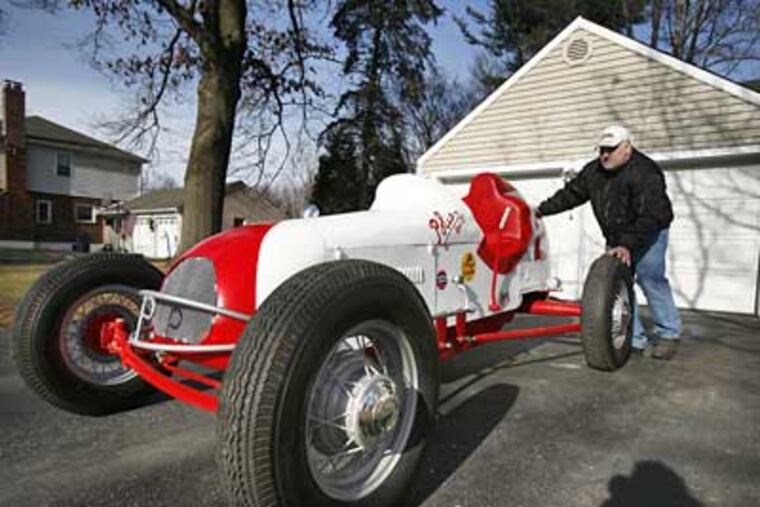
Sometimes his wife would hear him talking in the garage.
"Who are you talking to?" she would ask her husband, who was alone.
Paul Cavaliere was not embarrassed to admit it. He was talking to dead people, specifically his grandfather and uncle, asking them for help when he was stumped.
His prayers were answered. Again and again, over the course of seven months, questions were resolved, problems surmounted, seemingly as if by supernatural power. And now the object of those intercessions is nearly complete and can be seen in all its proud homemade glory: an open-wheel race car of the sort that sped around the track at Indianapolis in the 1930s and '40s.
Cavaliere built the car from scratch as a tribute to his uncle Ronny Polis, an amateur race-car driver who perished in 1957 when his car flipped during a race at a track in Hagerstown, Md.
Racing runs in the family. Cavaliere is a passionate drag racer and his late grandfather, William Polis, was a pit-crew worker at the Indianapolis Motor Speedway.
In the '30s, '40s and '50s, Cavaliere's relatives and other local car-racing enthusiasts didn't have to travel far. There were oval tracks in Hatfield, Langhorne, Flemington, Allentown and Reading, and a quarter-mile dragstrip at the Vargo Dragway in Perkasie.
On the wall of his garage in Warrington, Bucks County, Cavaliere keeps an 8-by-10 photo of Polis at the wheel of his midget race car. It was the model for the car Cavaliere constructed, which resembles his uncle's car in style, form and color, but is longer, wider and higher. Not only does this makes it dimensionally more akin to a vintage car of the sort that might have competed at Indy, but it also enables Cavaliere, a burly barrel-chested former weightlifter, to fit inside the cockpit.
Cavaliere favors dragsters, which roar point to point in a straight line, usually in a matter of seconds. But a 2006 visit to Chris Leydon's vintage race-car restoration shop in Buckingham heightened his interest in what he calls "roundy-round" cars - cars that race around a track. He came home charged up and determined to make a car just like Uncle Ronny's.
It would be a challenge, but hardly insuperable and not altogether novel. Cavaliere, 42, who works as an assembly and test technician at Fluitron, a manufacturer of high-end compressors in Ivyland, is mechanically gifted. He learned his skills the old-fashioned way, by watching and doing and apprenticing himself to masters. He has worked in a machine shop and knows how to rejuvenate an engine.
Over the years, Cavaliere has built hot rods, muscle cars and choppers. In 1990, he found the skeleton of a 1959 Lyndwood dragster and restored it to pristine, race-ready condition. This rare showpiece occupies the other half of Cavalier's two-bay garage and workshop.
Nevertheless, the new project would test his genius. He had no plans, drawings or blueprints. His only references were pictures of his uncle's car. He calculated dimensions based on estimates of his uncle's height and the size of his torso as revealed in photographs.
"I'm not afraid to start something," Cavaliere says. "And when I start something, I finish it."
He began the project in the summer of 2007, but while retrieving a rear axle at a junkyard near Lambertville, N.J., he ripped apart his biceps muscle, hardly a promising omen. His arm in a cast, he spent the winter locating and collecting parts, with tremendous assistance from the Internet.
Indeed, the car is a Frankensteinian hodgepodge, with a four-cylinder flathead engine and three-speed transmission from a 1931 Model A Ford; a front end from a 1942 Ford; a steering box from a 1968 Dodge; wire wheels from a 1935 Ford that was decaying in a field in Indiana; and original tires from a 1935 Ford that was in a museum in upstate New York. What parts Cavaliere couldn't find or scavenge, he fabricated himself.
He tackled the project in earnest last spring, working on Sundays and some weeknights. He did all the work in his garage and made do with the tools he had on hand. He configured the frame first in wood, then welded an exact steel version.
While he purchased the fiberglass nose and tail of the racer, he made the cowl and bonnet himself, pounding out the compound contours from a sheet of aluminum with a homemade wooden mallet and a dolly fashioned from a 4-by-4. He used PVC pipe of varying diameters as forms for the broadening curves and punched out the louvers with the help of a friend.
The intake and exhaust manifolds he fashioned himself. He also made the brackets and links for the shocks, altered the radius rods that stabilize the axles, and crafted the grille and front bumper, which feature the letter P for Polis. Based on his cardboard templates, his wife, Norma, sewed the red seat upholstery, and Cavaliere rigged up a booth so he could paint the car himself. On both sides of the tail are big red 2's - his uncle's number - and in script on the side of the cowl are the words "Polis Special II."
Although Cavaliere tried to make the car as original-looking as possible, he was not averse to a few modern modifications. It is equipped with an electric starter, for instance, and an electric pump supplies fuel to the carburetor from a rear-mounted gas tank.
Cavaliere finished the car in early October. Total sweat equity invested: 165 hours. He kept it a secret from all but his immediate family. The reaction of his mother and uncles when he unveiled it? "They couldn't believe I made it."
Cavaliere still needs to install a radiator before he can rev up the engine and drive the car. But he has already trailered it to one show, where onlookers responded with admiration and curiosity.
Those who've seen the car usually assume it's a beautifully restored relic, and Cavaliere obliges them with a fictitious pedigree: He found the car in a barn in Hatboro, he tells them, and his Uncle Ronny used to drive it at the Warminster Speedway.
"You didn't know there was a Warminster Speedway?" Cavaliere asks.
He then produces a copy of a plan for the elaborate horse, auto and airplane racing complex that was proposed in 1914 for a site at the intersection of Street and York Roads. The track never came to be. Construction was halted by World War I, but the section of Warminster where the track would have been built is still known as Speedway today.
For Cavaliere, the race car is the embodiment of "a passion" that is nourished in part by his fascination with the artifacts and lore of local racing history.
"To me, it's like keeping something going," Cavaliere says. "It's all going to die eventually if nobody tries to save this stuff."
If only Uncle Ronny were alive and could see this magnificent mobile memorial, imagine how pleased and awestruck he'd be.
"I think he was here already," says Cavaliere. "He's been watching all along."