Doctor who checks credentials faces questions over his own resume
As chief medical officer of Main Line Health, Donald C. Arthur helps vet the credentials of 1,200 physicians working for the prosperous hospital network in Philadelphia's western suburbs.
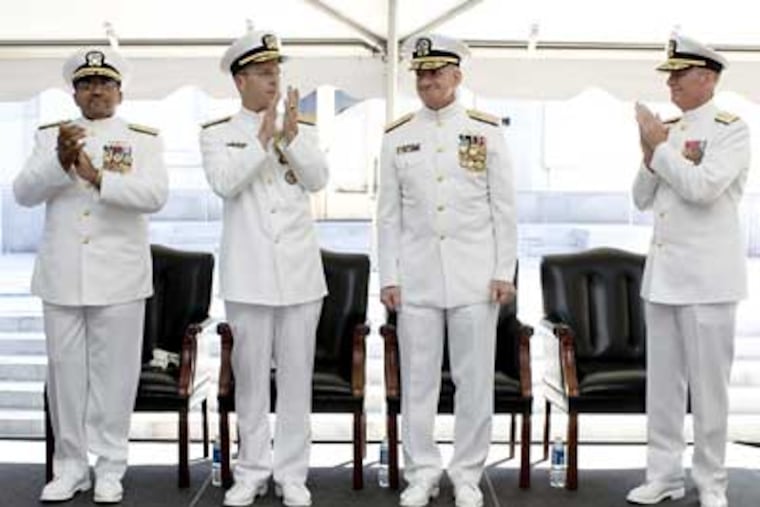
As chief medical officer of Main Line Health, Donald C. Arthur helps vet the credentials of 1,200 physicians working for the prosperous hospital network in Philadelphia's western suburbs.
But the Navy's former surgeon general has long faced questions about the accuracy of his own resumé.
At least four official biographies have credited Arthur with a nonexistent master's degree - one that he agrees he never received.
Over the years, his resumé also has listed a Ph.D. and a law degree from two unaccredited schools, including one that closed after its leader pleaded guilty to fraud.
To the dismay of some veterans, Arthur has told Congress and others that he served in combat during the first Gulf War, though records show that his unit was never in battle.
"Arthur jumped over a bunch of qualified officers who told the truth, and he appears to have done it based on false information," said B.G. Burkett, an award-winning author who investigates military frauds.
The Navy's chief spokesman, Rear Adm. Frank Thorp, said a "preliminary inquiry" found no wrongdoing by Arthur before his 2007 retirement. Arthur wouldn't authorize release of the report.
The tall, silver-haired Arthur, 59, said the questionable degrees were innocent errors that had no bearing on his promotions.
During a 75-minute interview at the original Bryn Mawr Hospital building, accompanied by Main Line Health's chief spokeswoman, Arthur said he never claimed to have a master's, only that he took master's-level courses, and that he did real work to earn the law degree and Ph.D.
He declined to describe his combat role. He said he would rather focus on efforts to improve care at Main Line.
"I'm an honorable person who has led an honorable life," he said.
The controversy about Arthur's three questionable degrees was first documented by the Chicago Tribune in October. A former FBI agent specializing in academic fraud plans to cite Arthur's case in a scholarly article. Last year, Main Line Health changed his biography to show that he did not serve in combat in the 1991 Gulf War.
"In 44 years in the Navy, I have never seen anyone at any rank have such bogus credentials be in such a position of power, prestige and leadership," said Benjamin Newman, a Maine doctor who retired from the Navy in May.
"Isn't it paradoxical that someone with such problems would be now in a position to make judgments about others' credentials?"
Arthur's long list of degrees was noted even at his retirement ceremony in 2007.
"B.A., M.A., J.D., Ph.D and of course M.D. - he's got more degrees than a thermometer," said Adm. Mike Mullen, chairman of the Joint Chiefs of Staff and then-chief of naval operations.
Anthony V. Coletta, Bryn Mawr's medical-staff president, said he was surprised to learn of the questions about Arthur's degrees. Coletta said Arthur has had a positive impact on patient care and had addressed "sometimes difficult situations with doctors" over his 14-month tenure.
Besides his $420,000 base salary from Main Line, Arthur receives a $137,724 annual pension for his 33 years of Navy service.
Main Line's top executive said he, too, supports Arthur, and noted that the questionable degrees were not in the resumé sent to the network.
"I don't believe there is a credentialing problem here," said Main Line CEO Jack Lynch, calling Arthur "a perfect fit" with the system.
Checking the academic, professional and disciplinary records of doctors is key to ensuring quality, and is required by federal law. There's no indication that Arthur has been lax in those duties.
No combat record
Some veterans dispute Arthur's claim that he served in combat in 1991 and merited a Combat Action Ribbon.
Arthur's Navy retirement form lists the ribbon among his awards, and various bios maintain that he saw action in the first Gulf War.
Arthur has also spoken publicly about the impact of his combat experience. In July 2007, he told a U.S. House subcommittee: "Having been in combat, I know that no one goes into combat and comes out without being significantly affected."
The Marine Corps' official history of his unit makes no mention of any combat.
Frederick M. Burkle Jr., who was the top medical officer of Arthur's unit in Saudi Arabia, said, "We could certainly see the war was going on at a great distance, but we were not hit and we did not receive any fire."
Arthur said, "I don't know that it is productive to get into 'how did you qualify [for a combat ribbon], what did you do.' "
Navy spokesman Thorp said the 2006 review found "no impropriety on the surgeon general's part concerning his belief that he had earned the Combat Action Ribbon."
A year after that inquiry, the claim of combat resurfaced. A 2007 Defense Department report on mental-health services states: "In 1991, Dr. Arthur served in combat operations with the Marine Corps in Desert Storm."
In March, when Arthur endorsed Sen. Hillary Rodham Clinton's bid for the Democratic presidential nomination, her campaign stated that he had been in combat.
Main Line Health's Web site originally said Arthur "saw combat action." That was later changed to say he had a "combat service support role."
Degrees 'at a fraction'
In June 1992, Century University in New Mexico awarded Arthur a Ph.D. in health-care management.
Now called American Century University, the school is not accredited by any group recognized by the U.S. Department of Education. Its Web site says its degrees can be obtained "at a fraction" of the cost of those from traditional universities.
Arthur said he wrote a 350-page dissertation: "Policies and Procedures for a Model Emergency Department." He declined to make the document available.
Arthur received the law degree from LaSalle University in Louisiana in August 1993, 14 months after the Ph.D.
LaSalle, which has no connection to Philadelphia's La Salle University, was cited by federal investigators as a diploma mill that government and military officials used to bolster their credentials.
In 2004, Robert J. Cramer, managing director of the General Accounting Office, told the Senate about an Air Force lieutenant colonel who paid for a LaSalle degree "to advance his career."
"He did not attend classes or take any tests, his master's degree from LaSalle was a 'joke,' and he received it after paying approximately $5,000," Cramer testified.
LaSalle was raided by the FBI in 1996. Its founder pleaded guilty to fraud and tax evasion. The school has closed.
"There is something odd about his interest in collecting credentials that he knows aren't very meaningful," said Maurice Schweitzer, a Wharton School associate professor who studies business ethics. "Anyone that has used what are weak credentials to seek promotion shouldn't be in a position to evaluate credentials of others."
Arthur said that he did extensive course work to earn both the law degree and the Ph.D. and at the time believed the schools had "appropriate accreditation."
Thorp, the Navy spokesman, said the Navy does not recognize degrees from "known diploma mills." He declined to elaborate on Arthur's case.
The master's degree first appeared in Arthur's paperwork when he joined the Navy in 1974, Thorp said.
Arthur blamed the error on "the administrative person who put the information down and apparently misunderstood that an M.A. program is not a degree."
Four years later, in his last year of medical school, the master's reappeared. His 1978 medical school yearbook says he had a master's in genetics from Northeastern University in Boston.
Arthur could not explain how that mistake occurred, adding, "I have never claimed to have an M.A."
Records reviewed by The Inquirer show that the master's was cited twice more when Arthur's service record was submitted to Congress for promotions.
In 2002, when Arthur was up for a second star, the nonexistent master's, the Ph.D., and the law degree appeared on his transcript.
In 2004, when Arthur was nominated to be vice admiral and the Navy's surgeon general, the law degree was stricken but the master's and Ph.D. remained.
When his medical school gave him a distinguished alumnus award in 2005, the law degree and Ph.D. were listed, records show.
The way the Century and LaSalle degrees appeared and reappear in his resumé are red flags, said retired FBI agent Allen Ezell, who investigated diploma mills.
Now a fraud investigator for Wachovia Bank, Ezell has included Arthur in a draft of an article for the American Association of Collegiate Registrars and Admissions Officers' magazine.
"I contend he knew what he was doing regarding his Ph.D. and J.D. - he did not get to be a vice admiral by being naive or stupid," Ezell wrote in a draft of the paper.
In 2005, Burkett questioned Arthur's degrees - and various military awards - in a letter to Adm. Mullen.
That prompted the Inspector General review, which cleared Arthur in 2006, but found the master's was listed in his commissioning papers.
Arthur said the controversy was behind him.
"The pot-stirrers want to keep bringing things up - calling my friends, calling my family, calling everybody I am acquainted with and making all manner of accusations," he said. "Quite frankly, I'm done."