Remembering John Updike amid scenes from his novels
Friends and fans gather at a college in Reading.
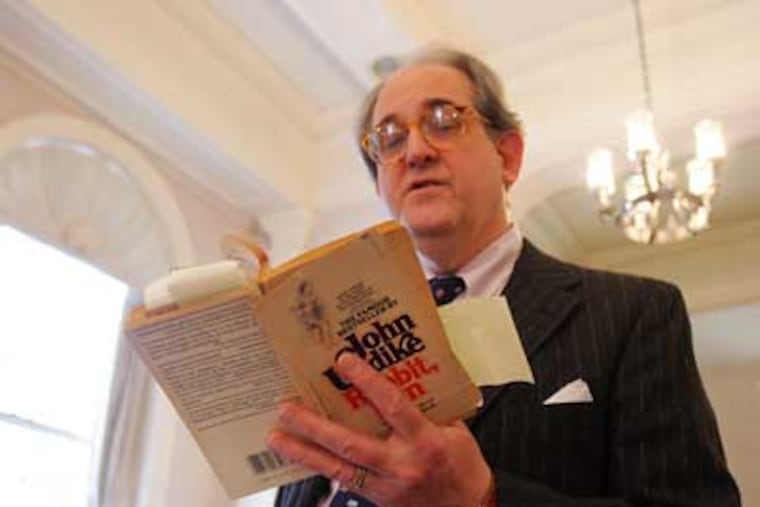
A wet snow dropped like tears on Albright College's campus yesterday afternoon in Reading as friends and fans of John Updike gathered to commemorate the author's connections, both real and fictional, to his native Berks County.
Albright professors, elementary-school classmates and self-described "Updike stalkers" attended the hastily planned memorial service in tiny Kachel Chapel.
The funeral for Updike, who died last week at 76, had been a day earlier, in his adopted Massachusetts. He will be cremated and his ashes scattered there.
But it is Berks County that remains the landscape of his greatest work. Moving about Reading, or Shillington or Plowville, it is virtually impossible not to encounter some setting from a novel, short story or memoir. The prolific author, in the words of one speaker, "transported our city into the realm of eternal fiction."
Just a few hundred yards away from the chapel, across 13th Street, stood the college's football stadium, where Updike began one of his most tender stories, "In Football Season."
"I remember the smell of the grass crushed by footsteps behind the end zones," he wrote of a long-ago Friday night game there. "The smell was more vivid than that of a meadow, and in the blue electric glare the green vibrated as if excited, like a child, by being allowed up late. I remember my father taking tickets at the far corner of the wall, wedged into a tiny wooden booth that made him seem somewhat magical, like a troll."
As the service displayed, many here adored Updike and his work. And the author, throughout his life, returned the feeling.
"We sort of felt, 'There's enough here. We don't need to know anybody outside of Shillington,' " Updike recalled of his boyhood in an interview that Albright lecturer Dorothy Hoerr shared.
Still, there were more than a few here who felt betrayed by his books' unstinting detail and sexual candor.
"The world loved his work," said one former classmate who asked that her name not be used, "but in Shillington, a lot of people wondered what all the fuss was about."
Albright English professor Richard Androne recalled the trustees meeting in 1982 when the college considered granting an honorary doctorate to Updike.
"One trustee rose to object," Androne noted. " 'He writes dirty books,' he said."
The degree was granted nonetheless.
Hoerr interviewed Updike several years ago for a 250-word article in a monthly Berks County magazine.
"He was so gracious," she said. "The interview went on for 13 pages."
In the portion Hoerr read at the service, Updike remembered Shillington, where he lived until the family moved to Plowville when he was 13.
"I remember when I won a little Mickey Mouse bank for winning a spelling bee in third grade," he told her, adding that he'd also won a freckle contest at Shillington Playground.
Joan Venne Youngerman, a Shillington native and classmate of the author's, said the two of them, with names coming so late in the alphabet, sat near each other all through their school years.
"He came back to visit often," she said, before describing a scene that symbolized the small-town innocence Updike so often portrayed. "We'd sit on our porch on Gregg Street and have lemonade."
Youngerman said she and others in their Shillington High class of 1950, for whose reunions Updike unfailingly returned, are asked often to identify the model for the author's most famous character, the faded basketball star Rabbit Angstrom.
(The author said in a 2005 C-Span interview that Angstrom was a composite of fallen athletes his teacher-father had known.)
"I don't know. And I don't why anyone would want to be Rabbit," Youngerman said. "None of us did that poorly."
Albright English instructor Maria Mogford grew up in Reading, but never read Updike until she was a second-year graduate student. She quickly became a fan and wrote the author, suggesting he had been neglected by his hometown and asking for permission to turn some of his work into theatrical productions.
"I have really not lived there since I was married in 1953," Updike wrote her, politely turning down her request in the typewritten letter. "So I might say that I neglected it rather than the other way around."