Museum-quality love letters
English poet John Keats was dying of tuberculosis when he wrote in 1820 to longtime love Fanny Brawne: " 'Tis certain I shall never recover if I am to be so long separate from you."
English poet John Keats was dying of tuberculosis when he wrote in 1820 to longtime love Fanny Brawne: " 'Tis certain I shall never recover if I am to be so long separate from you."
Keats was leaving soon for Italy, hoping to improve his health. "I cannot live without you," he declared, also warning the sometimes flirtatious Fanny not to write back "unless you can do it with a crystal conscience."
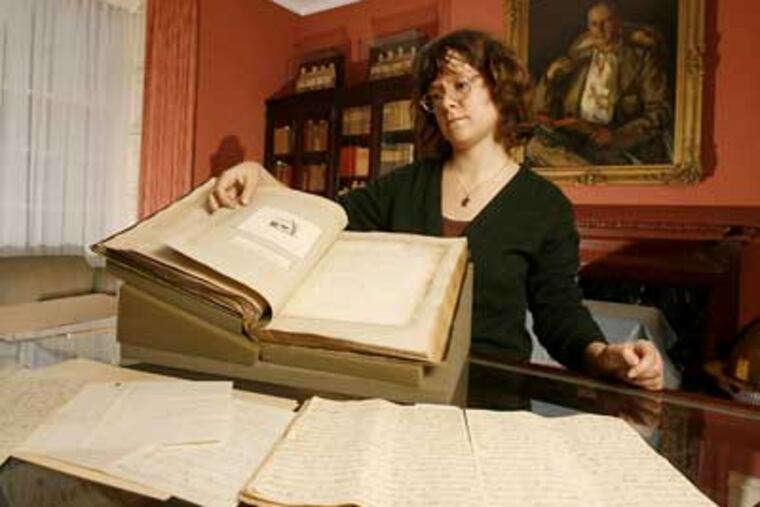
He died several months later, but his letter and love for Fanny live on this month at the Rosenbach Museum and Library in Rittenhouse Square. Visitors seeking inspiration for Valentine's Day can read several love letters, poems and other documents from the museum's collection.
Although the letters vary in age - the oldest is from 1775, the newest from the 1930s - all have one thing in common: "Passion," said Rosenbach education coordinator Farrar Fitzgerald, who will lead the tours.
One letter, from dancer Isadora Duncan to her lover Mercedes de Acosta in 1927, was so passionate Fitzgerald later decided to take it out of the tour's lineup.
A letter from another one of de Acosta's paramours, actress Marlene Dietrich, did make the cut. In the letter, which is undated but likely from the 1930s, Dietrich begs de Acosta's forgiveness for an unnamed mistake.
"I wanted to heal all your wounds and instead, because I see that I can't heal them, I give you new ones," she wrote. "I wanted so much to give you happiness."
Fitzgerald said that while Dietrich's scrawled handwriting is almost unreadable, "part of the excitement is trying to struggle through."
Other letters on the tour err on the side of practical.
Founding Father and local doctor Benjamin Rush wrote a series of letters to his future wife, Julia, in 1775 laying out his ideas on marriage.
Rush wrote to her that there are eight levels of a happy partnership, which include not just "animal love," but also agreement in taste and temper.
"The more married people think alike upon all subjects," he wrote, "the less danger there is of disputing."
The letters come from the museum's permanent collection. Brothers A.S.W. and Philip Rosenbach bought the letters, along with hundreds of thousands of old books, artwork and artifacts, during the late 19th and early 20th centuries.
Before their deaths in 1952 and 1953, the brothers converted their home on Delancey Place into a museum to house their collection. It opened to the public in 1954.
Although the hands-on tour was organized to celebrate Valentine's Day, Fitzgerald said it also reflects a general interest in old love letters.
Deirdre Mahoney, a communications professor at Northwestern Michigan College who has written about 19th-century courtship rituals, said the public is fascinated by such letters because of how intimate they are.
"It's a private location where folks get to date and they can gaze and flirt and flatter," Mahoney said. "We're voyeurs. We love to watch that unfold."
Fitzgerald said she believes that the public is interested in old love letters because people just don't write them anymore, and that many don't because they "aren't as confident in their writing as they used to be.
Romance coach Leslie Karsner, who is based in Yankeetown, Fla., said that the sheer amount of time it takes to write a good love letter can be daunting for modern-day romantics. Karsner is one of the growing number of online purveyors of prewritten, customizable love letters.
"It means slowing down. It means turning the TV off or closing the office door," she said. "And that's not always easy to do."
An October survey by AT&T found that 68 percent of users had sent a romantic text message. The survey also found that for more than half of texters, "Thinking of you" is the most popular message.
"There are still people out there who are true romantics and believe it should be on pen and paper," said Allison Ray, director of marketing for AT&T's Philadelphia region. "But if you want to get the message out fast, texting is the way to get it out there."
William Decker, an English professor at Oklahoma State University who wrote a book on letter-writing practices, said texters and e-mailers can still relate to old love letters because the message has stayed the same.
"Anyone who has been in love, or has been separated from the person with whom they are in love, can generally identify with the whole activity of trying to make contact across states and through time," Decker said.
Still, Mahoney worries that unless couples print out their romantic e-mails, future generations won't have letters like the ones at the Rosenbach to study or read for romantic inspiration.
"We won't have the artifacts and those keepsakes, wrapped under the bed with a silk ribbon," she said.
The hands-on tours are planned for Wednesday and Friday and March 25. Fitzgerald said organizers might run one a month after then. The tour lasts about one hour, and is free with admission to the museum. Groups are limited to six, and visitors must be at least 8 years old.
Seven of the documents will be passed around as part of the tour. Most of the letters are in extremely fragile condition, so visitors will be required to wash their hands before touching them. The Keats letter will not be passed around.
In honor of Valentine's Day, the Rosenbach will also run special "Romance at the Rosenbach" tours throughout February.
If You Go
For more information on times and admission, visit www.rosenbach.org or call 215-732-1600.