Craft Market at Convention Center
This weekend, the Convention Center is replete with some of the most exquisite high-end crafts you'll ever lay your eyes on.
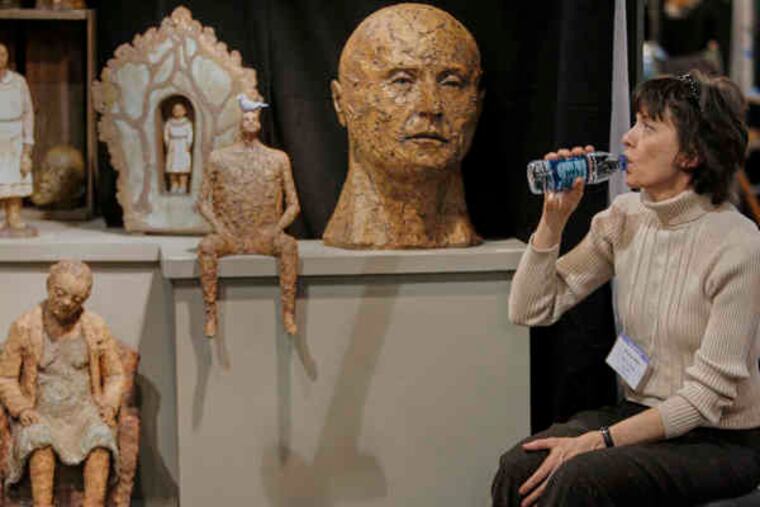
This weekend, the Convention Center is replete with some of the most exquisite high-end crafts you'll ever lay your eyes on.
Jeweled kaleidoscopes that look as if they had come from Princess Anastasia's steamer trunk. Hand-carved wooden vessels as big as dinosaur eggs. Floor lamps with long, thin stems bursting into blooms of handblown ruby and emerald glass. Supple leather shoulder bags with a large turquoise stone magically embedded in the flap. Ceramic vases with cutout flower petals along the rim, laced with gold and enamel.
They're all for sale. But here's the catch. You can't buy any of them. You can't even get in to see them.
Twice a year, about 1,200 artists convene here for the Buyers Market of American Craft, one of the largest wholesale craft trade shows in the country. They come from big cities like Atlanta and Los Angeles and little towns like Tamworth, Ontario, and Loveland, Colo.
They come to sell their work to 2,500 shop owners and wholesale buyers. During the next six to 10 months, the goods will be produced, shipped, marked up, and put on shelves. You'll find them in museum gift shops, small stores, and art galleries in Martha's Vineyard or Avalon or Santa Monica, ski-resort shops in Jackson Hole - and a few hip places in Center City and Manayunk and Jenkintown and Lambertville.
Even though there is not a single item in the acres of stuff that anyone really needs, it's being sold anyway. And this year, in this recession, the artists are not as nervous as you might think.
"You're not supposed to survive as an artist anyway," said Matt Schwartz, a 34-year-old photographer from Brooklyn, N.Y., "but I've been doing really well."
Over Christmas, Schwartz, who creates dreamy pastel images from Polaroid pictures, made $40,000 in sales at a craft show in Manhattan.
"We've heard from some buyers who had been coming here for years who said they were skipping the show this year," said Karen Steininger, a potter from Altoona, Iowa. She and her husband make mugs that read "Master of all he surveys" and corked jars marked "Ashes of problem students."
Sales, however, have been steady, said Steininger. "Especially our items that are more cynical."
As unemployment rises and stocks self-immolate, people seem to be snappish. Small plaques that read "Suck it up" and "My way or die" have been more popular than ever, she said.
At a seminar Thursday, the first day of the convention, first-time artists were coached on how to deal with the bad economy.
"Check your buyer's credit," the motherly expert cautioned.
She added that they shouldn't feel obliged to be too generous. "Everybody here has an aunt or uncle in Philadelphia and gets passes for them to come onto the floor, but you don't have to give all of them the full 50 percent off."
Several artists said they were adapting their work to fit the national melancholy.
"I've literally painted over my serious work," said Linda Chamberlain, a mixed-media artist from Michigan. "I'm doing happier work now."
One of her most popular creations is a whimsical painting of a dog sitting in the bed of an old jeep, looking at the sky on a mountaintop.
"Basically, we want to feel good," said Chamberlain. "People like animals. They like the retro feel of the jeep." As long as the colors are uplifting and the images cheerful, "people are still hungry for art."
Since most of the artists are self-employed and their materials often are not cheap, the credit crisis has weighed heavily.
"I'm maxing out my credit line," said Jill Schwartz, an internationally known artist who makes jewelry and crafts called "Elements" from her home in western Massachusetts. (Her work used to be sold in the now-shuttered American Pie stores in Philadelphia.)
Schwartz, who has 11 employees, said she went to her bank last week to see if she could get an extra $50,000 in credit.
"I heard they had received part of the stimulus package," she said. "If it was what it was cracked up to be, they would be loaning to small businesses."
Her banker, however, told her that she would have to prove she wasn't a risk. "But everybody who needs credit now is a risk," Schwartz said. "I told him I didn't want to cut workers."
The banker responded, "Well, maybe you should think about it."
Instead, Schwartz decided to cut back everyone's hours. "They were all pretty understanding," she said.
At the show, which ends tomorrow, her booth was bustling with buyers.
"We'll see," she said. "Little companies like mine have been feeling the pressure for the last few years. Now everyone's getting hit. It's interesting to know you're not alone. In a way, it feels like recognition."