Annette John-Hall: After police shooting, don't write off a generation
Tragically, it has become Philadelphia's template for sorrow. Another police officer killed. Another family torn apart. Another memorial. Another long line of solemn-faced officers paying respects, their badges swathed in black.
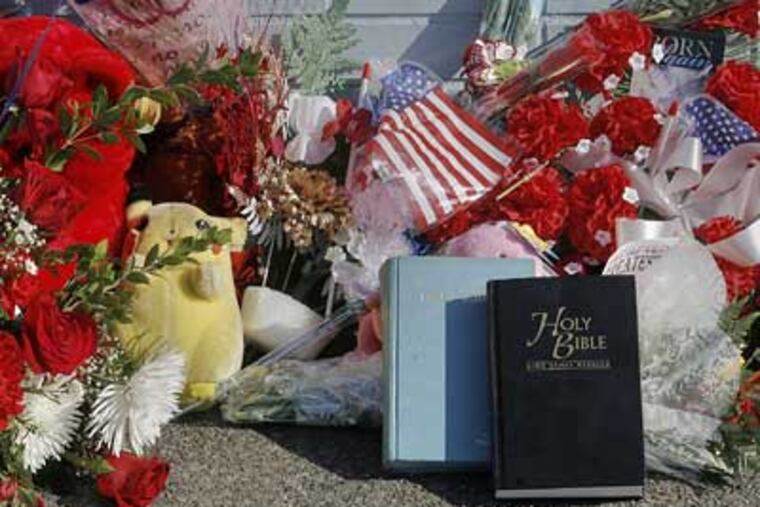
Tragically, it has become Philadelphia's template for sorrow.
Another police officer killed.
Another family torn apart.
Another memorial.
Another long line of solemn-faced officers paying respects, their badges swathed in black.
Another hearse.
Another funeral. And another black eye for a city already reeling from seven other police deaths in less than three years.
Officer John Pawlowski, only 25 and an expectant father, became No. 8 Friday night when, police say, 33-year-old Rasheed Scrugs killed Pawlowski with a .357 Magnum he had hidden in his coat pocket.
I mean, there are predators who live among us - cold-blooded career criminals who think nothing of killing anybody who crosses their path, especially the cops who put their lives on the line to protect us every single day.
I don't know about you, but I'm sharing the raw anger and frustration Commissioner Charles H. Ramsey had to be feeling when he said that Scrugs, who was critically wounded by cops, should have been killed.
"He wasn't hit enough," Ramsey said. ". . . I don't care."
Feeling helpless
For decent, law-abiding citizens worn down by too much violence, we're feeling a palpable helplessness to go with our outrage.
You just want to scream at these thugs, "Who the hell raised you?!"
Sure, it's tempting to throw up your hands and write off a whole generation of young men on their way to becoming Rasheed Scrugses. As a seething Ramsey declared Saturday at a news conference: "Lock them up, throw away the key. Build another prison. Don't let them out."
But somewhere along the way, we have to step in. Because there's a fine line between the path Rasheed Scrugs took and the path Charles Gibbs is taking.
We may have been tempted to give up on someone like Gibbs, a third-year law student at Widener, who eight years ago was voted the city's youngest block captain.
He was only 18.
Like Scrugs, Gibbs, now 26, grew up poor and black in West Philly.
His neighborhood, around 58th and Baltimore, produced everyone from saints to sinners.
"Some of my friends have become pastors of churches and professors. But I've buried friends and sat in on trials of friends who were sent up for the rest of their lives," he says. "In West Philly, there's no set formula for what will happen to you."
Caring adults
Gibbs, who, like plenty of kids, was smart and inquisitive but easily distracted, benefited from caring adults who worked together for his good.
And most important, no one gave up on him.
Not his mother, who raised Gibbs and his sister alone, and scraped to send them to Catholic school. Or block captains like Blanche and Herman Nixon, who would not hesitate to correct Gibbs when they saw him doing something wrong.
Or the 18th District cops who let him go on ride-alongs with them.
A lot of Gibbs' friends became police officers because of those caring cops. That's part of the reason this rash of shootings sickens him so much.
"I'm disappointed that African American men who look like me are killing cops," Gibbs says. "And I'm nervous that the cops think all African American men share the same hate toward the Police Department. Because I know beyond a shadow of a doubt that it's not true."
So what can we do?
Well, Gibbs intends to get his law degree and work in his community.
"We have to take proactive roles," he says. "Speak up when you see something wrong. I've always found that three guys on a corner are outnumbered by 60 people on a block."
And above all, Philadelphians need to put aside whatever skepticism they may have and support the police - especially now, when they're hurting. "They have to be uplifted," Gibbs says.
"The police are our public servants. They're residents of Philly who are doing their part.
"If they haven't given up, who am I to give up?"