Commitment unites Rutgers-Camden team
The Scarlet Raptors of Rutgers University-Camden, while not the best college men's basketball team in America, may be the most committed.
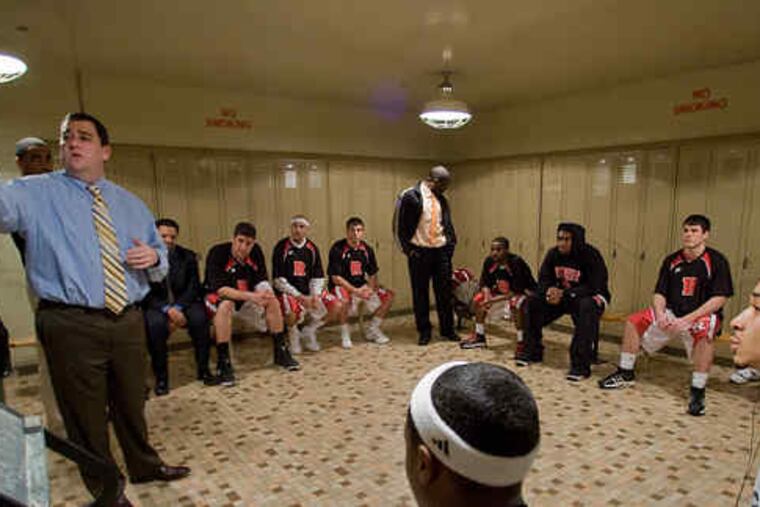
The Scarlet Raptors of Rutgers University-Camden, while not the best college men's basketball team in America, may be the most committed.
This season, the New Jersey Athletic Conference school is renovating its gym, so the team played most home games in another county, 30 minutes away if traffic cooperates.
At any school, that's a hardship. At Division III Rutgers-Camden, just add it to the list. The team's leading scorer works two jobs. The No. 2 scorer works five overnights a week at Philadelphia International Airport, from 2 to 8 a.m.
"He sleeps, literally, on Sundays," his coach said.
The coach, Brian Wischusen, in his third season at Rutgers-Camden, said of his players, mostly commuters: "They're bouncing back and forth from real lives."
The Scarlet Raptors were winless in the NJAC, 5-16 overall, going into a home-away-from-home game last week against the College of New Jersey. They played as if first place were on the line. They scored the game's first nine points, played pressure defense throughout, kept making the extra pass, and withstood multiple challenges from their conference rival to pull out an 83-77 victory.
There was no storming of the court, since the home crowd was a couple of dozen relatives and the women's team, which makes its own commute for games.
But set aside the X's and O's. To understand the commitment Rutgers-Camden players make, find a mass-transit map. Junior Tarik Hanton, who lives in South Philadelphia, picks up the No. 17 SEPTA bus most mornings at 20th and Passyunk, he said, and takes it to Eighth and Market, where he catches a PATCO train to Camden for classes. Then Hanton gets on a shuttle bus for practice 20 minutes down the road at RiverWinds in West Deptford or, for games, at least 10 more minutes away at Gloucester County College.
Most days, Hanton is in three counties, getting from Philadelphia to Camden County to Gloucester County, then reversing the route. A couple of players commute from Burlington County. Center Mike Meloni lives in Palmyra, and guard Brandon Canty comes in from Riverside.
"They drive or take the River Line," Wischusen said. "The River Line is helpful. The problem with the River Line is if we get back too late, the River Line shuts down."
On a given day, junior Chris Clahar, the team's second-leading scorer, sets foot in the most counties. He lives in the Overbrook section of Philadelphia, so to get to campus he'll take the No. 65 bus to 69th Street in Upper Darby, get on the Market Street El heading back into the city, transfer to PATCO to Camden, and end up at Gloucester County College. If you're scoring, that's Philadelphia to Delaware County back to Philadelphia to Camden County and then to Gloucester County.
Unless he's at the airport. He works as a screener at Terminal A.
"I've got to really divvy up my time correctly," said Clahar, who, like Hanton, came to Rutgers-Camden from Community College of Philadelphia.
"We've got guys with kids who have full-time jobs to support their families, yet they still make the commitment to show up for practice and work just as hard," said senior guard Bill Banks, from Berlin, who scored 26 points against the College of New Jersey. He works two days a week as a laborer in a machine shop and weekends at a caterer.
Only five players live on campus. The guys who can't get home sometimes crash on a couch. There were "true growing pains," said Wischusen, the coach. In the beginning, he said, there were cliques, "the guys who live on campus, off campus." They've really come together while still learning how to win, to finish off games, he said.
Ask Hanton, the team's top rebounder, about commitment to his sport, and he'll tell you how, while living in North Philadelphia, he was selected to play in an all-star game in Northeast Philly.
"I didn't have money to get to the game. I walked from North Philadelphia to the Northeast," Hanton said. "It took me like three hours to get there. I was like 14. I worked hard in the league. I said, 'I'm not missing the game.' "
These guys have never been defined by their gym.
"The gym around my neighborhood, it wasn't open that often," Clahar said of growing up in Overbrook. "Snow, sleet, rain - I was always out there at the playground."
Clahar, who had to get to the airport afterward, sat on the bench for the College of New Jersey game. He had torn the meniscus in one of his knees and has surgery scheduled for next month, he said. He wasn't sure whether he would play again this season. He had tried in a game the week before.
"That day, I was having trouble walking, let alone playing," Clahar said. "It's hard for me to get any type of bounce."
He just didn't want to call himself done. The trip had been hard.
"I think a lot of bigger schools, if they had gone through something like this, a lot of people would have dropped off," Clahar said.