Monica Yant Kinney: For gambling addict, N.J. list is a loser
Four years ago, Scott Jones rolled the dice. The Barrington man already was battling Parkinson's disease when he realized he had become a gambling addict. So Jones put himself on New Jersey's self-exclusion list, believing the bold step would bar him from entering Atlantic City casinos and blowing his disability checks on the slots.
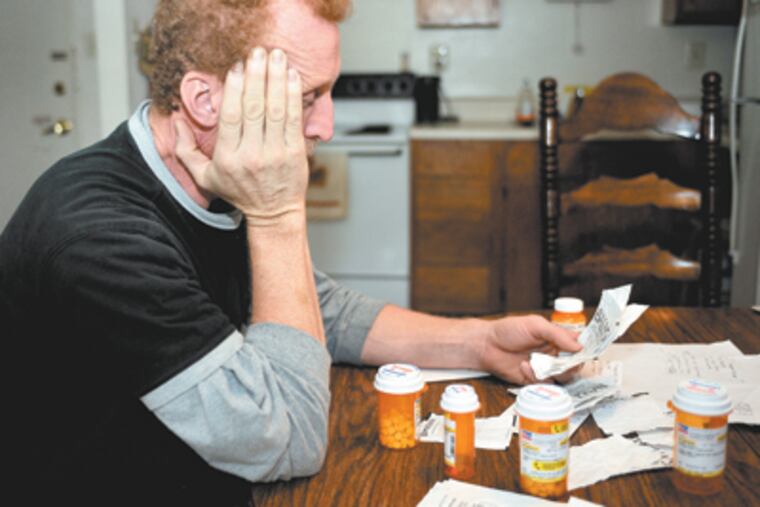
Four years ago, Scott Jones rolled the dice.
The Barrington man already was battling Parkinson's disease when he realized he had become a gambling addict. So Jones put himself on New Jersey's self-exclusion list, believing the bold step would bar him from entering Atlantic City casinos and blowing his disability checks on the slots.
"I'm ashamed. I'm embarrassed. I know I'm ultimately responsible for my actions, but this is an addiction. I need help," he says. "Putting myself on that list, I felt relief."
Just as he should have, since casinos and politicians tout the list as a way to save problem gamblers from themselves.
Gambling may be new to Pennsylvania, but 581 people already are on its self-exclusion list. As part of the hoopla surrounding National Problem Gambling Awareness Week at the start of the month, the New Jersey Casino Control Commission celebrated the poor soul who sank so low he/she became the 1,000th name.
"Gaming should be entertainment," Linda Kassekert, the commission's chairwoman, tells me. Casino operators take problem gambling "very seriously. . . . They've been very proactive on the issue."
Really? Jones tells me he resumed his habit six months after hoping he wouldn't - naively assuming he couldn't. Since then, he has bet and lost big all over town.
"I've gambled at least 30 times since I went on the list," he admits. "Only once was I asked to leave, for trying to cash a check."
Help, please
Two types of gamblers supposedly are banned from the action in Atlantic City.
The 194-name criminal-exclusion list is a publicly accessible Who's Who of bad guys, from "Skinny" Joey Merlino to Gaetano "The Galoot" Vastola. If those folks waltz into Harrah's, alarm bells ring.
The larger self-exclusion group, which Jones joined? Top secret to all but gaming officials and 11 casinos, which are supposed to stop marketing to these addicts.
Donald Trump won't be checking IDs at the doors of his betting parlors, but if casino staffers recognize you, they can ask you to leave.
That's highly unlikely if a gambler is losing. If an addict gets caught winning, he still loses. That's because under the statute, self-excluded players must forfeit spoils to the state; casinos can be penalized as well.
Either Jones is an aberration or the list is a toothless joke. Since 2001, only six casinos have been fined - a mere $105,000 - for letting self-excluded gamblers play.
He spent the rent
Jones began playing the slots in 1999 after separating from his wife. The addiction took root, he said, while he used Mirapex, a prescription drug that a 2005 Mayo Clinic study cited for possibly spurring compulsive gambling in Parkinson's patients.
At 50, the former forklift operator lives alone in an apartment complex for the elderly and infirm.
"I get bored and lonely and sad," Jones, surrounded by pill bottles, tells me in his tiny one-bedroom unit. "I talk myself into going down to the casinos. My mind tricks me into thinking I can win. But then I can't leave until I've lost everything."
Granted, Atlantic City casinos are busy places. But with his red hair, halting walk, and frequent tremors, Jones stands out in a crowd.
"They know me," he insists of casino staff. "They all know me."
In the wee hours of March 3, Jones took a bus to Bally's. He began his binge at 5:39 a.m. with $1,916.46 in the bank.
By 8:23 a.m., he was down to $906.46 and had made so many withdrawals he exceeded his daily limit, ATM receipts show. So Jones asked a Bally's employee to fax TD Bank a handwritten request to access more of his money - a favor casinos happily oblige.
(That raises another question: If a bank says you've spent too much, shouldn't Bally's agree? Some riverboat casinos have "loss limits" of $500 a day. Canadian slot machines shut down after 60 minutes of play.)
By 9:29 a.m., Jones' account had dwindled to $471.46. An hour later, he had lost an additional $200.
A balance inquiry at 2:22 p.m. revealed the true cost of one man's gambling addiction: Scott Jones had just $21.46 to his name.
A Bally's spokeswoman calls Jones' story "unsettling," but says his interaction with casino staff was not the type to alert them that a problem gambler was spiraling on the premises. Jones could initiate an investigation with the Division of Gaming Enforcement.
The father of two tears up as he talks about how he'll get by for a month after spending the rent.
"I know I'm a good person, but I deserve what I'm getting," he says. "I want to stop. My ultimate goal is to help someone else."
By speaking out, he may help others more than the flimsy self-exclusion list helped him.