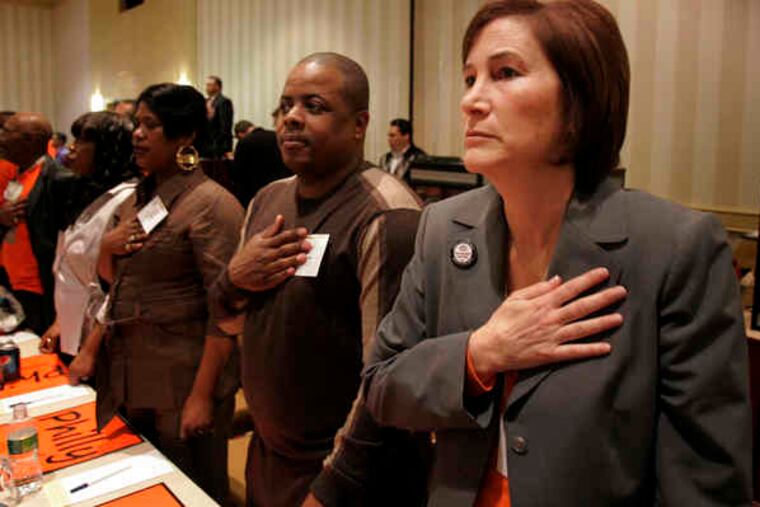
Hundreds of hotel housekeepers, bellhops, and waiters gathered in Philadelphia yesterday for their first convention as a new union.
"This is the most excited I've been in 42 years in the labor movement," said Edgar Romney, the president of the new organization, Workers United, adding that the new union would be better positioned to help workers achieve a better life.
The event even featured a guest appearance by one of the most charismatic and colorful leaders of the labor movement - Andy Stern, the president of the nation's fastest-growing union, Service Employees International Union.
But behind the brave slogans, stirring speeches, and color-coordinated orange T-shirts worn by the 450 delegates was another story altogether. It is a tale, some say, of intrigue and bad faith just as the labor movement, for the first time in decades, has political clout in Washington with the support of President Obama.
The new union is the divorced half - or maybe the divorced third, depending on who is counting - of the July 2004 marriage between Unite, the dwindling union for textile workers, and Here, an expanding union that represents hospitality workers.
That marriage is on the skids, with a dissident group, primarily led by former Unite officials, suing for divorce in federal court.
The dissident group, which includes the Philadelphia Joint Board, argues incompatibility in style, goals, and leadership. "We feel as though the merger has been a failure," Romney said.
At stake are millions of dollars in dues from 380,000 members and a prize jewel: the one and only labor-owned bank.
Meanwhile, a suitor for the new union's members, dues, and assets is waiting in the wings - Stern's SEIU.
"SEIU is quite literally attempting a hostile takeover of the union," said John Wilhelm, a top Unite Here official and a former president of Here who remains in charge of its hospitality division. "If this was really an internal dispute, it would be resolved in the normal course of the processes in the convention," set for June.
Stern said yesterday that he had asked Unite and Here to join his union before they merged. When the two sides began to separate, he repeated his offer to both.
"Like most bad marriages, the disagreements have grown over the last two or three years," said Stern, a former union social worker, who got his labor start in Philadelphia.
"I'm here to talk about how we can build a partnership to organize more workers," Stern said.
The dissident group may take him up on it. "I can't see any disadvantages," Romney said. This time, though, he said, he will add a prenup, opt-out agreement. Yesterday, the delegates approved allowing the new union's board to vote on joining SEIU at a later date.
Because of a storied history that included the International Ladies Garment Workers Union and the fierce organizing battle portrayed in the movie Norma Rae, Unite had resources, including the Amalgamated Bank in New York, founded in 1923. But as textile jobs moved to Asia, Unite's numbers dwindled.
On the other hand, Here's membership was growing with the hospitality industry, and there were plenty of workers to organize. Pouring coffee or changing hotel sheets are jobs that cannot be done abroad. But Here had its own baggage, including financial problems.
That was why it seemed like a good match. Many unions were merging to preserve clout as membership declined and add scale as their employing companies also merged.
It is not clear how the divorce will play out. In Atlantic City, for example, Here Local 54 and its 15,000 casino workers are staying with Unite Here.
In Philadelphia, the situation is different.
When the unions merged, the area hospitality workers' local, Here Local 274, was in disarray. Lynne Fox, the leader of the city's Unite textile organization, took over and cleaned up the union.
"Philadelphia is a great example of the merger working. We had a broken-down local - the former leadership was not particularly good," said Warren Heyman, a Here official from New York who worked with Fox.
"It really was a win-win," he said.
Now Fox, who was elected one of two executive vice presidents yesterday, is pulling her organization out of Unite Here, and Heyman is scrambling to keep area members in.
"We wanted to do more organizing, and we were hamstrung," Fox said. "We found that there was a national agenda that had to do with other cities - not Philadelphia."
Fox said she had the backing of the 9,000 area members who voted March 7, through a majority of 29 delegates, to divorce.
Among them is Regina James, a cafeteria worker at KIP Charter School and a member of Here Local 634, which represents cafeteria workers in Philadelphia's public schools. "We are definitely happy to be part of Workers United," James said. She said the Unite Here national organization in New York had neglected the Philadelphia group, a point of view repeated by Fox.
But the president of James' local, Doris Smith, said most of her members did not want to go with the new union. "Our members are very concerned."
Workers at the Hyatt Regency at Penn's Landing and the Radisson-Warwick want to stay with Unite Here, some hotel employees say.
"Workers United," sniffed Radisson-Warwick bellhop Paul Minniti of South Philadelphia. "It should be called Workers Divided."